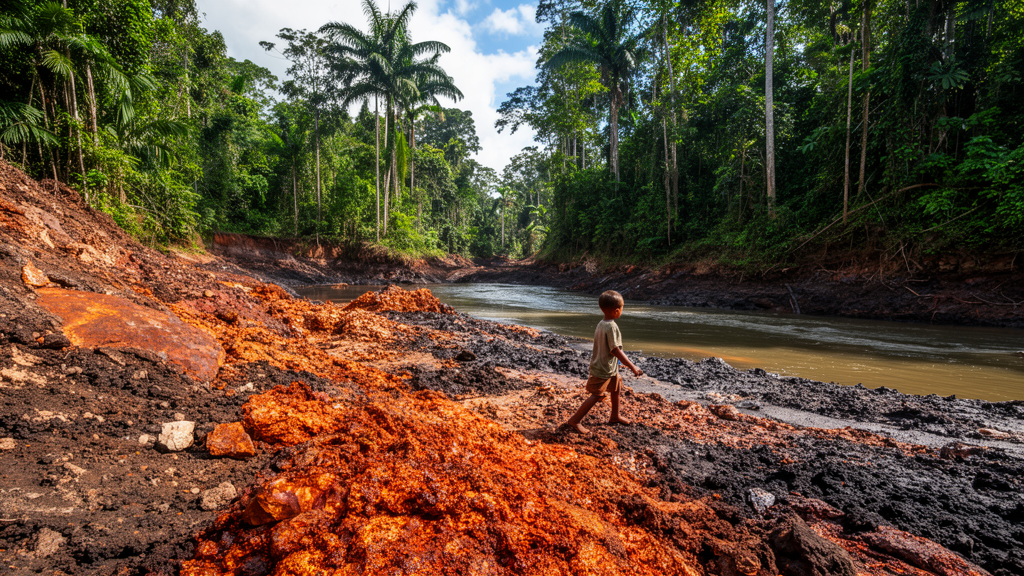
Unregulated artisanal and small-scale mining operations across the southeastern Brazilian Amazon have generated uncontained tailings residues that harbor severe, localized copper hotspots capable of posing non-carcinogenic health hazards to children. A comprehensive geochemical investigation conducted across thirty-nine illegal mining sites in the Carajás Mineral Province demonstrates that while regional discussions surrounding mining contamination predominantly center on elemental mercury, copper constitutes the primary geochemical hazard within these polymetallic extraction landscapes. By evaluating one hundred and eleven tailings residues alongside sixty-five adjacent native soils collected across the Verde River and Araras Stream watersheds in the state of Pará, researchers established that the physical processing and surficial deposition of ore material substantially redistribute copper into chemically labile and physiologically soluble phases. Although median concentrations across the broader tailings footprint frequently remain comparable to surrounding native soils, the upper distribution tail exhibits unprecedented metal enrichment, driving intestinal bioaccessible copper concentrations up to thirty-four thousand one hundred and forty-four milligrams per kilogram in the most disturbed residues and exceeding screening hazard thresholds established for vulnerable residential receptors.
The expansion of illegal mining across the Brazilian Amazon has accelerated rapidly over recent decades, driven by informal gold and base metal extraction that operates outside environmental regulatory frameworks and geotechnical oversight. Satellite monitoring indicates that mapped illegal mining footprints across the Amazon biome expanded by roughly one thousand two hundred percent between 1985 and 2022, increasing from approximately two hundred and eighteen square kilometers to over two thousand six hundred and twenty-seven square kilometers. Although artisanal gold recovery relies extensively on mercury amalgamation—justifiably focusing public health attention on aquatic emissions and bioaccumulation in riverine communities—the underlying mineral deposits of southeastern Pará belong to extensive iron oxide-copper-gold systems. These hydrothermal geological formations contain substantial inventories of associated base metals, including copper, nickel, cobalt, and chromium. When informal miners excavate and crush these mineralized materials without engineered retention barriers, liners, or effluent capture systems, the loose tailings are abandoned directly upon the surface, establishing direct pathways for dust inhalation and incidental soil ingestion among nearby populations.
The research was situated within the Carajás Mineral Province, an internationally significant metallogenic province characterized by complex Archean basement lithologies, intensive shear zones, and prolonged supergene weathering profiles. The investigation targeted two distinct hydrological catchments: the Verde River watershed, encompassing seven hundred and sixty-nine square kilometers, and the Córrego Araras watershed, spanning two hundred and twenty-four square kilometers. Both basins are predominantly underlain by the Canaã dos Carajás Domain and the Carajás Basin, with minor southern contributions from the Sapucaia Domain. The regional bedrock comprises tonalite-trondhjemite-granodiorite orthogneisses, metavolcanic rock sequences, banded iron formations, and layered mafic-ultramafic intrusions that have experienced multi-stage hydrothermal alteration evolving from sodic-calcic to potassic assemblages overprinted by iron oxides, carbonates, and sulfides. Longstanding regional deforestation, combined with an equatorial tropical monsoon climate exhibiting stark contrasts between five-month dry spells averaging three hundred and fifty millimeters of precipitation and intense seven-month wet seasons exceeding one thousand five hundred millimeters, further exacerbates physical surface erosion and geochemical dispersion.
To evaluate the specific chemical alterations induced by informal extraction, the research team implemented a paired field sampling design across thirty-nine active and abandoned illegal mining operations, sampling seventeen sites in the Verde River catchment and twenty-two within the Araras basin. A total of one hundred and seventy-six surficial samples from the zero to twenty centimeter depth horizon were retrieved between 2023 and 2024, comprising one hundred and eleven tailings residues and sixty-five paired adjacent native soils. Tailings residues represented fine-grained slurry deposits and compacted waste layers generated during unlicensed extraction and gravity concentration. Adjacent native soils were collected along undisturbed perimeters situated five to fifty meters outside visible residue boundaries, preferentially targeting upslope and upwind locations beneath intact litter and vegetation cover to avoid redeposited sediment fans. This systematic pairing permitted researchers to discriminate between geogenic background enrichment inherited from natural hydrothermal alteration halos and the secondary redistribution resulting from crushing, sorting, and atmospheric weathering of tailings.
Geochemical analyses of oven-dried and pulverized fractions were conducted using inductively coupled plasma–mass spectrometry following standard aqua-regia digestion, alongside cold-vapor atomic absorption spectrometry for total mercury and high-temperature combustion for total sulfur. To rigorously characterize baseline variations across mineralized lithologies without distorting background thresholds through extreme outliers, the authors applied the non-parametric modified median absolute deviation method to log-transformed elemental datasets. Relative elemental enrichment across sampling sites was evaluated using enrichment factors normalized against hafnium, an immobile high-field-strength element quantified via lithium metaborate fusion to guarantee total zircon dissolution. Quality control protocols maintained strict analytical rigor across eighty-seven certified reference materials, eight preparation blanks, and twelve analytical duplicates, confirming recovery rates between ninety-seven point eight and one hundred and eighteen percent. Normality assessments via Shapiro–Wilk testing confirmed non-normal distributions across most analytes, prompting the deployment of non-parametric Mann–Whitney U tests, site-level paired Wilcoxon procedures, and linear mixed-effects modeling.
The resulting elemental inventories demonstrated that copper and nickel constituted the dominant contamination signals within the tailings residues. Tailings exhibited significantly higher median aqua-regia copper concentrations of five hundred and twenty-seven milligrams per kilogram compared to two hundred and fifty-three milligrams per kilogram in native soils, while median nickel contents reached one hundred and one milligrams per kilogram in tailings against forty milligrams per kilogram in adjacent soils. Tailings also displayed modest elevations in aluminum and cobalt, whereas manganese, cadmium, and mercury exhibited lower concentrations within residue materials. Conversely, chromium and barium frequently exceeded baseline thresholds across both native soils and residues, reflecting natural background concentrations inherited from lateritized mafic-ultramafic host lithologies rather than mining additions.
Contrasting physicochemical soil properties between matrices illuminate the mechanisms governing metal behavior and mobility within the surface environment. Adjacent native soils displayed substantially higher organic matter contents and elevated cation exchange capacity, accompanied by higher exchangeable calcium and potassium levels that enhance colloidal binding and favor the stabilization of potentially toxic elements within inert soil fractions. In contrast, tailings residues exhibited higher exchangeable magnesium and sodium contents, reflecting the accelerated physical breakdown of hydrothermal gangue minerals such as actinolite, chlorite, and albite. Although total sulfur exhibited a lower median in tailings than in soils, individual tailings samples reached an extreme three point seven two percent sulfur, indicating isolated concentrations of oxidizing sulfides. This absence of severe acid mine drainage suggests that ongoing sulfide weathering is effectively buffered by the dissolution of basic silicate gangue and secondary carbonate minerals such as malachite, which precipitates alongside copper-phosphates like pseudomalachite.
To determine operational binding pools, the team performed sequential chemical extractions following the Community Bureau of Reference four-step protocol, separating metals into acid-soluble and exchangeable pools, reducible fractions bound to iron-manganese oxyhydroxides, oxidizable fractions associated with sulfides and organic matter, and residual crystalline mineral matrices. Chromium and nickel were overwhelmingly concentrated within the recalcitrant residual fraction in both soil and waste matrices, reflecting their structural incorporation into resistant spinels, silicates, and lateritic iron concretions inherited from parent rock. Conversely, copper exhibited dramatic operational redistribution: tailings residues displayed significantly increased partitioning into the acid-soluble and reducible pools, with combined reactive fractions averaging thirty-three percent in tailings compared to fourteen percent for nickel. Under fluctuating tropical redox conditions driven by seasonal waterlogging, iron and manganese oxyhydroxides in unmanaged tailings can undergo reductive dissolution, releasing substantial quantities of weakly adsorbed copper ions into surrounding pore waters and facilitating environmental mobility.
Operational lability was further substantiated through chelating extractions using diethylenetriaminepentaacetic acid, which targets readily exchangeable cationic metal species in the soil solution. Because chromium occurs predominantly within stable trivalent spinels or unreactive chromate complexes, its extractability remained negligible across all samples. For nickel and cobalt, native soils actually yielded higher median extractable percentages relative to total metal inventories than tailings, because prolonged pedogenic weathering in natural profiles has transferred these elements into accessible secondary manganese oxide coatings. However, in tailings residues, the upper distribution tail revealed pronounced localized lability: maximum extractable nickel reached forty-nine point five milligrams per kilogram, and extractable copper reached nine thousand six hundred and ninety-six milligrams per kilogram—more than fifty times higher than the native soil maximum of one hundred and eighty-three point seven milligrams per kilogram. These findings illustrate that mechanical pulverization exposes fresh, reactive chalcopyrite surfaces, generating extreme localized pulses of soluble copper upon atmospheric exposure.
In vitro bioaccessibility extractions simulating human physiological environments directly mirrored these chemical lability gradients across gastric, intestinal, and pulmonary pathways. Oral bioaccessibility was measured using the Simple Bioaccessibility Extraction Test with glycine buffers at physiological body temperature, while pulmonary solubility was quantified in Gamble’s synthetic lung fluid using the inhalable particle fraction below ten micrometers. While median bioaccessible copper remained broadly comparable between native soils and tailings, the upper tail in tailings residues escalated dramatically. Maximum intestinal bioaccessible copper attained thirty-four thousand one hundred and forty-four milligrams per kilogram in tailings versus four hundred and sixty-five point three milligrams per kilogram in native soils, with the five most contaminated tailings samples accounting for over ninety-three percent of all bioaccessible copper measured across the forty-six analyzed residue samples. Pulmonary bioaccessible nickel also peaked at sixty-three point five milligrams per kilogram in tailings compared to one point nine milligrams per kilogram in background soils, demonstrating significant respiratory availability in fine windblown dust.
Human health risk modeling conducted under United States Environmental Protection Agency screening frameworks, parameterized with standardized Brazilian residential child and occupational adult exposure assumptions, synthesized these exposure pathways into quantitative hazard indices. For adult occupational exposure scenarios, all hazard indices remained below the regulatory threshold of one, peaking at zero point eighty-five in tailings. Similarly, native soils remained consistently safe across all modeled child scenarios, with a maximum child hazard index of zero point fourteen. In sharp contrast, residential child exposure models revealed three distinct tailings hotspots where non-carcinogenic hazard indices breached acceptable safety limits, generating hazard indices ranging between four point thirty-eight and ten point twenty-four under primary intestinal models and between two point seventy-two and six point ninety-nine under gastric assumptions. Incidental soil ingestion accounted for more than ninety-nine point nine eight percent of the combined hazard, driven almost exclusively by the extreme bioaccessibility of copper. Comprehensive Monte Carlo sensitivity simulations encompassing one hundred thousand iterations per sample demonstrated that these child hazard exceedances persisted across the entire simulated range of body weights and inhalation rates.
Conversely, screening assessments for carcinogenic risk associated with chronic inhalation of bioaccessible nickel in resuspended mineral dust revealed estimated risks well below regulatory thresholds of concern. Applying the conservative inhalation slope factor for nickel subsulfide to bioaccessible fractions, lifetime cancer risks remained below ten to the negative six across all samples, reaching a maximum of two point one times ten to the negative nine for children and five point six times ten to the negative nine for adults. Because nickel remains tightly locked within residual crystalline matrices and primary silicates, pulmonary dissolution yields negligible systemic uptake despite elevated bulk concentrations. These contrasting outcomes between copper ingestion and nickel inhalation underscore that bulk aqua-regia totals alone cannot reliably predict exposure hazards in complex mining environments. The authors emphasize that effective environmental monitoring, risk mitigation, and site remediation within the Amazon basin must integrate total elemental inventories with sequential chemical partitioning and physiological bioaccessibility assays, prioritizing immediate physical containment, access restriction, and dust control at identified tailings hotspots where children might experience regular contact.
Subject of Research: Geochemical mobility, bioaccessibility, and human health screening risks of copper and co-occurring toxic elements in illegal mining tailings of the Brazilian Amazon
Article Title: Bioaccessible copper hotspots and localized child hazard in illegal mining tailings of the Southeastern Amazon
Article References: de Figueiredo, M. M. J. C., Guimarães, J. T. F., Salomão, G. N., Gastauer, M., Sahoo, P. K., da Silva, E. F., Reis, L. S., da Silveira Pereira, W. V., da Costa Leite, R., Junior, R. O. S., de Sousa, M. M., & Ramos, S. J. (2026). Bioaccessible copper hotspots and localized child hazard in illegal mining tailings of the Southeastern Amazon. Environmental Geochemistry and Health, 48(18), Article 717. https://doi.org/10.1007/s10653-026-03583-0
Image Credits: AI Generated
DOI: 10.1007/s10653-026-03583-0
Keywords: Carajás Mineral Province, artisanal mining, tailings residues, copper contamination, bioaccessibility, toxic elements, Community Bureau of Reference fractionation, DTPA extraction, health risk assessment, child hazard index, environmental geochemistry, Pará, Verde River watershed, Araras Stream watershed, iron oxide-copper-gold deposits, pulmonary bioaccessibility, gastrointestinal exposure, nickel inhalation risk
News Source: Harold Sullivan. (November 24, 2026). Illegal Amazon Mining Tailings Harbor Copper Hotspots Posing Child Health Risks. Scienmag.