• HOME
  • NEWS
  • EXPLORE
    • CAREER
      • Companies
      • Jobs
    • EVENTS
    • iGEM
      • News
      • Team
    • PHOTOS
    • VIDEO
    • WIKI
  • BLOG
  • COMMUNITY
    • FACEBOOK
    • INSTAGRAM
    • TWITTER
Wednesday, April 1, 2026
BIOENGINEER.ORG
No Result
View All Result
  • Login
  • HOME
  • NEWS
  • EXPLORE
    • CAREER
      • Companies
      • Jobs
        • Lecturer
        • PhD Studentship
        • Postdoc
        • Research Assistant
    • EVENTS
    • iGEM
      • News
      • Team
    • PHOTOS
    • VIDEO
    • WIKI
  • BLOG
  • COMMUNITY
    • FACEBOOK
    • INSTAGRAM
    • TWITTER
  • HOME
  • NEWS
  • EXPLORE
    • CAREER
      • Companies
      • Jobs
        • Lecturer
        • PhD Studentship
        • Postdoc
        • Research Assistant
    • EVENTS
    • iGEM
      • News
      • Team
    • PHOTOS
    • VIDEO
    • WIKI
  • BLOG
  • COMMUNITY
    • FACEBOOK
    • INSTAGRAM
    • TWITTER
No Result
View All Result
Bioengineer.org
No Result
View All Result
Home NEWS Science News Biology

ILCregs play an important role in regulation of intestinal inflammation

Bioengineer by Bioengineer
August 25, 2017
in Biology
Reading Time: 2 mins read
0
Share on FacebookShare on TwitterShare on LinkedinShare on RedditShare on Telegram
IMAGE

Credit: Image by IBP

The intestine contains an extensive and diverse microbial flora, including potential pathogens and dietary antigens that needs to be tolerated. Dysregulation of mucosal responses may cause a loss of tolerance, leading to harmful intestinal inflammation such as human inflammatory bowel disease (IBD).

Innate lymphoid cells (ILCs) are located in mucosal surfaces to potentiate immune responses, sustain mucosal integrity and promote lymphoid organogenesis. Three subsets of ILCs have been defined to date and produce substantial effector cytokines upon harmful stress. These ILCs play critical roles in the regulation of type 1, type 2, and type 3 (or Th17 cell) responses, controlling host protective immunity and intestinal homeostasis.

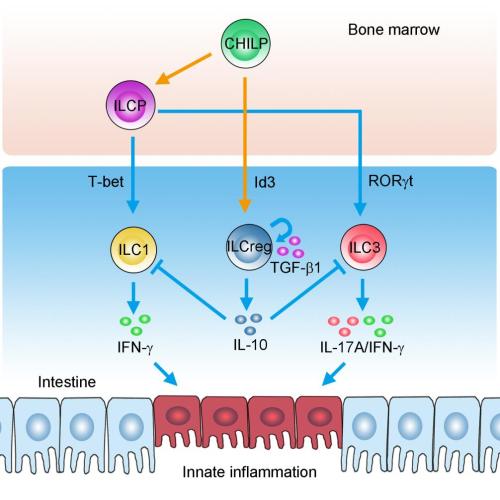
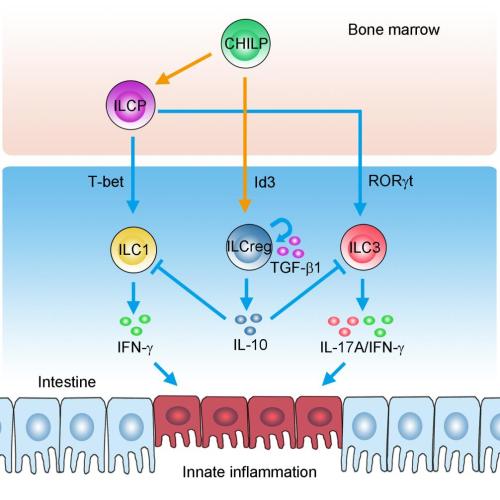
Researchers from FAN Zusen's group at the Institute of Biophysics (IBP) of the Chinese Academy of Sciences have identified a regulatory subpopulation of ILCs (called ILCregs) that exist in the gut and harbor a unique genetic identity distinct from ILCs or regulatory T cells (Tregs).

During inflammatory stimulation, ILCregs can be induced in the intestine and suppress the activation of ILC1s and ILC3s via secretion of IL-10, leading to protection against innate intestinal inflammation.

In addition, TGF-ß1 is consequently secreted by ILCregs upon intestinal inflammation, and autocrine TGF-ß1 sustains the maintenance and increase of ILCregs. Therefore, ILCregs exert an inhibitory role in the innate immune response, favoring the resolution of intestinal inflammation.

Researchers found that ILCregs may be used to develop potential therapies to restore immune tolerance in chronic inflammatory and autoimmune diseases.

###

This research, entitled "Regulatory Innate Lymphoid Cells Control Innate Intestinal Inflammation," which was published in Cell on August 24, involved cooperation with the Institute of Biophysics (IBP), the Institute of Genetics and Developmental Biology, Sichuan University and Jinan University. Profs. FAN Zusen and WANG Shuo (IBP) are the corresponding authors. Drs. WANG Shuo and XIA Pengyan (IBP) are the co-first authors of this paper.

This work was supported by the National Natural Science Foundation of China, the Strategic Priority Research Programs of the Chinese Academy of Sciences, the Youth Innovation Promotion Association of CAS, and the China Postdoctoral Science Foundation.

Media Contact

FAN Zusen
[email protected]
86-106-488-8457

http://english.cas.cn/

Original Source

http://english.cas.cn/ http://dx.doi.org/10.1016/j.cell.2017.07.027

Share12Tweet8Share2ShareShareShare2

Related Posts

Chikungunya Virus Lingers in Joint Macrophages, Causes Chronic Disease

Chikungunya Virus Lingers in Joint Macrophages, Causes Chronic Disease

April 1, 2026
Unveiling How Two Genes Collaborate to Shape Dental and Facial Features

Unveiling How Two Genes Collaborate to Shape Dental and Facial Features

April 1, 2026

Do Your Genes Influence How Lifestyle Choices Affect Aging?

April 1, 2026

Combining Single-Cell Multiomics Unlocks Precise Identification of Rare Cell Types and States

March 31, 2026
Please login to join discussion

POPULAR NEWS

  • blank

    Revolutionary AI Model Enhances Precision in Detecting Food Contamination

    96 shares
    Share 38 Tweet 24
  • Imagine a Social Media Feed That Challenges Your Views Instead of Reinforcing Them

    1006 shares
    Share 398 Tweet 249
  • Promising Outcomes from First Clinical Trials of Gene Regulation in Epilepsy

    51 shares
    Share 20 Tweet 13
  • Popular Anti-Aging Compound Linked to Damage in Corpus Callosum, Study Finds

    43 shares
    Share 17 Tweet 11

About

We bring you the latest biotechnology news from best research centers and universities around the world. Check our website.

Follow us

Recent News

NADPH Enzymes Suppress Pancreatic Precancerous Lesions

Entorhinal Cortex Maps Remote Tasks Without CA1

Chikungunya Virus Lingers in Joint Macrophages, Causes Chronic Disease

Subscribe to Blog via Email

Enter your email address to subscribe to this blog and receive notifications of new posts by email.

Join 78 other subscribers
  • Contact Us

Bioengineer.org © Copyright 2023 All Rights Reserved.

Welcome Back!

Login to your account below

Forgotten Password?

Retrieve your password

Please enter your username or email address to reset your password.

Log In
No Result
View All Result
  • Homepages
    • Home Page 1
    • Home Page 2
  • News
  • National
  • Business
  • Health
  • Lifestyle
  • Science

Bioengineer.org © Copyright 2023 All Rights Reserved.