


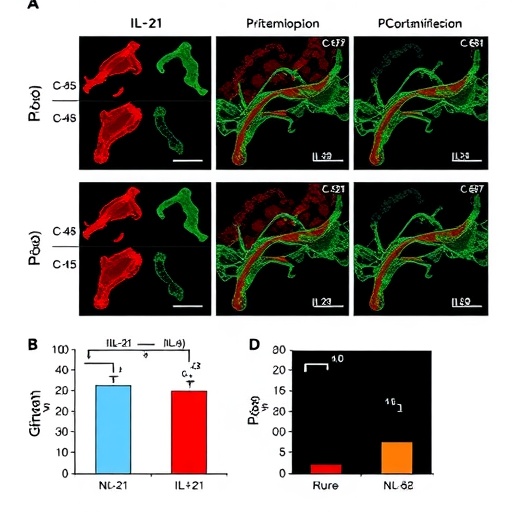
In a groundbreaking study published in the Journal of Translational Medicine, researchers have delved into the role of interleukin-21 (IL-21) in modulating liver inflammation, specifically in the context of chronic hepatitis B virus (HBV) infection. The research, conducted by a team led by Li, X., Jin, Z., and Pan, M., provides new insights into how this cytokine can influence immune responses and potentially offer therapeutic avenues for patients suffering from chronic liver diseases caused by viral infections.
Chronic HBV infection is a significant global health issue, affecting millions and often leading to serious complications such as liver cirrhosis and hepatocellular carcinoma. The pathophysiology of chronic HBV strongly involves the body’s immune response and the intricate dynamics among various immune cell populations. One critical aspect of this immune response involves the regulation of inflammation, which can become dysregulated in chronic infections. The work by Li and colleagues carefully examines the balance of inflammation and immune suppression in this scenario.
Previous research has highlighted the role of myeloid-derived suppressor cells (MDSCs) in regulating immune responses, particularly during chronic infections and cancer. MDSCs are a heterogeneous population of immune cells that possess potent immunosuppressive functions. Their accumulation in the liver during chronic HBV infection has been linked with increased disease severity and progression. Understanding how to manipulate these cells could thus present novel therapeutic approaches for restoring immune functionality against HBV.
In their research, the authors explore how IL-21 can enhance the immunosuppressive functions of MDSCs. They suggest that IL-21 not only promotes the development of these cells but also boosts their activity, creating a more robust barrier against excessive inflammation. This finding is particularly significant as excessive inflammation is often detrimental, leading to tissue damage and progression of liver disease.
The study presents compelling evidence that through the modulation of MDSCs, IL-21 may hold the potential to attenuate liver inflammation. By conducting a series of experiments involving both in vitro and in vivo models, the researchers were able to demonstrate that IL-21 treatment led to an increased proportion of MDSCs that exhibited heightened immunosuppressive capabilities. Enhanced MDSC function was marked by the upregulation of key immunosuppressive molecules, underscoring the importance of this cytokine in the immune landscape of chronic HBV infection.
Interestingly, the authors also investigate the mechanisms through which IL-21 exerts its effects on MDSCs. Their results indicate that IL-21 signaling regulates various transcription factors and cytokine production, which collectively enhance MDSC expansion and function. These findings provide a deeper understanding of the molecular underpinnings of MDSC biology and suggest potential targets for therapeutic intervention.
Furthermore, the researchers discuss the clinical implications of their findings. The ability to fine-tune the immune response in chronic HBV infection using IL-21 could pave the way for more effective treatment strategies. Currently, therapies aimed at chronic HBV remain limited, and the prospect of employing cytokines like IL-21 could represent a significant shift in the management of this chronic disease.
However, the authors also address the complexity of cytokine interactions and the heterogeneous nature of the immune response in chronic infections. Despite the promising effects of IL-21 on MDSCs, they caution that indiscriminate enhancement of immune suppression could potentially lead to adverse outcomes, such as increased virus persistence or malignant transformations. Thus, careful consideration of dosing and timing will be crucial in the development of IL-21-based therapies.
As the research community continues to unravel the intricacies of the immune system’s role in chronic infections, studies such as this one highlight the ever-evolving landscape of potential therapeutic agents. IL-21, once considered primarily in the context of autoimmune diseases and allergies, now emerges as a pivotal player in the management of chronic viral infections as well.
In conclusion, the work of Li, X., Jin, Z., and Pan, M., elucidates a novel role for IL-21 in enhancing the immunosuppressive functions of MDSCs in chronic HBV infection. This investigation opens up exciting avenues for translating cytokine-based therapies into clinical practice. As research progresses, it is imperative to further understand the balance of immune activation and suppression, ensuring that therapeutic interventions can enhance recovery without exacerbating disease pathology.
This study not only advances the scientific understanding of liver inflammation in chronic HBV infection but also underscores the potential for innovative therapeutic strategies leveraging the nuances of the immune system. As the search for effective treatments continues, the insights gained from this research could prove instrumental in changing the landscape of chronic hepatitis B management and improving outcomes for millions affected worldwide.
Subject of Research: The role of interleukin-21 in liver inflammation and myeloid-derived suppressor cells in chronic HBV infection.
Article Title: IL-21 attenuates liver inflammation by enhancing myeloid-derived suppressor cells immunosuppressive function in chronic HBV infection.
Article References: Li, X., Jin, Z., Pan, M. et al. IL-21 attenuates liver inflammation by enhancing myeloid-derived suppressor cells immunosuppressive function in chronic HBV infection. J Transl Med 23, 1410 (2025). https://doi.org/10.1186/s12967-025-07406-1
Image Credits: AI Generated
DOI: https://doi.org/10.1186/s12967-025-07406-1
Keywords: interleukin-21, myeloid-derived suppressor cells, chronic hepatitis B, liver inflammation, immune modulation.
Tags: chronic hepatitis B virus infectionchronic viral infection and inflammationcytokine influence on immune dynamicshepatocellular carcinoma and chronic HBVIL-21 cytokine role in liver inflammationimmune cell populations in hepatitis Bimmune response regulation in viral hepatitisimmunosuppression mechanisms in HBVliver cirrhosis and HBV connectionmyeloid-derived suppressor cells in liver diseasetherapeutic strategies for chronic liver infectionstranslational medicine in liver research



