


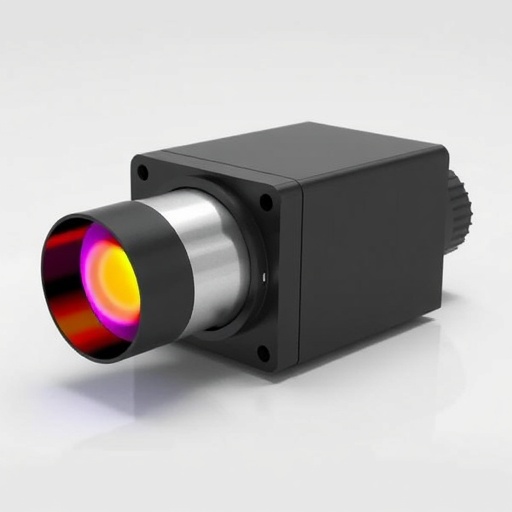
In a groundbreaking stride toward the next generation of spectral imaging, researchers Zhao, Li, and Ooi have unveiled a miniaturized ultraviolet (UV) spectral imager empowered by the unique properties of III-nitride semiconductors. This avant-garde technology, detailed in their recent publication in Light: Science & Applications, heralds a remarkable convergence of material science, photonics, and device engineering, promising to unlock unprecedented capabilities for compact, high-resolution UV spectral analysis.
Traditional spectral imaging systems have historically been bulky and cumbersome, constrained by their reliance on discrete optical components and complex mechanisms. Such devices often find limited applicability in fields that require compact form factors, for example in portable diagnostics, environmental monitoring, or in situ biological studies. The innovation reported by Zhao and colleagues fundamentally redefines these limitations by harnessing the exceptional optoelectronic properties of III-nitride compounds. These materials, primarily comprising gallium nitride (GaN), aluminum nitride (AlN), and indium nitride (InN), are renowned for their wide bandgap, robustness, and efficient generation and detection of UV photons.
At the heart of this miniaturized spectral imager lies a meticulously engineered array of III-nitride photodetectors integrated into a compact on-chip platform. By leveraging advanced epitaxial growth techniques, the researchers have fabricated semiconductor layers with atomically precise interfaces, enabling controlled absorption and emission within the ultraviolet range. This precise material control is pivotal, as it allows tailoring the bandgap engineering to selectively filter and analyze a broad spectrum of UV light, from UVA to deep UV wavelengths.
One of the most transformative aspects of this device is its spectral resolution and sensitivity, which rivals—if not surpasses—many conventional benchtop systems. This success stems from the intrinsic electronic and optical advantages of III-nitrides, including high electron mobility and superior thermal stability. These properties facilitate rapid, low-noise electronic readout and robust operation under variable environmental conditions, essential for real-world applications that often demand reliability and resilience.
The integration process described extends beyond mere photodetector fabrication; the device incorporates innovative waveguide structures and nanoscale gratings that modulate light paths within the imager. This sophisticated on-chip optical architecture enables compact yet precise spectral dispersion, allowing the system to interrogate spectral signatures with fine detail without the need for large diffraction gratings or prism assemblies. Such miniaturization signifies a paradigm shift, rendering complex spectral analysis feasible on handheld or embedded devices.
Exploring the potential applications, the authors stress the immense impact this technology could have on areas such as biochemical sensing, where UV light uniquely interacts with biomolecules to reveal critical information about composition and structure. Environmental monitoring stands to benefit as well, particularly in detecting pollutants or ozone concentrations through their distinct UV absorption fingerprints. This miniaturized system’s portability and efficiency could democratize UV spectral sensing, connecting fields as diverse as agriculture, public health, and even extraterrestrial exploration.
The research team also underscores the energy efficiency of their miniaturized spectrometer. III-nitride devices, with their direct wide bandgap and low defect densities, manifest minimal dark current and reduced power consumption compared to traditional UV detectors. This renders the system ideal for integration into wireless sensor networks and wearable devices, where power constraints have historically limited functionality or detection accuracy.
While the achievements of Zhao, Li, and Ooi are noteworthy, the engineering journey was not without challenges. III-nitrides are notoriously difficult to grow defect-free due to lattice mismatches with common substrates. Overcoming these hurdles involved employing innovative buffer layers and substrate treatments to vastly improve crystal quality. The resultant electronic uniformity is a crucial factor enabling consistent spectral performance across the imager array.
Moreover, the compact nature of the device confronts the intrinsic trade-off between spatial resolution and spectral fidelity, a challenge deftly addressed through nanofabrication precision and proprietary signal processing algorithms. These algorithms decode the raw photodetector outputs into high-fidelity spectral maps, an example of how deep integration of hardware and software advances the frontier of miniaturized optical sensing.
Projection into future development pathways includes tuning the spectral range further into the vacuum ultraviolet (VUV) and ultraviolet C (UVC) bands by modifying the III-nitride alloy compositions. Such advances could augment the imager’s utility in sterilization monitoring, semiconductor lithography, and fundamental research into UV photochemistry.
The publication ignites excitement around the potential for fully integrated photonic circuits that combine UV light sources, modulators, and detectors all within III-nitride platforms. This monolithic integration foreshadows devices that not only analyze but also manipulate UV photons at unprecedented scales, opening avenues for quantum sensing and secure communications that exploit UV’s unique photon interactions.
Beyond the immediate technical insights, this research marks a watershed moment in the translation of material science breakthroughs into real-world devices. The miniaturized UV spectral imager starkly contrasts with the legacy of large, laboratory-bound instruments, suggesting a future where sophisticated light analysis is embedded seamlessly into everyday technology with broad societal benefits.
In sum, Zhao, Li, and Ooi’s work encapsulates the spirit of innovation driving cutting-edge spectral imaging technology forward. By capitalizing on the formidable optoelectronic attributes of III-nitrides, they have engineered a device that not only promises enhanced performance but also unparalleled miniaturization. The ramifications touch scientific research, industry applications, and the democratization of advanced UV diagnostic tools.
As this technology matures, its integration into mobile and wearable platforms could redefine how we perceive and interact with the ultraviolet world. Imagine health diagnostics performed in real-time through a smartphone-based UV spectrometer or environmental assessment via ubiquitous, low-cost sensors embedded in urban landscapes. The fusion of III-nitride materials with innovative device architectures paves the way toward these future realities.
This pioneering research also stimulates interdisciplinary collaborations between material scientists, optical engineers, and computational physicists, emphasizing how convergent expertise fosters breakthroughs. The intricate balance of material synthesis, nanostructure design, and sophisticated data analysis exemplifies modern scientific endeavor at its finest.
Ultimately, the miniaturized UV spectral imager presented by Zhao, Li, and Ooi shines light—both literally and figuratively—on the transformative potential of III-nitride technology. Their elegant synthesis of theory, fabrication, and application defines a new benchmark in UV photonics, unlocking opportunities that ripple across technology landscapes and end-user experiences for years to come.
Subject of Research: Miniaturized ultraviolet spectral imaging powered by III-nitride semiconductor technology.
Article Title: III-Nitrides empower miniaturized spectral imager in ultraviolet.
Article References:
Zhao, Y., Li, T. & Ooi, B. III-Nitrides empower miniaturized spectral imager in ultraviolet. Light Sci Appl 15, 82 (2026). https://doi.org/10.1038/s41377-025-02132-1
Image Credits: AI Generated
Tags: advanced epitaxial growth techniquescompact high-resolution imagingenvironmental monitoring toolsGallium Nitride applicationsIII-nitride semiconductorsin situ biological studiesinnovative imaging solutionsmini ultraviolet spectral imageroptoelectronic propertiesphotonics and device engineeringportable diagnostics technologysemiconductor layer fabrication



