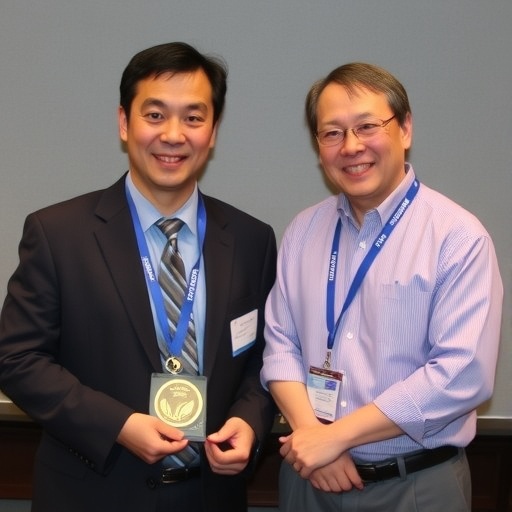
In a remote mountain village in China, a young Fang Peng encountered electricity for the first time — a transformative moment that sparked a lifelong passion for electric power. As a fourth grader, Peng’s fascination with a lone light bulb connected via an extension cord planted the seeds of his future groundbreaking work in electric power systems. Today, as a distinguished professor at the University of Pittsburgh, Peng’s pioneering research is revolutionizing the way electricity is managed, converted, and protected, ensuring more resilient and efficient power systems worldwide.
Peng’s journey into electrical power engineering is marked by a profound early experience: a burn on his thumb caused by touching a live socket in their modest home. This incident instilled in him a deep respect for the formidable force of electricity and ignited his commitment to making electric power safer. His relentless pursuit has led to innovations in electric power conversion technology that tackle both its immense power and inherent dangers with equal ingenuity.
Recently, Peng received the Institute of Electrical and Electronics Engineers (IEEE) Medal in Power Engineering, the organization’s most prestigious award. This honor recognizes his pioneering contributions to Z-source and modular multi-level converters — technologies essential for modernizing power distribution and transmission systems. Z-source converters overcome the limitations of traditional converters by enabling both voltage step-up (boost) and step-down (buck) within a single circuit, while uniquely tolerating fault conditions such as short and open circuits, which previously posed risks to power system stability.
Traditional voltage converters operate with inherent constraints: they can only increase or decrease voltage and cannot handle fault conditions without damage. Z-source converters, however, incorporate a distinctive network of inductors and capacitors arranged in a “Z” topology. This structure allows for versatile voltage manipulation while maintaining operational integrity during abnormal conditions. This robust fault tolerance is crucial for maintaining uninterrupted electric power amidst the increasing complexity of modern grids.
Further complementing this, modular multi-level converters (MMCs) consist of scalable modules that can be dynamically added or removed to meet varying power demands. This modularity enables highly efficient power conversion across a broad range of voltages and power levels, accommodating the fluctuating inputs from diverse energy sources such as renewables. The adaptability of MMCs is a cornerstone in developing flexible, high-performance power systems crucial for future smart grids.
Peng has extended his Z-source converter technology beyond standard applications into the challenging realm of direct current (DC) systems. DC power, known for its stability and efficiency, has historically faced difficulties in fault interruption due to its continuous, unidirectional flow, which generates persistent arcs when circuits break. Peng’s advancements in Z-source concepts have facilitated the design of DC circuit breakers that can safely and effectively interrupt current, mitigating electrical hazards and enhancing grid resilience.
Unlike alternating current (AC), which naturally zeros out and aids arc extinction, DC requires innovative interruption mechanisms. Peng’s Z-source circuitry provides a self-protection mode that can detect fault conditions and isolate problem areas before they escalate, preventing catastrophic failures such as wildfires ignited by downed power lines. His systems combine real-time fault detection with rapid switching capabilities, demonstrating a transformational approach to power system reliability and safety.
Peng’s work stands at the forefront of electric power engineering, addressing the crucial balance between increasing power demands, renewable integration, and grid stability. His research not only advances theoretical understanding but has also found practical applications globally, influencing power conversion designs in industries ranging from electric vehicles to renewable energy storage systems.
In addition to his IEEE Medal, Peng holds several esteemed fellowships and awards, including membership in the National Academy of Engineering and recognition as a Fellow of the National Academy of Inventors. His accolades underscore the global impact of his work and the high esteem in which he is held by the scientific community. Alan George, Chair of the Department of Electrical and Computer Engineering at the University of Pittsburgh, praises Peng as an “exceptional recipient” whose innovations profoundly improve daily life through safer and more efficient electric power systems.
Peng’s dedication extends beyond research and into education and collaboration. At the University of Pittsburgh’s Swanson School of Engineering, he works alongside leading experts like Dr. Brandon Grainger and Dr. Paul Ohodnicki to foster Pittsburgh’s burgeoning renaissance in electric power and energy innovation. Their joint efforts are propelling the region into the forefront of electrical energy technology development, nurturing cutting-edge solutions to meet tomorrow’s energy challenges.
Emphasizing practical safety and operational resilience, Peng’s contributions directly confront the real-world dangers posed by electrical failures. His designs minimize the risk of power system faults escalating into destructive events such as wildfires, blackouts, and equipment damage. This proactive approach to fault tolerance and energy conversion is critical as societies worldwide increasingly rely on electricity for everything from communications to transportation and healthcare.
As electric grids evolve towards more decentralized and renewable configurations, the need for adaptive, tolerant power electronics like those developed by Peng has never been greater. His Z-source and modular multi-level technologies provide the versatility needed to integrate myriad energy sources while ensuring consistent, safe power delivery. In a world striving for sustainability, Peng’s innovations illuminate a path towards greener, smarter electrical infrastructures.
Fang Peng’s story is a vivid illustration of how a childhood spark of curiosity can evolve into a lifetime of transformative discovery. His pioneering work is not only advancing electrical engineering but is also playing an essential role in shaping a safer, more reliable, and more efficient future for global electric power systems. With his contributions, the electric power field is poised to meet the challenges of the 21st century with unprecedented capability and resilience.
Subject of Research: Electric Power Engineering; Power Electronics; Z-source Converters; Modular Multi-level Converters; Electrical Grid Resilience
Article Title: Fang Peng: Illuminating the Future of Electric Power Conversion with Z-Source and Modular Multi-Level Technologies
News Publication Date: [Not provided]
Web References:
– https://www.engineering.pitt.edu/people/faculty/fang-peng/
– https://corporate-awards.ieee.org/award/ieee-medal-in-power-engineering/
– https://grid.pitt.edu/
– https://news.engineering.pitt.edu/pitt-engineering-professor-fang-peng-elected-to-national-academy-of-engineering/
Image Credits: Thomas Altany, the University of Pittsburgh
Keywords
Engineering, Electrical engineering, Electrical power, Power systems, Power distribution, Electronic circuits, Circuit design, Capacitors
Tags: advancements in power conversion systemselectric power management innovationselectric power system safetyFang Peng electric power researchIEEE Medal in Power Engineeringmodern power distribution technologiesmodular multi-level converters technologypioneering electrical engineering awardsresilient electric power infrastructuretransformative electrical engineering contributionsUniversity of Pittsburgh power engineeringZ-source converters innovation