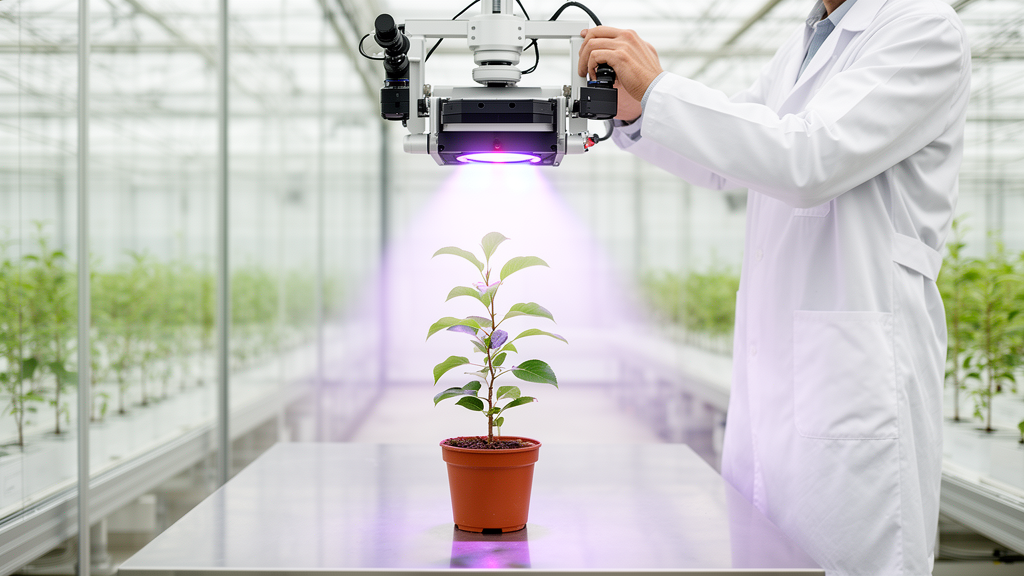
Agricultural researchers have demonstrated that combining visible to near-infrared hyperspectral imaging with a hybrid convolutional and recurrent deep learning architecture can identify early infection stages of apple leaf ring rot while estimating leaf SPAD values under controlled experimental conditions. Apple ring rot, caused by the fungal pathogen Botryosphaeria dothidea, poses a persistent threat to commercial orchards by infecting foliage, reducing photosynthetic efficiency, impairing fruit development, and triggering premature defoliation. Conventional orchard diagnosis has long depended on manual visual scouting, which cannot detect latent infections before visible lesions appear, or destructive laboratory assays that require substantial processing time and cannot provide rapid tracking across tree canopies. By scanning infected leaves across continuous spectral bands spanning 400 to 1000 nanometers, the research team developed a non-destructive analytical framework that simultaneously evaluates symptom progression and physiological status from the same spectral dataset.
The study was conducted across two consecutive growing seasons using two-year-old healthy potted apple seedlings of the Red Fuji cultivar maintained at Shandong Agricultural University. Twenty seedlings purchased in March 2024 and thirty seedlings acquired in March 2025 were grown in a standardized substrate mixture composed of humus soil and garden soil at a two-to-one volume ratio, accompanied by routine irrigation and manual weeding. Pathogen inoculations were carried out in late June of each year during the vigorous growth phase using purified Botryosphaeria dothidea strains cultured on potato dextrose agar. Ten fully expanded, undamaged leaves from the middle canopy of each seedling were selected, sanitized with sodium hypochlorite, and inoculated beside the midrib using five-millimeter mycelial plugs after light epidermal puncturing. The sampling schedule tracked five distinct progression stages: uninoculated baseline leaves at zero days after inoculation, asymptomatic tissue at two days, initial brown lesions at four days, darkened irregular lesions at six days, and lesions encircled by chlorotic halos at eight days.
Across the two experimental seasons, the researchers sampled forty leaves per infection stage in 2024 and sixty leaves per stage in 2025, generating a balanced cohort of five hundred distinct leaves with each specimen measured at only one time point. Before scanning, surface fungal plugs were carefully detached. Leaf reflectance was recorded using an indoor hyperspectral imaging system equipped with a GaiaField-V10E sensor, a specialized HSIA-OL23 lens, and an HSIA-LST-200W halogen illumination source, operated thirty-eight centimeters above the leaf stage with an exposure time of 11.8 milliseconds. Radiometric calibration was performed against a ninety-nine percent diffuse reflectance white reference panel and dark current measurements. Spectral regions of interest covering the main blade were delineated using ENVI 4.6 software to calculate mean whole-leaf reflectance curves across 237 effective bands after discarding noisy edge channels. Relative leaf chlorophyll status was measured immediately after imaging using a SPAD-502 Plus meter, averaging six readings per leaf across upper, middle, and lower positions along both sides of the midrib.
Mean spectral profiles revealed distinct physiological responses as fungal colonization advanced across the foliage. Green vegetation profiles featured a prominent reflectance peak near 550 nanometers alongside chlorophyll absorption troughs at 410 and 680 nanometers, accompanied by elevated reflectance across the near-infrared plateau between 760 and 1000 nanometers. As infection progressed from zero to eight days after inoculation, significant reflectance declines appeared in both the green 520 to 580 nanometer range and the near-infrared spectrum. The researchers attributed the green reflectance drop to fungal-induced chlorophyll degradation and relative carotenoid increases, whereas near-infrared attenuation reflected cellular collapse, tissue water loss, and disrupted intercellular scattering. Concurrently, measured leaf SPAD values exhibited a systematic decline across infection stages, dropping sharply after four days as pathogen proliferation disrupted chloroplast integrity.
To prevent model bias and preserve class distributions, the five hundred leaf profiles were pooled and partitioned into calibration, validation, and prediction sets following a six-to-two-to-two ratio, yielding 300, 100, and 100 samples, respectively. Stratification was structured by infection stage for diagnostic modeling and by SPAD value quartiles for continuous regression. Rather than feeding all 237 spectral bands directly into machine learning pipelines, the team applied competitive adaptive reweighted sampling and the successive projections algorithm strictly within the calibration subset to identify the most informative wavebands. For disease classification, competitive adaptive reweighted sampling isolated thirteen bands—including 409, 421, 428, 450, 650, 690, 766, 854, 909, 928, 941, 954, and 989 nanometers—whereas the successive projections algorithm selected ten bands. For SPAD estimation, the reweighted sampling method extracted seventeen key wavelengths, while successive projections retained eight.
Initial exploratory data analysis using principal component analysis revealed that the first three principal components captured 95.23 percent of total spectral variance, with the primary component alone accounting for 84.78 percent. While severe infections at eight days after inoculation separated clearly into an isolated cluster, substantial overlap occurred among samples spanning zero to six days, demonstrating that early disease stages cannot be resolved reliably using unguided linear projections alone. To extract complex non-linear spectral signatures, the investigators engineered a hybrid deep learning model combining one-dimensional convolutional neural network layers with a long short-term memory recurrent network in MATLAB 2022a. In this architecture, two sequential convolutional layers containing 32 and 64 channels extract localized spectral shape features, such as subtle absorption notches and red-edge inflection shifts, from ordered wavelength inputs. The resulting feature representations pass into a single-layer unidirectional recurrent module with 64 hidden units to capture sequential spectral dependencies before reaching task-specific output layers.
In comparative classification evaluations on the independent one-hundred-leaf prediction set, the hybrid deep learning model operating on the thirteen bands chosen through competitive adaptive reweighted sampling surpassed all alternative configurations. The optimal model achieved a macro-averaged precision of 0.9429, a macro F1-score of 0.941, and a Kappa coefficient of 0.925. In contrast, support vector machine classifiers, random forests, and standalone convolutional or recurrent networks yielded lower predictive metrics. Examining the confusion matrix demonstrated that severe infections at eight days reached perfect recognition, with all twenty validation leaves correctly classified. At the asymptomatic two-day stage, eighteen of twenty leaves were accurately identified, corresponding to a ninety percent recall rate, with the remaining two assigned to the four-day stage. Across healthy control leaves, nineteen of twenty were identified correctly, and no asymptomatic leaves were incorrectly classified as healthy controls.
The companion regression task assessed non-destructive estimation of leaf SPAD values, comparing the hybrid network against partial least squares regression, back-propagation neural networks, and standalone deep architectures. The hybrid regression model trained on seventeen reweighted bands achieved superior precision on the prediction set, attaining a coefficient of determination of 0.8868, a root mean square error of 2.4103, and a residual predictive deviation of 2.9872. In calibration and validation sets, coefficients of determination reached 0.9359 and 0.9164, respectively. Across all testing scenarios, models built on algorithmically selected wavelengths outperformed full-spectrum models, confirming that filtering out uninformative or redundant spectral channels prevents overfitting and sharpens algorithmic focus onto biologically meaningful pigment and water absorption regions.
The authors expanded their analysis by deploying the calibrated hybrid regression network across individual pixel spectra of representative leaves from each infection stage to generate exploratory two-dimensional false-color maps of predicted SPAD distributions. These visualizations documented spatial degradation patterns, transitioning from homogeneous orange-red hues indicating high SPAD values in healthy leaves to localized green depressions at two to four days, followed by widespread yellow-green zones across six- and eight-day leaves. The observed reductions were particularly pronounced surrounding fungal inoculation sites. However, the researchers emphasized that these spatial maps remain exploratory visualizations because the underlying regression network was trained solely on spatially averaged whole-leaf spectra rather than localized micro-scale SPAD measurements, and pixel predictions were not systematically checked against calibration boundary limits.
The study authors highlighted several methodological boundaries that must be resolved prior to practical deployment in commercial horticulture. Most notably, all measurements were obtained under strictly regulated indoor lighting and controlled seedling environments, which do not replicate the fluctuating solar illumination, complex canopy geometry, atmospheric dust, and background interference typical of commercial orchards. Furthermore, leaf samples from the two trial years were pooled prior to dataset partitioning rather than reserved as independent year-to-year test sets, leaving multi-year climate generalization unverified. The experimental population was also restricted to a single cultivar, Red Fuji, necessitating broader testing across diverse apple genotypes, age classes, and co-occurring orchard pathogens. Future investigations are planned to explore lightweight transformer architectures, model quantization, and multimodal sensor integration to advance real-time precision orchard monitoring platforms.
Subject of Research: Hyperspectral imaging and hybrid neural networks for early diagnosis of apple leaf ring rot and leaf SPAD prediction
Article Title: Early diagnosis of ring rot and prediction of SPAD values in apple leaves using hyperspectral imaging and a CNN-LSTM hybrid model
Article References: Wang, Y., Liu, R., Wang, Y., Li, Z., Zheng, Y., Yu, C., Wang, C., Zhang, H., & Wang, J. (2026). Early diagnosis of ring rot and prediction of SPAD values in apple leaves using hyperspectral imaging and a CNN-LSTM hybrid model. Smart Agricultural Technology, 15, Article 102706. https://doi.org/10.1016/j.atech.2026.102706
Image Credits: AI Generated
DOI: 10.1016/j.atech.2026.102706
Keywords: Apple leaf ring rot, Botryosphaeria dothidea, Hyperspectral imaging, CNN-LSTM hybrid model, SPAD prediction, Red Fuji seedlings, CARS band selection, Successive projections algorithm, Plant disease diagnosis, Precision agriculture, Leaf reflectance spectra, Support vector machine, Random forest, Deep learning, Agricultural technology, Non-destructive leaf testing
News Source: Blake Davidson. (November 12, 2026). Hyperspectral Imaging and Deep Learning Detect Early Apple Ring Rot in Seedlings. Scienmag.