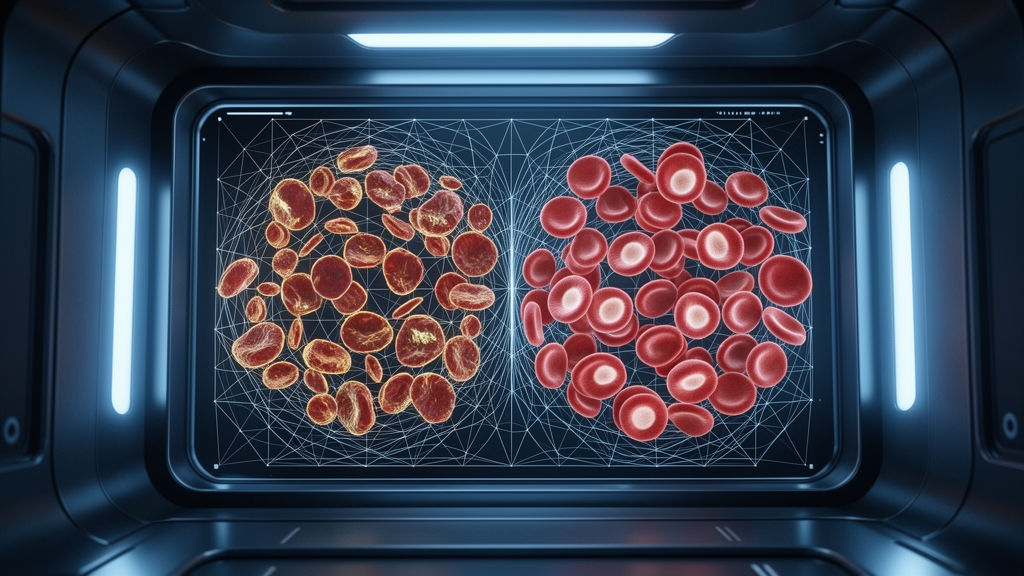
Researchers in Thailand have developed a weakly supervised geometric artificial intelligence framework that differentiates between thalassemia and iron deficiency anemia on digitized peripheral blood smear images while systematically deferring ambiguous cases to medical specialists. The automated architecture, known as Riemannian Multiple Instance Learning or R-MIL, projects microscopic red blood cell patches into hyperbolic space to suppress label noise and morphological artifacts. In an independent validation cohort of 48 patients, an integrated clinical abstention mechanism resolved 64.6 percent of cases autonomously without generating a single false negative for thalassemia, achieving 1.00 sensitivity and 0.87 accuracy within that confident decision partition. By actively isolating high-energy out-of-distribution variations and sending uncertain samples to expert hematologists, the system provides a safety-calibrated human-in-the-loop screening pipeline tailored for resource-limited clinical environments.
The clinical motivation behind the study stems from a profound public health disparity and conflicting treatment pathways in hematology. Globally, anemia affects between 1.6 and 2.0 billion people, with iron deficiency representing the predominant cause in most regions. Concurrently, inherited hemoglobin disorders such as thalassemia affect approximately 7 percent of the global population, with carriers accounting for roughly 3 percent. In Thailand, the disease burden is particularly severe: an estimated 30 to 40 percent of the population carries thalassemia traits, and approximately 1 percent suffers from active clinical disease. Despite this high prevalence, national healthcare infrastructure contends with a severe shortage of expert hematologists to evaluate peripheral blood smears. Differentiating iron deficiency anemia from thalassemia is medically urgent because their therapeutic management strategies are diametrically opposed. Treating iron deficiency requires nutritional iron supplementation, whereas thalassemia involves defective globin synthesis in the presence of adequate iron stores; administering iron supplements to an undiagnosed thalassemia patient can trigger potentially fatal iron overload and systemic organ toxicity.
Conventional diagnostic workflows rely heavily on definitive laboratory evaluations, such as hemoglobin typing, hemoglobin electrophoresis, and polymerase chain reaction assays, coupled with complete blood counts. However, rural and community hospitals frequently lack the specialized hardware and trained technical personnel required to run these advanced diagnostic panels. As a consequence, patients residing in remote areas face significant financial expenses and logistical burdens when traveling to tertiary medical centers for definitive testing. While automated microscopic analysis offers an accessible alternative, computational hematology has faced enduring mathematical hurdles. Previous computational attempts using complete blood count indices or standard convolutional neural networks often degraded significantly in microcytic overlapping regimes. Under standard multiple instance learning, labels are assigned at the patient level rather than the cell level, causing morphologically normal or non-specific red blood cells within a patient sample to carry diseased class labels. In flat Euclidean latent spaces, standard neural attention mechanisms struggle to separate these overlapping distributions, frequently assigning high confidence to irrelevant cellular artifacts and causing severe stochastic instability.
To overcome these structural limitations, the research team designed a two-stage geometric pipeline that projects red blood cell features onto a Riemannian manifold. Specifically, the framework utilizes the Poincaré ball model of hyperbolic geometry, whose metric volume expands exponentially toward its boundary. This non-Euclidean property provides an inductive bias that accommodates vast hierarchies of morphological variations, pushing unrelated cellular anomalies toward the peripheral boundary with minimal geometric distortion. Operating on feature representations extracted by a ConvNeXt-Large backbone pre-trained on ImageNet, a Riemannian Supervisor Gate calculates localized manifold energy using tangent space projections and the Ledoit-Wolf shrinkage estimator for covariance estimation. The localized energy acts as a Mahalanobis distance metric that quantifies anisotropic morphological deviations. Rather than discarding all high-energy outliers, the system incorporates a Saliency Rescue Gate that recovers exactly ten valid biological cells exhibiting extreme morphological distortions, preventing the accidental loss of diagnostically critical deformed cells before slide-level aggregation via the hyperbolic Fréchet mean.
The study protocol utilized peripheral blood smear specimens gathered under ethical approval from the Ethics Committee for Research in Human Subjects at Hatyai Hospital in Thailand. The research cohort comprised 159 patients whose definitive ground truth diagnoses were verified by board-certified hematologists through comprehensive laboratory references, including complete blood counts, serum ferritin assays, and hemoglobin electrophoresis. Patients with mixed etiologies or ambiguous laboratory findings were strictly excluded. To establish a rigorous binary proof-of-concept, the present phase also excluded individuals with thalassemia trait carrier status, focusing exclusively on clinically manifest thalassemia versus iron deficiency anemia. High-resolution images of ten microscopic fields per patient were acquired at 100-times magnification under standardized quality control, normalized in the LAB color space to minimize staining variations, and segmented into individual red blood cell patches using the Cellpose library followed by quality inspection. The dataset was partitioned at the patient level into a training cohort of 111 patients and an independent, sequestered test set of 48 patients consisting of 21 iron deficiency anemia cases and 27 thalassemia cases.
Within the internal training cohort, the authors conducted a five-fold Monte Carlo cross-validation to derive all calibration bounds, model weights, and hyperparameter selections, completely isolating the test cohort from model fitting. Analysis of individual standalone backbone models across the five training folds highlighted severe diagnostic volatility when operating without geometric consensus. Standalone single-fold models produced a coefficient of variation of 101.0 percent for classification accuracy and a staggering 137.3 percent for diagnostic sensitivity within their confident zones. Standalone models also suffered from performance inversions, where mean accuracy dropped from 62.9 percent on the overall test set down to 45.5 percent when evaluating only their autonomously confident predictions. This striking drop demonstrated that unregularized softmax outputs frequently generate hallucinated confidence on out-of-distribution patches. To stabilize inference, the investigators implemented a consensus-driven five-fold ensemble alongside a polarity anchor skip connection that prevents symmetric cross-entropy label-flipping in sparse slide bags.
Evaluating the complete architecture on the 48 unseen test patients confirmed the efficacy of Riemannian manifold constraints over Euclidean baselines. In a six-model ablation matrix comparing identical architectures and shared weights across geometric spaces, a vanilla Euclidean baseline collapsed to an accuracy of 0.33. In contrast, the identical baseline operating in Riemannian geometry achieved an accuracy of 0.77, a difference confirmed to be statistically significant via McNemar testing at p less than 0.001. Introducing the patch-level Riemannian Supervisor Gate produced an asymmetric filtering rate across classes, rejecting 6.24 percent of thalassemia patches compared to 3.41 percent of iron deficiency patches due to severe cellular deformations. Despite this higher rejection rate in thalassemia bags, the Saliency Rescue Gate successfully protected diagnostic integrity: even in patient cases experiencing up to 14.68 percent patch rejection, the pipeline maintained high diagnostic certainty, yielding mean probabilities between 0.657 and 0.700 and generating correct patient-level classifications without inducing false negatives.
The full clinical workflow coupled the geometric ensemble with an abstention triage mechanism, defining a high-confidence autonomous zone alongside an uncertain zone governed by median fold-calibrated thresholds. On the independent 48-patient test cohort, the system autonomously resolved 31 cases, yielding a clinical coverage rate of 64.6 percent while referring the remaining 17 cases, or 35.4 percent, to expert manual review. Within this high-confidence autonomous subset, the model achieved an accuracy of 0.87, a sensitivity for thalassemia of 1.00, a negative predictive value of 1.00, a positive predictive value of 0.89, and a negative likelihood ratio of 0.00, successfully eliminating all false negatives. Specificity for iron deficiency anemia within the autonomous zone stood at 0.43, reflecting the model’s conservative triage design that favors referral over erroneous classification. Paired statistical evaluations using the Wilcoxon signed-rank test demonstrated a significant reduction in continuous absolute probability error between the baseline and abstained cohorts at p equals 0.0187, confirming that the abstention logic successfully deferred difficult, ambiguous cases without harming straightforward diagnostic predictions.
To verify probability reliability for human-in-the-loop deployment, the authors evaluated probability calibration methods across the autonomous cohort. While raw uncalibrated ensemble probabilities displayed extreme overconfidence in the mid-range transition zone between 0.5 and 0.6, yielding an Expected Calibration Error of 0.306 and an extreme calibration slope of 191.307, post-hoc calibration markedly improved diagnostic alignment. Non-parametric isotonic regression reduced the Expected Calibration Error to 0.030 and the Brier score to 0.043; however, the authors positioned parametric Platt scaling as their primary calibration standard to avoid overfitting on the small clinical sample of 31 confident cases. Platt scaling halved the Brier score from 0.164 down to 0.074, providing reliable probability outputs aligned with clinical frequencies. Furthermore, testing the Supervisor Gate against 12,000 external patches from the public AneRBC dataset demonstrated that the manifold filter accepted 99.89 percent of valid patches and rejected 0.11 percent showing severe staining artifacts without requiring retraining, confirming patch-level filtering stability under domain shift.
Despite these promising outcomes, the authors outlined key constraints that define the scope of their findings. The empirical data originated from a single clinical center, and the overall cohort was limited to 159 patients. While patch-level screening succeeded on external benchmark imagery, multi-center prospective trials across diverse imaging devices and clinical populations remain necessary before real-world deployment. Crucially, the diagnostic scope was strictly binary, as thalassemia trait carriers were excluded from this phase due to limited case accrual. While mathematical modeling predicts that intermediate carrier morphologies would naturally fall within the calibrated uncertain interval and trigger safe deferral, this behavior remains an untested mechanistic hypothesis. Additionally, the current model processes morphological image features alone. Integrating multimodal inputs, such as quantitative complete blood count parameters, could provide complementary signals to further improve screening accuracy and expand autonomous coverage across general hematology populations.
Subject of Research: Deep learning pipeline with clinical abstention for hematological screening of anemia on blood smears
Article Title: A geometry-constrained multiple-instance learning pipeline with clinical abstention for differentiating iron deficiency anemia and thalassemia on peripheral blood smears
Article References: Damkliang, K., Chumnaul, J., Suwanno, K., Cheranakhorn, C., Sangkeaw, S., & Sottisataworn, S. (2026). A geometry-constrained multiple-instance learning pipeline with clinical abstention for differentiating iron deficiency anemia and thalassemia on peripheral blood smears. Applied Intelligence, 56(17), Article 565. https://doi.org/10.1007/s10489-026-07573-8
Image Credits: AI Generated
DOI: 10.1007/s10489-026-07573-8
Keywords: microscopic hematology, peripheral blood smears, iron deficiency anemia, thalassemia, multiple instance learning, Riemannian geometry, Poincaré ball, hyperbolic embeddings, clinical abstention, human-in-the-loop, out-of-distribution detection, medical artificial intelligence, decision support systems, Fréchet mean, probability calibration, image segmentation, diagnostic screening
News Source: Denise Maddox. (November 20, 2026). Hyperbolic Multiple Instance Learning Distinguishes Thalassemia From Iron Deficiency Anemia. Scienmag.