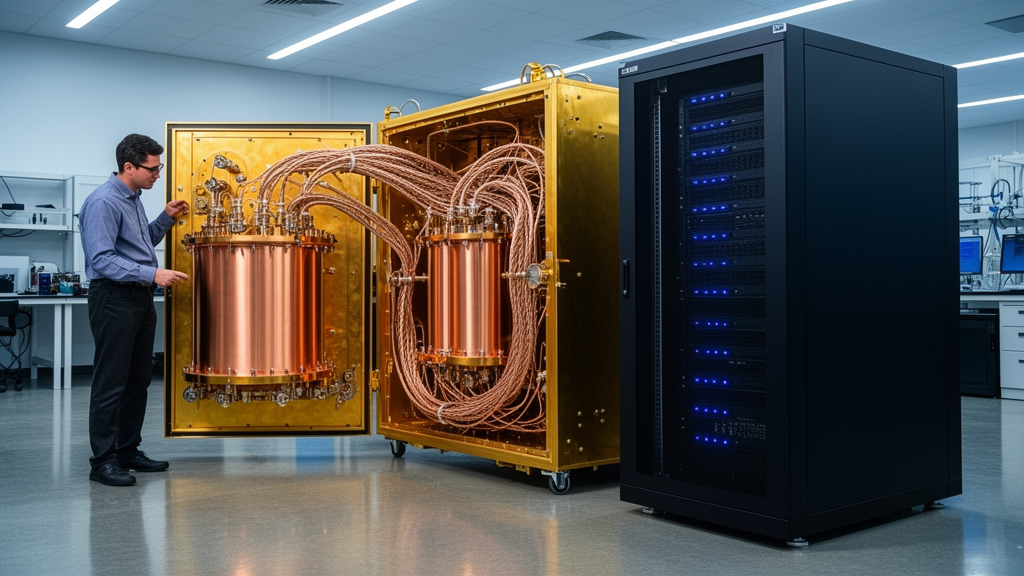
Hybrid quantum machine learning systems can match or marginally exceed the performance of state-of-the-art classical models while using fewer parameters, yet a clear and reproducible quantum advantage remains unproven across practical applications. That central conclusion emerges from a systematic review conducted by researchers Raed Abu Zitar, Murad Al-Rajab, Samia Loucif, and Ahmad Nasayrah, published in Artificial Intelligence Review. The authors evaluated the current standing of quantum machine learning, assessing whether contemporary quantum platforms deliver measurable computational benefits over conventional machine learning architectures.
As defined within the investigation, quantum machine learning integrates foundational principles of quantum mechanics, specifically superposition, entanglement, and interference, into mathematical and logical operations that classical computational systems cannot emulate. While modern noisy intermediate-scale quantum devices face substantial technical constraints, the authors observe that these existing NISQ-era platforms are already capable of sustaining small- to medium-scale machine-learning workloads. This operational capability on real and simulated processors has catalyzed a rapid expansion of experimental and theoretical investigations across the computational sciences over the past decade.
To establish an exhaustive overview of the discipline, the research team conducted a rigorous literature screening guided by the formal PRISMA methodology. The investigators systematically evaluated an initial pool of 5,463 publications that appeared between January 2015 and June 2025. From this broad corpus, the authors identified and analyzed 160 high-quality studies that directly implemented or evaluated quantum machine learning algorithms on real quantum hardware or simulated quantum processors, providing an evidence base grounded in empirical implementation rather than purely speculative theory.
The surveyed literature converges into four distinct thematic categories based on algorithmic design and computational execution. The first group comprises direct quantum adaptations of established classical algorithms, while the second encompasses variational and hybrid quantum-classical models that distribute computational tasks between classical processors and quantum circuits. The third category focuses on quantum linear-algebra accelerators designed to optimize matrix and vector calculations. Finally, the fourth thematic grouping includes quantum-inspired generative modeling and reinforcement learning techniques developed to tackle complex generative and decision-making problems.
Across the 160 reviewed studies, quantum machine learning algorithms have been applied to diverse operational domains spanning image classification, signal classification, cybersecurity, finance, chemistry, and healthcare. Within these target sectors, researchers routinely evaluate their algorithmic pipelines against established computational benchmarks. Prominently featured corpora in the reviewed literature include the MNIST image dataset, the CIC-IDS2019 cybersecurity benchmark for intrusion detection, and specialized credit-risk evaluation corpora used to test predictive classification performance in complex financial modeling contexts.
Separately from their systematic synthesis of published literature, the authors conducted an independent empirical benchmark detailed in the report. This validation effort utilized a five-seed testing framework to evaluate five quantum classifiers alongside two classical classifiers across five public tabular datasets: Breast Cancer, Diabetes, Iris, Sonar, and Bank Marketing. Comparative analyses from this controlled experiment confirmed that hybrid quantum-classical systems generally match or marginally outperform state-of-the-art classical baselines while operating with significantly reduced parameter counts, illustrating the compactness of quantum representations.
Despite these parameter efficiencies, the authors emphasize that a verifiable, reproducible quantum advantage remains elusive due to persistent technological bottlenecks. Primary obstacles documented across the field include significant data-encoding overheads, circuit-depth constraints, environmental noise, and the barren-plateau phenomenon encountered during optimization and training. To unlock the full practical potential of quantum machine learning, the review identifies three critical technological milestones that must be resolved: advanced error mitigation techniques, the development of scalable qubit architectures, and the realization of efficient data-loading schemes.
Subject of Research: Systematic evaluation of quantum machine learning algorithms, benchmarks, and performance limitations
Article Title: A systematic review of quantum machine learning: algorithms, application domains, and emerging trends
Article References: Zitar, R. A., Al-Rajab, M., Loucif, S., & Nasayrah, A. (2026). A systematic review of quantum machine learning: algorithms, application domains, and emerging trends. Artificial Intelligence Review. https://doi.org/10.1007/s10462-026-11744-x
Image Credits: AI Generated
DOI: 10.1007/s10462-026-11744-x
Keywords: quantum machine learning, hybrid quantum-classical models, PRISMA methodology, noisy intermediate-scale quantum, quantum classifiers, quantum linear-algebra accelerators, quantum-inspired generative techniques, MNIST, CIC-IDS2019, credit-risk corpora, barren plateaus, circuit-depth constraints, error mitigation, qubit architectures, data-encoding overheads, Bank Marketing dataset, Breast Cancer dataset, tabular classification
News Source: Teresa Odom. (November 12, 2026). Hybrid Quantum Machine Learning Matches Classical Baselines but Clear Advantage Remains Elusive. Scienmag.