• HOME
  • NEWS
  • EXPLORE
    • CAREER
      • Companies
      • Jobs
    • EVENTS
    • iGEM
      • News
      • Team
    • PHOTOS
    • VIDEO
    • WIKI
  • BLOG
  • COMMUNITY
    • FACEBOOK
    • INSTAGRAM
    • TWITTER
Monday, November 23, 2026
BIOENGINEER.ORG
No Result
View All Result
  • Login
  • HOME
  • NEWS
  • EXPLORE
    • CAREER
      • Companies
      • Jobs
        • Lecturer
        • PhD Studentship
        • Postdoc
        • Research Assistant
    • EVENTS
    • iGEM
      • News
      • Team
    • PHOTOS
    • VIDEO
    • WIKI
  • BLOG
  • COMMUNITY
    • FACEBOOK
    • INSTAGRAM
    • TWITTER
No Result
View All Result
Bioengineer.org
No Result
View All Result
Home NEWS Science News Health

Hybrid EfficientNet and SVM Architecture Classifies Retinal OCT Scans Accurately

by
November 23, 2026
in Health
Reading Time: 2 mins read
0
Hybrid EfficientNet and SVM Architecture Classifies Retinal OCT Scans Accurately

Hybrid EfficientNet and SVM Architecture Classifies Retinal OCT Scans Accurately

Share on FacebookShare on TwitterShare on LinkedinShare on RedditShare on Telegram

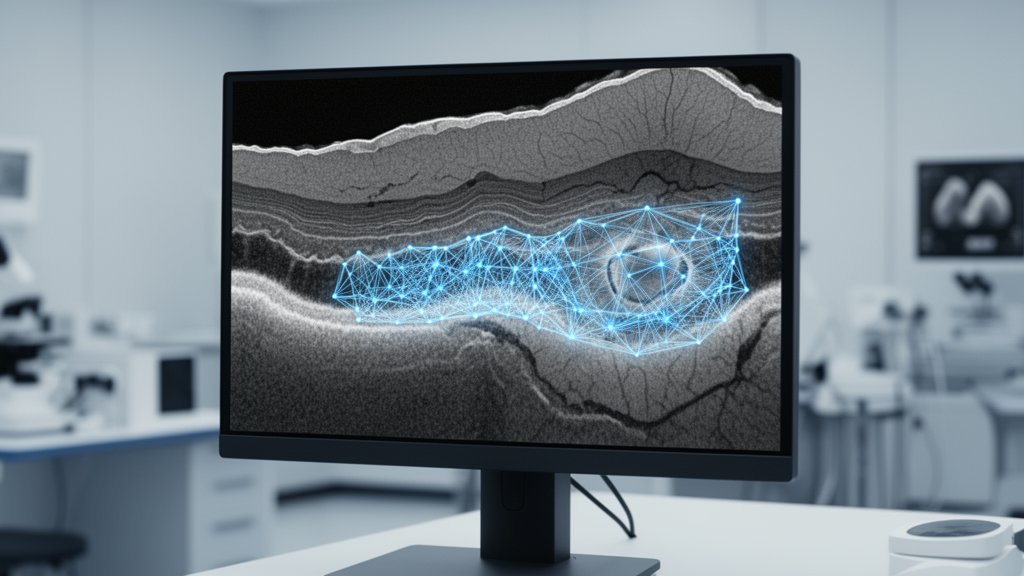
Researchers have developed a hybrid machine learning model combining deep transfer learning with support vector machines to automate the multiclass classification of retinal optical coherence tomography scans. Optical coherence tomography provides an essential noninvasive imaging method to detect retinal conditions such as choroidal neovascularization, diabetic macular edema, and drusen, in addition to identifying healthy retinal structures. However, visual evaluation by clinicians remains observer-dependent, time-intensive, and reliant on specialized clinical knowledge, spurring development of automated screening aids.

To strengthen discrimination across disease categories, the proposed Deep Transferred EfficientNet and Support Vector Machine framework pairs transfer-learned EfficientNet representations with an SVM decision model rather than relying on standard convolutional neural networks with softmax classification layers. The experimental evaluation employed a representative working subset of 8,767 scans selected from the 84,495-image OCT2017 dataset. This selected subset comprises roughly 10.4 percent of the overall collection, a design choice intended to curtail computational overhead while preserving class balance across choroidal neovascularization, diabetic macular edema, drusen, and normal samples.

The investigation assessed five distinct backbone architectures spanning EfficientNet-B0 to EfficientNet-B4 using stratified 10-fold cross-validation. Among the tested configurations, the DTE-SVM-B0 model delivered the highest overall diagnostic performance, achieving an accuracy of 0.9076, a precision of 0.9074, a recall of 0.9076, and an F1-score of 0.9073. Meanwhile, the DTE-SVM-B2 configuration exhibited the smallest standard deviation across validation folds, demonstrating comparatively higher diagnostic stability across repeated splits.

Comparative analyses showed that DTE-SVM-B0 outperformed established benchmark models, including ResNet50, DenseNet-121, and baseline EfficientNet-B0 classifiers configured with traditional softmax layers. Ablation experiments further demonstrated that replacing the standard softmax layer with an SVM classifier enhanced classification performance across every tested EfficientNet variant. Category-level clinical evaluations indicated high sensitivity and specificity overall, with choroidal neovascularization detected most reliably, whereas drusen proved to be the most challenging pathology to identify within the dataset.

Subject of Research: Automated retinal disease classification using hybrid EfficientNet and SVM models on OCT images

Article Title: Leveraging CNN and Transfer Learning With EfficientNet for Enhanced Optical Coherence Tomography (OCT)

Article References: Arekanti, S., Bhushan, C. M., Alam, I., Koppuravuri, P., Shaik, F., Hussain, M. M., & Gazi, F. (2026). Leveraging CNN and Transfer Learning With EfficientNet for Enhanced Optical Coherence Tomography (OCT). International Journal of Biomedical Imaging, 2026(1), Article 1272954. https://doi.org/10.1155/ijbi/1272954

Image Credits: AI Generated

DOI: 10.1155/ijbi/1272954

Keywords: optical coherence tomography, retinal imaging, EfficientNet, support vector machines, deep learning, transfer learning, choroidal neovascularization, diabetic macular edema, drusen, image classification, OCT2017 dataset, medical imaging, computer-aided diagnosis, convolutional neural networks, ablation testing, stratified cross-validation, ophthalmology

News Source: Ophelia Keating. (November 23, 2026). Hybrid EfficientNet and SVM Architecture Classifies Retinal OCT Scans Accurately. Scienmag.


Tags: ablation testingChoroidal neovascularizationcomputer-aided diagnosisconvolutional neural networksdeep learningdiabetic macular edemaDrusenEfficientNetimage classificationMedical ImagingOCT2017 datasetOphthalmologyoptical coherence tomographyretinal imagingStratified cross-validationsupport vector machinesTransfer Learning
Share12Tweet7Share2ShareShareShare1

Related Posts

Natural Compounds Target Inflammatory Cascades and Adhesion Molecules in Ischemic Kidney Injury

Natural Compounds Target Inflammatory Cascades and Adhesion Molecules in Ischemic Kidney Injury

November 23, 2026
Adding Dance Movement Therapy to Physical Therapy Improves Older Adult Balance

Adding Dance Movement Therapy to Physical Therapy Improves Older Adult Balance

November 23, 2026

Sensory Processing Sensitivity Profiles Associated With Healthcare Students’ Mental Effort

November 23, 2026

Bibliometric Study Maps Evolving Research Across Sudden Infant and Intrauterine Death

November 23, 2026

POPULAR NEWS

  • Thoracoscopic Enucleation Removes Giant Esophageal Tumor While Preserving Critical Anatomy

    Thoracoscopic Enucleation Removes Giant Esophageal Tumor While Preserving Critical Anatomy

    29 shares
    Share 12 Tweet 7
  • Optimized mRNA Structure Boosts Recombinant Bacterial Asparaginase Yield for Cancer Therapy

    29 shares
    Share 12 Tweet 7
  • Threaded Wire Fixation Demonstrates High Tuberosity Healing in Humeral Head Fractures

    29 shares
    Share 12 Tweet 7
  • Molybdenum and Copper Alter Austenite Decomposition in Recycled Medium Manganese Steels

    29 shares
    Share 12 Tweet 7

About

We bring you the latest biotechnology news from best research centers and universities around the world. Check our website.

Follow us

Recent News

Expanding Wetland Shrubs Shifted Autumn Passerine Distributions Across Western Hungary

Developer Cognitive Metrics Outperform Traditional Code Features in Software Defect Prediction

Natural Compounds Target Inflammatory Cascades and Adhesion Molecules in Ischemic Kidney Injury

Subscribe to Blog via Email

Enter your email address to subscribe to this blog and receive notifications of new posts by email.

Join 88 other subscribers
  • Contact Us

Bioengineer.org © Copyright 2023 All Rights Reserved.

Welcome Back!

Login to your account below

Forgotten Password?

Retrieve your password

Please enter your username or email address to reset your password.

Log In
No Result
View All Result
  • Homepages
    • Home Page 1
    • Home Page 2
  • News
  • National
  • Business
  • Health
  • Lifestyle
  • Science

Bioengineer.org © Copyright 2023 All Rights Reserved.