A hybrid deep learning framework termed DeepLeafAnalyzer achieved 98.42 percent accuracy in identifying crop foliage conditions across controlled and open field datasets by pairing dual-stage region of interest optimization with multi-scale neural feature refinement. Developed by researchers Santoshi Chinta, Suresh Kumar Mandala, and Raghavendar Raju Lingala, the computational architecture addresses diagnostic reliability obstacles that frequently undermine automated agricultural disease monitoring systems during real-world farm deployment.
While standard deep learning classifiers often demonstrate strong diagnostic precision within controlled laboratory environments characterised by uniform lighting and clear backgrounds, their practical performance frequently deteriorates in agricultural fields. Practical deployment remains vulnerable to shifting natural illumination, complex background clutter, physical occlusion, significant variations in lesion size, and an absence of predictive interpretability. These operational hurdles impede early, accurate diagnosis of crop leaf diseases, which remains vital for sustainable agricultural production and targeted crop management.
To resolve these field-level diagnostic impediments, the investigators designed a dual-stage Region of Interest optimization workflow within the overall HybridLeafNetAnalyzer framework. In the second operational stage, a YOLO localisation network pinpoints and extracts the specific disease-relevant leaf areas to ensure subsequent classification models evaluate only meaningful botanical pathological patterns.
Following region isolation, the integrated HybridLeafDiseaseNet applies specialized neural components to process structured visual information. The framework incorporates a Long Short-Term Memory sequence encoder to model ordered spatial representations across image features. To account for varying symptom dimensions, the network combines a Feature Pyramid Network with Atrous Spatial Pyramid Pooling for multi-scale representation, further enhanced by Vision Transformer-style self-attention mechanisms and a Channel-Spatial Attention Module that together refine contextual feature representations.
The authors evaluated DeepLeafAnalyzer across three distinct imaging benchmarks reflecting diverse collection environments. The testing protocol incorporated the PlantVillage dataset collected under controlled laboratory conditions, the FieldPlant dataset gathered under variable field conditions, and the AI Challenger dataset. Within this standardized experimental protocol, the proposed architecture was evaluated directly against several established deep learning baselines, including VGG16, ResNet50, MobileNetV2, and EfficientNet-B0 architectures.
Under experimental evaluation, DeepLeafAnalyzer recorded an overall diagnostic accuracy of 98.42 percent, alongside 98.55 percent precision, 98.31 percent recall, and an F1 score of 98.43 percent. The authors conducted ablation experiments to measure the individual contribution of distinct framework elements, finding that removing the dual-stage Region of Interest optimization produced the most severe performance penalty, resulting in a 4.56 percentage point reduction in model accuracy.
To evaluate model transparency, the researchers generated Grad-CAM visualisations to verify that internal predictive decisions corresponded to visually relevant disease regions on leaf surfaces. The underlying implementation code supporting the study was released openly on GitHub to facilitate verifiable leaf disease classification across varying imaging environments.
Subject of Research: Deep learning framework for crop leaf disease detection across varied imaging conditions
Article Title: DeepLeafAnalyzer A Hybrid Deep Learning Framework for ROI Optimized Multi Scale Leaf Disease Detection
Article References: Chinta, S., Mandala, S. K., & Lingala, R. R. (2026). DeepLeafAnalyzer A Hybrid Deep Learning Framework for ROI Optimized Multi Scale Leaf Disease Detection. International Journal of Computational Intelligence Systems. https://doi.org/10.1007/s44196-026-01691-4
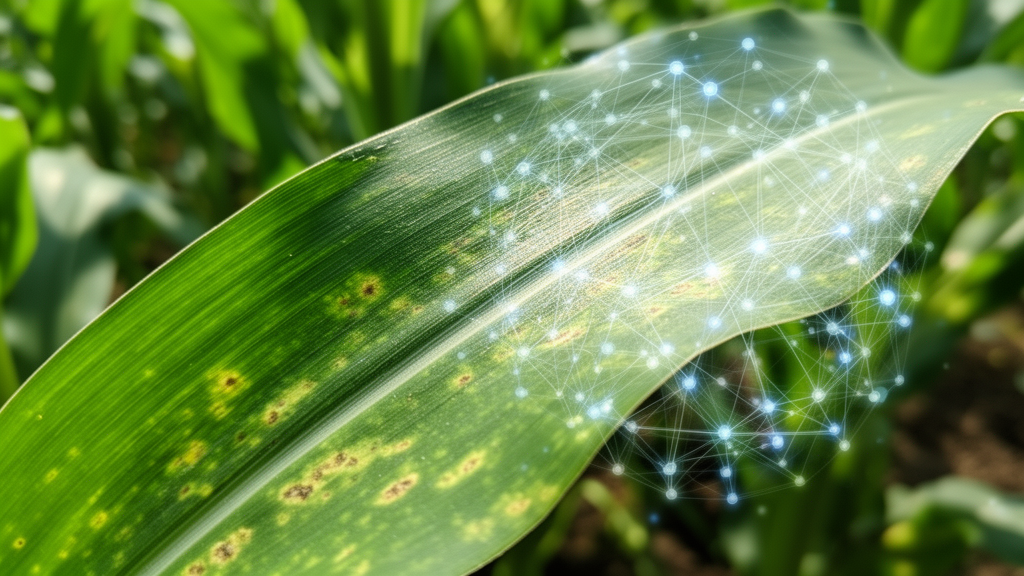
Image Credits: AI Generated
DOI: 10.1007/s44196-026-01691-4
Keywords: DeepLeafAnalyzer, crop leaf diseases, plant pathology, computer vision, U-Net segmentation, YOLO localization, Region of Interest optimization, Feature Pyramid Network, Atrous Spatial Pyramid Pooling, Vision Transformer, Channel-Spatial Attention Module, PlantVillage dataset, FieldPlant dataset, AI Challenger, Grad-CAM visualization, LSTM feature encoder, multi-scale classification, agricultural imaging
News Source: Alan Morgan. (November 21, 2026). Hybrid Deep Learning Framework Detects Crop Leaf Diseases in Variable Field Settings. Scienmag.