A hybrid brain-computer interface combining three distinct neural signatures can successfully decode sustained covert spatial attention without requiring users to shift their gaze, according to an electroencephalography study conducted with twenty-eight healthy participants. The investigation evaluated non-invasive decoding pipelines to determine whether directional focus could be identified when observers keep their eyes fixed on a central target, offering an alternative pathway for individuals who cannot execute voluntary ocular movements.
Brain-computer interfaces that utilize code-modulated visual evoked potentials represent some of the quickest non-invasive communication systems currently available for individuals who have lost voluntary motor control. However, conventional implementations of these interfaces depend fundamentally on the user directly orienting their physical gaze toward a selected visual target. This mechanical requirement creates an insurmountable barrier for individuals with severe motor impairments who have also lost functional control over their eye movements.
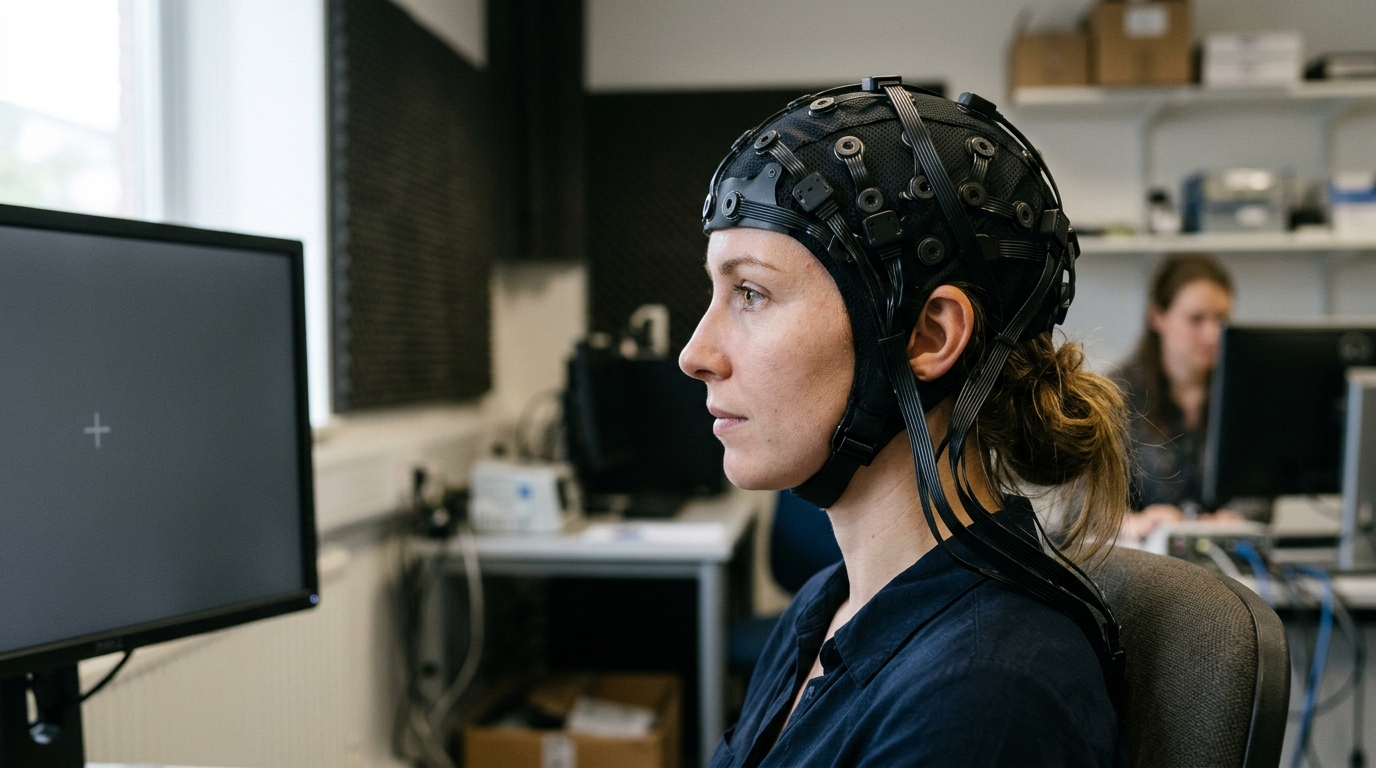
To address this clinical limitation, the research team designed an experimental two-choice spatial attention task and recorded electroencephalography signals from twenty-eight healthy adult volunteers. During the recorded sessions, two peripheral visual stimuli were presented simultaneously on the left and right sides of a central fixation cross. Participants were directed to allocate their spatial attention toward one designated side under two distinct experimental instructions: attending overtly by physically moving their eyes toward the target, or attending covertly while strictly maintaining central fixation.
The visual presentation integrated multiple sensory patterns designed to elicit distinct electrophysiological responses simultaneously. The background area of each peripheral stimulus flickered continuously according to independent pseudo-random noise sequences. Concurrently, geometric shapes appeared in the foreground of the stimuli in accordance with an oddball paradigm. This dual-layer presentation enabled researchers to track how different attentional mechanisms modulated distinct cortical signals during both overt and covert focal conditions.
The researchers systematically implemented and compared diverse decoding pipelines across three targeted electrophysiological signatures: code-modulated visual evoked potentials elicited by the pseudo-random flicker, shifts in alpha bandpower modulated by spatial orientation, and event-related potentials triggered by the foreground oddball presentation. After analyzing the performance of each individual signal, the investigators constructed hybrid classifiers that integrated the optimal decoding pipeline established for each respective neural marker.
The experimental results confirmed that decoding the attended directional side was technically feasible across all three individual neural signatures during covert attention conditions. Marked performance differences emerged between the viewing modalities: while code-modulated visual evoked potentials yielded the highest decoding accuracy during overt eye orientation, the signature registered the lowest comparative accuracy under covert conditions. In contrast, neural modulations in alpha bandpower and particularly oddball-evoked potentials exhibited substantially greater stability and robustness when participants focused without moving their eyes.
Integrating the three data streams into a unified hybrid decoding pipeline enhanced classification performance beyond the capability of any individual neural marker alone. In the covert attention condition, event-related potentials served as the dominant classification contributor, while alpha bandpower provided the most effective complementary data stream. The investigators noted that decoding sustained covert spatial attention establishes viable brain-computer interface control without gaze movement, suggesting applications both in assistive communication for severe paralysis and in neuroergonomic systems monitoring operator attention when gaze is otherwise occupied.
Subject of Research: Decoding covert spatial attention using a hybrid electroencephalography brain-computer interface
Article Title: Decoding sustained covert spatial attention with a hybrid brain-computer interface combining c-VEP, alpha bandpower, and ERP
Article References: Thielen, J., Narayanan, S., van Lohuizen, J., Vodila, R., & Ahmadi, S. (2026). Decoding sustained covert spatial attention with a hybrid brain-computer interface combining c-VEP, alpha bandpower, and ERP. Frontiers in Neuroergonomics, 7, 1953221. https://doi.org/10.3389/fnrgo.2026.1953221
Image Credits: AI Generated
DOI: 10.3389/fnrgo.2026.1953221
Keywords: brain-computer interfaces, c-VEP, code-modulated visual evoked potentials, covert spatial attention, overt spatial attention, electroencephalography, alpha bandpower, event-related potentials, oddball paradigm, hybrid classifiers, assistive communication, neuroergonomics, pseudo-random noise sequences, attentional state monitoring, visual evoked potentials, neural decoding pipelines
News Source: Cassandra Pierce. (November 25, 2026). Hybrid Brain-Computer Interface Decodes Covert Spatial Attention Without Requiring Eye Movements. Scienmag.