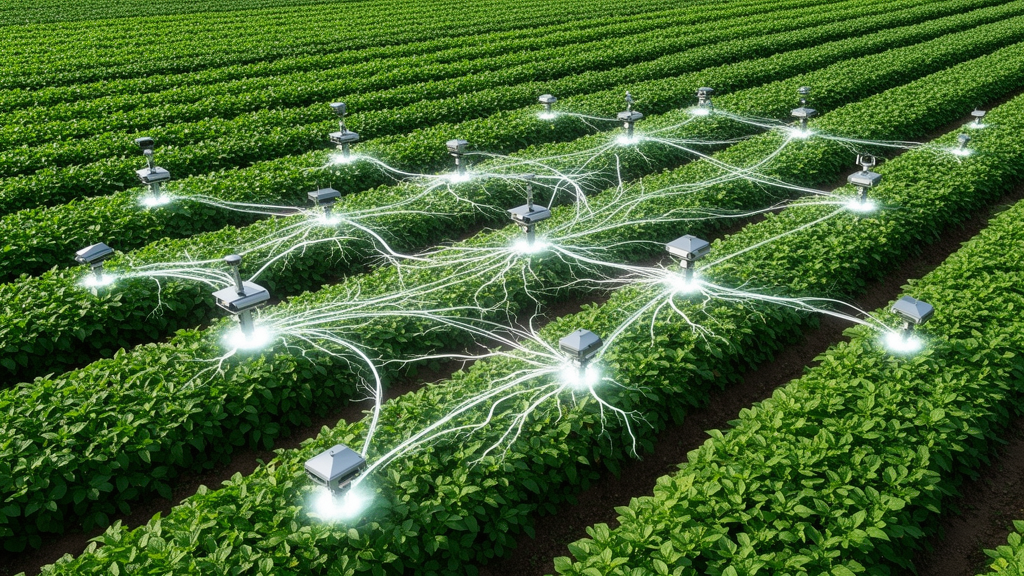
A newly developed hybrid routing framework combining mayfly optimization, fuzzy logic, and ant colony algorithms sustained simulated ZigBee wireless sensor networks for up to 830 operational rounds under vegetation-influenced propagation conditions. Engineered specifically to tackle the severe transmission losses and premature battery exhaustion common in precision agriculture, the Mayfly Ant Colony Optimisation protocol demonstrated substantial gains in operational stability over legacy network algorithms. In comparative computational evaluations based on an empirical foliage radio model, the hybrid approach achieved first node depletion at 590 rounds and retained functioning nodes far longer than standard agricultural clustering protocols. By coordinating the spatial organization of clusters, the selection of responsible cluster heads, and multi-hop forwarding toward a centralized base station, the system prevented localized energy depletion across sensor fields. The study demonstrates how bio-inspired metaheuristics and multi-criteria decision models can mitigate the communication bottlenecks caused by dense crop canopies without demanding unsustainable field maintenance.
Distributed wireless sensor networks have become foundational instruments in modern precision farming, where autonomous electronic nodes continuously record vital agro-climatic indicators including soil moisture, ambient temperature, and relative humidity. Despite these benefits, managing severe energy limitations remains an imposing engineering challenge throughout agricultural installations. Sensor nodes depend on compact, low-capacity batteries that cannot be routinely replaced or recharged across expansive, crop-covered acreage without prohibitive labor costs and operational disruption. Furthermore, dense plant canopies, thick foliage, variable soil conditions, and shifting weather patterns introduce significant signal attenuation and path loss. These factors rapidly drain battery reserves, degrade signal quality, cause premature communication link failures, and disrupt the continuous flow of telemetry necessary for reliable decision-support systems.
To support agricultural monitoring, network engineers frequently implement the IEEE 802.15.4 ZigBee wireless standard because it provides a practical operational trade-off among physical transmission range, energy demand, and data throughput. ZigBee transceivers offer medium-range, low-power digital communication well suited for dense farm-scale networks, presenting distinct functional advantages over alternative communication standards such as Bluetooth or LoRa. However, conventional routing protocols initially designed for general-purpose wireless sensor networks, such as Low Energy Adaptive Clustering Hierarchy and Hybrid Energy-Efficient Distributed clustering, exhibit notable operational rigidity in agricultural settings. These legacy schemes struggle to adapt to heterogeneous energy landscapes and fluctuating link qualities caused by surrounding crops. While previous modifications incorporating fuzzy logic have improved cluster-head election by factoring in multiple operating parameters, deterministic and standalone algorithms still struggle to balance dynamic energy demands against environmental uncertainties.
To establish realistic analytical conditions for evaluating network performance, the research integrated an empirical radio energy model derived from real-world field measurements gathered in a cassava plantation. Standard free-space and two-ray ground analytical models typically underestimate signal degradation in outdoor agricultural environments because they overlook canopy reflection, multipath scattering, and foliage obstruction. To resolve this limitation, the authors adopted a dual-slope path-loss formulation featuring a distinct breakpoint distance set at 20 meters, which separates line-of-sight conditions from non-line-of-sight propagation. Below this threshold, the model applies a path-loss exponent of 2.55 and an attenuation constant of 4.33, while transmissions beyond 20 meters face an increased path-loss exponent of 4.25 and an attenuation constant of 2.21. By embedding these empirically calibrated coefficients directly into transmitter amplifier power calculations, the simulation accurately replicated the progressive signal attenuation and circuit energy dissipation typical of densely cultivated farmland.
The mathematical formulation of the network energy management problem addressed both intra-cluster communication costs and inter-cluster routing paths as an integrated multi-objective optimization problem. Because balancing transmission distance, node density, and energy depletion represents a non-deterministic polynomial hard challenge, the authors structured linear programming objective functions to evaluate candidate configurations systematically. For the initial cluster formation phase, the objective minimized intra-cluster separation distances between regular sensor nodes and their designated cluster heads, while simultaneously maximizing the spatial distance between different cluster heads to eliminate coverage overlap across the sensing field. For multi-hop routing, a dedicated cost function integrated three distinct parameters: the residual energy of candidate relay nodes, the physical distance between consecutive hops, and the node degree of target relays. This formulation deliberately favored high-energy, lightly loaded intermediate nodes to suppress network congestion and prevent early battery exhaustion.
The first functional stage of the hybrid framework implements the Mayfly Optimization Algorithm to construct balanced spatial clusters across the deployment area. Drawing inspiration from the flight mechanics and mating swarms of mayflies, the metaheuristic maintains a productive balance between global space exploration and local exploitation. Candidate cluster positions are represented by individual male and female mayflies whose spatial coordinates and velocities update iteratively across consecutive algorithmic generations. Male mayflies execute an attraction-based flight path steered by their historical personal best positions, the swarm-wide global best position, and an exploratory nuptial dance velocity factor. Concurrently, female mayflies accelerate directly toward fitter male counterparts or execute random exploratory flights when male fitness drops. The resulting mating interactions produce paired offspring that undergo Gaussian mutation, ensuring diverse cluster geometries that minimize total intra-cluster transmission distances without sacrificing field sensing coverage.
Once global spatial clusters are formed, the framework activates a Mamdani-type Fuzzy Inference System to elect the optimal cluster head within each individual cluster boundary. Rather than relying on rigid energy thresholds that can destabilize routing topologies, the fuzzy logic engine evaluates three concurrent input parameters for each candidate node: remaining residual energy, physical distance to the central base station, and local node density. Across four sequential stages encompassing fuzzification, rule evaluation, fuzzy output aggregation, and defuzzification via the centroid method, the system processes 27 distinct linguistic inference rules. These rules assign high suitability ranks to nodes possessing abundant energy reserves, moderate proximity to the base station, and manageable local connectivity degrees. The highest-ranked node in each cluster assumes data collection, aggregation, and forwarding duties, ensuring that cluster management burdens rotate adaptively according to real-time physical conditions.
The final operational phase establishes multi-hop forwarding paths between elected cluster heads and the base station through Ant Colony Optimization. Artificial ants traverse the network graph, establishing communication routes through probabilistic state transitions influenced by link pheromone concentrations and local heuristic desirability. Heuristic desirability incorporates the inverse of transmission distance and operational energy costs, encouraging ants to discover efficient forwarding paths. Upon completing route tours, successful paths receive pheromone reinforcement inversely proportional to overall path cost, while an evaporation coefficient prevents early convergence on suboptimal routes. By prioritizing intermediate cluster heads that exhibit substantial residual energy and modest physical separation, the artificial ant colony constructs resilient transmission backbones. This coordinated multi-hop structure prevents distant cluster heads from draining their reserves through costly long-distance transmissions directly across foliage to the base station.
The complete Mayfly Ant Colony Optimisation protocol was evaluated using MATLAB R2016a simulations modeling a homogeneous agricultural network of 60 stationary sensor nodes uniformly dispersed across a 100-meter by 100-meter field. The unconstrained base station was permanently positioned at central coordinates of 50 meters by 50 meters to maintain balanced spatial distribution, with each sensor node initialized with 0.5 Joules of usable energy. The target number of operational cluster heads was consistently fixed at 10 percent of active sensor nodes across all testing scenarios to ensure equitable benchmarking against standard LEACH, HEED, and Fuzzy-LEACH routing protocols under identical parameters.
Quantitative simulation outcomes confirmed that the proposed hybrid protocol substantially extended network operating lifespans across every standard operational benchmark. The hybrid system recorded its first node death at 590 rounds, reached half node depletion at 720 rounds, and sustained its final surviving node through 830 rounds. Benchmarked against LEACH, the hybrid architecture delivered improvements of 142.68 percent in first node death, 123.78 percent in half node death, and 95.97 percent in last node death. Relative to HEED, gains reached 82.01 percent, 88.69 percent, and 101.22 percent across the respective metrics, while also outpacing Fuzzy-LEACH by 10.15 percent, 13.62 percent, and 3.38 percent.
Analysis of network survivability and power dissipation curves demonstrated that the hybrid protocol retained superior operational stability across extensive operating cycles. The network preserved more than 50 actively sensing nodes past round 600, whereas conventional LEACH and HEED networks suffered severe drop-offs well before round 450. Furthermore, the hybrid model exhibited a gradual, controlled climb in total energy consumption, reaching its maximum 0.5-Joule consumption plateau only at round 830, compared to round 450 for LEACH and HEED and round 700 for Fuzzy-LEACH. The protocol consistently maintained the highest average residual energy throughout all simulated intervals, validating the load-balancing effectiveness of coupling mayfly clustering with pheromone-guided ant routing. This balanced energy depletion profile verified that intermediate nodes shared packet forwarding responsibilities smoothly rather than collapsing under excessive forwarding loads.
Notwithstanding these positive computational results, the authors noted that their conclusions derive entirely from software-based simulations rather than physical hardware deployments in active agricultural fields. While incorporating empirical path-loss variables measured in cassava plantations lent realistic weight to the energy equations, software simulations cannot capture every environmental contingency, such as seasonal foliage growth, shifting weather fronts, soil moisture fluctuations, and transceiver hardware inconsistencies. Nevertheless, the algorithmic framework operates independently of specific crop types and can be generalized across diverse agricultural environments by recalibrating empirical propagation constants and path-loss exponents. Future research will explore integrating machine learning and predictive metaheuristics into the routing pipeline to enable autonomous adaptation under fluctuating agricultural field dynamics.
Subject of Research: Energy-efficient clustering and multi-hop routing for agricultural wireless sensor networks
Article Title: Hybrid Mayfly Ant colony optimization for energy-efficient clustering and routing in ZigBee wireless sensor networks for precision agriculture
Article References: Iyaomolere, B. A., Popoola, J. J., & Akingbade, K. F. (2026). Hybrid Mayfly Ant colony optimization for energy-efficient clustering and routing in ZigBee wireless sensor networks for precision agriculture. Discover Sensors, 2(1), Article 16. https://doi.org/10.1007/s44397-026-00049-x
Image Credits: AI Generated
DOI: 10.1007/s44397-026-00049-x
Keywords: wireless sensor networks, precision agriculture, ZigBee IEEE 802.15.4, mayfly optimization algorithm, ant colony optimization, fuzzy inference system, energy efficiency, multi-hop routing, cluster head selection, empirical radio energy model, cassava farm propagation, first node dead, half node dead, last node dead, network lifetime, load balancing, residual energy
News Source: Alan Morgan. (November 14, 2026). Hybrid Bio-Inspired Routing Extends Agricultural ZigBee Sensor Network Lifetime in Simulations. Scienmag.