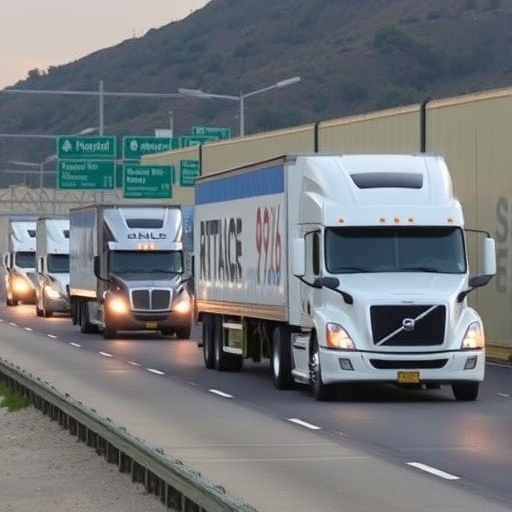
The future of logistics is on the brink of a seismic shift, driven by innovative advances in autonomous vehicle technology entwined with human decision-making processes. A groundbreaking study recently published in the journal Communications Engineering introduces a novel framework for human-led truck platooning equipped with lane-changing capabilities—ushering in a new era where efficiency, safety, and adaptability are harmonized. This pioneering approach redefines how heavy freight transportation could operate on highways globally, promising substantial improvements in traffic flow, fuel economy, and operational flexibility.
Truck platooning, the concept of multiple trucks traveling in close convoy, is no stranger to researchers and industry. Traditionally, it relies heavily on autonomous vehicles running in tight formations governed by vehicle-to-vehicle communication and adaptive cruise control systems. While these platoons enhance aerodynamics and reduce drag, thereby improving fuel efficiency and reducing emissions, their main limitation has long been rigidity—particularly the inability to make dynamic lane changes when necessary. The newly introduced human-led system addresses this critical challenge by integrating human oversight within an automated framework, thereby optimizing responsiveness and decision accuracy in complex traffic scenarios.
At the heart of this system lies a sophisticated vehicle control architecture allowing a lead truck, operated or supervised by a human driver, to manage a platoon of trailing trucks that are semi-autonomously coordinated. Unlike fully autonomous platoons that suffer delays in adapting to unexpected road conditions or slower acceptance in regulatory environments, this hybrid model leverages human intuition to execute dynamic lane changes and other maneuvers, instantly cascading commands across the platoon. This human-led interaction not only significantly improves the platoon’s agility but also allows for better handling of mixed traffic environments, where autonomous vehicles and traditional human-driven cars share the road.
Developed through years of rigorous modeling and real-world prototyping, the framework employs an advanced communication protocol ensuring seamless and secure information exchange within the platoon. Sensor fusion technology synthesizes data from multiple sources including LIDAR, radar, GPS, and in-cabin monitoring systems to provide a comprehensive situational awareness to the lead truck’s human operator. Machine learning algorithms continuously analyze this data stream, predicting traffic patterns and identifying optimal moments to initiate lane changes that balance safety with efficiency. Such intelligent coordination mitigates risks, reducing braking frequency and abrupt accelerations that typically erode fuel savings and elevate accident potential.
The logistic implications are profound. Trucking companies operating fleets with human-led platooning capability can expect not only lower operational costs through reduced fuel consumption—thanks to lower aerodynamic drag—but also enhanced delivery schedules due to more efficient lane management and reduced traffic congestion effects. Importantly, the system acts as an enabler of better labor conditions. Drivers remain central to the operation, maintaining engagement and control without being overloaded with monotonous driving tasks, which has historically led to fatigue and safety challenges. This human-machine symbiosis provides a future-ready blueprint for workforce integration in an increasingly automated industry.
Regulatory bodies, often cautious about sweeping adoption of automation due to safety concerns, are likely to welcome this intermediate approach. The presence of a human driver as a supervisory entity addresses many liability and ethical issues painted into the fully autonomous landscape. Pilot programs conducted on controlled highway corridors have demonstrated at least a 15% increase in traffic throughput during peak hours without compromising safety metrics. These improvements stem from smooth lane changes that absorb bottlenecks traditionally caused by slower merge behaviors in high-density traffic.
Moreover, the study details the architecture supporting platoon scalability. The system can extend beyond small three-truck convoys to larger fleets operating in multiple lanes, adapting dynamically to varying truck types, weights, and destination demands. This adaptability ensures greater robustness across differing geographic and regulatory environments, setting the stage for global adoption. Importantly, the communication framework incorporates fail-safe mechanisms, enabling safe platoon dissolution and individual vehicle operation should connectivity or sensor failures arise.
Energy sustainability is another dimension where this innovation shines. Heavy-duty trucks are notoriously thirsty beasts in terms of fossil fuel consumption. The aerodynamic benefits of platooning can reduce fuel use by up to 10%, according to prior research, but integrating seamless lane-switching multiplies these gains by minimizing unnecessary speed fluctuations and idle times. The environmental benefits of such technologies align with global goals towards net-zero emissions in transport sectors, signaling a pivotal contribution towards greener freight logistics.
On the technology integration front, the system supports over-the-air software updates, ensuring that the platooning algorithms evolve with emerging traffic data and regulatory standards. This capability future-proofs investments and allows iterative improvements without fleet downtime. In parallel, human operators receive enhanced training modules based on virtual simulations that replicate real-world traffic complexities, preparing them for high-stakes decision moments during platoon operations.
The social acceptance of this hybrid truck platooning offers a bridge over the current divides between autonomous technology skeptics and advocates. The co-existence of human drivers overseeing automated precision provides comfort to drivers, fleet managers, and the public alike, reducing psychological barriers to adoption. Early user feedback from drivers engaged in pilot tests reveals higher job satisfaction, corroborating the theory that automation need not replace humans but rather empower and elevate their capabilities.
In terms of economic impact, widespread deployment holds the potential to drastically reshape the freight ecosystem, impacting costs across the supply chain from manufacturers to consumers. Reduced fuel expenses and driver fatigue translate into lower shipment prices and fewer delays, boosting market competitiveness. Furthermore, infrastructure wear and tear decreases due to smoother traffic flow and fewer instances of abrupt stops, indirectly lowering public sector spending on road maintenance.
While the research sets a high technical standard, challenges remain, especially in ensuring cybersecurity resilience against hacking attempts that could compromise platoon integrity. The framework incorporates encryption, authentication protocols, and anomaly detection systems to safeguard against such threats, but ongoing vigilance and system hardening are necessary to counter continuous cyber evolution. Additionally, integration with traffic management systems and urban planning initiatives will be vital to realize the full potential of these human-led platoons within complex city logistics networks.
Looking forward, the implications of this research extend beyond just freight trucks. Similar human-led automated convoy systems could transform public transit buses, emergency vehicles, and even passenger cars, ushering in a new transport paradigm where human intuition and machine precision are not adversaries but collaborators. The tantalizing prospect is a transport ecosystem that is smart, responsive, and inherently safer—setting the stage for what many envision as the next great leap in mobility.
Ultimately, this research by Hu, Feng, Lei, and their colleagues presents a compelling blueprint that harmonizes the best of human insight and robotic control within the critical domain of heavy logistics. As trials expand and commercial deployments follow, the logistics industry may soon witness a revolution that is as technically impressive as it is pragmatically practical. The future of truck driving looks not to an isolated automation takeover but to a balanced human-machine partnership that could redefine efficiency and safety standards worldwide.
As this human-led platooning technology matures, stakeholders from manufacturers to regulators and fleet operators will need to collaborate closely to refine standards, ensure interoperability, and nurture trust among all participants. The fundamental takeaway from this research is clear: the road forward is a shared journey between humans and machines, navigating together an increasingly complex and demanding transportation landscape for the benefit of society at large.
Subject of Research: Human-led truck platooning technology incorporating lane-changing capabilities to enhance logistics efficiency.
Article Title: Human-led truck platooning with lane-changing capability for more efficient logistics: a framework and implementation.
Article References:
Hu, J., Feng, Y., Lei, M. et al. Human-led truck platooning with lane-changing capability for more efficient logistics: a framework and implementation. Commun Eng (2026). https://doi.org/10.1038/s44172-025-00578-0
Image Credits: AI Generated
Tags: adaptive cruise control for trucksadvancements in logistics technologyaerodynamics and fuel efficiency in truckingautonomous vehicle technology in logisticsefficient freight transportation systemsfuel economy enhancements in logisticshuman-led truck platooningintegrating human oversight in automationlane-changing capabilities in truck platooningoperational flexibility in freight transporttraffic flow improvements through platooningvehicle-to-vehicle communication systems