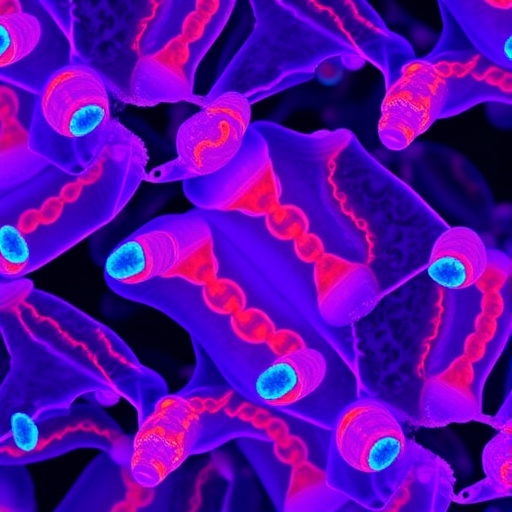
In a breakthrough study poised to transform our understanding of human intestinal biology, researchers have meticulously charted the response landscape of human intestinal organoids to a spectrum of secreted niche factors at unparalleled single-cell resolution. This exhaustive “dictionary” of cellular behaviors unravels the nuanced interplay between secreted proteins within the intestinal microenvironment and the diverse cellular constituents housed within these organoid systems. The findings represent a critical advancement in intestinal biology, organoid technology, and regenerative medicine, potentially illuminating new pathways for disease modeling and therapeutic intervention.
Human intestinal organoids have emerged as indispensable models that recapitulate key physiological features of the gut, offering a laboratory analogue for studying human-specific intestinal biology under conditions that closely mimic the in vivo state. However, the intestinal niche’s complexity—dominated by a matrix of secreted factors from epithelial cells, stromal components, immune populations, and microbial constituents—presents a daunting challenge when deciphering precise cellular responses. The study, authored by Capeling, Chen, Aliar, and colleagues, adopts cutting-edge single-cell transcriptomics to dissect this complexity systematically, allowing for an unprecedented granular view of how distinct cell types within the organoids interpret and respond to a myriad of niche signals.
Central to the investigation is the identification and cataloging of signaling molecules secreted within the intestinal microenvironment, including growth factors, cytokines, chemokines, and extracellular matrix components. By systematically exposing human intestinal organoids to these individual secreted factors, the team leveraged single-cell RNA sequencing (scRNA-seq) to decode the transcriptional changes induced in each cell type. This approach unveils how stem cells, absorptive enterocytes, goblet cells, enteroendocrine cells, Paneth cells, and diverse progenitor populations uniquely calibrate their gene expression programs in response to niche-derived cues.
A pivotal discovery of this study is the elucidation of signal-specific intracellular pathways activated by secreted factors and their consequent effects on cellular identity, proliferation, differentiation, and functional specialization within organoids. The data reveal previously unappreciated signaling axes responsible for maintaining epithelial homeostasis or directing lineage specification, underscoring the dynamic regulatory landscape underpinning intestinal physiology. This refined mapping of signal-to-response relationships creates a functional atlas that can predict cell fate outcomes based on niche factor combinations, offering striking insights into the spatial and temporal orchestration of gut epithelial renewal.
Moreover, the application of single-cell resolution nuances the appreciation of heterogeneity within seemingly homogeneous populations. For example, subsets of intestinal stem cells display divergent sensitivities to Wnt, BMP, and Notch signaling gradients, which fine-tune their proliferative capacity and differentiation potential. Such cellular heterogeneity has profound implications for understanding how intestinal tissues maintain resilience against injury, infection, or inflammation. The study’s dictionary further exposes the modular nature of secreted factors—how they synergize, antagonize, or fine-tune one another’s effects—to sculpt the complex intestinal architecture dynamically.
Technologically, the work stands as a testament to the power of integrative omics combined with high-throughput organoid culture techniques. By coupling precise medium composition control with multiplexed single-cell profiling, the researchers developed a scalable framework that can be adapted to other organ systems. This methodology paves the way for systematic interrogation of microenvironmental influences in health and disease, particularly in contexts where niche dysregulation contributes to pathogenesis, such as inflammatory bowel disease, colorectal cancer, or microbial dysbiosis.
The study further delves into the ramifications of these findings for therapeutic development. By delineating the signals that sustain or enhance stem cell function, or alternatively promote differentiation into barrier-forming absorptive cells, the research offers blueprints for engineering organoids with tailored properties suitable for transplantation, drug screening, or personalized medicine approaches. Additionally, characterizing how cancerous intestinal cells may co-opt or disrupt these signaling networks suggests novel molecular targets for intervention strategies aimed at restoring normal tissue homeostasis.
Intriguingly, the study also highlights the interplay between immunomodulatory signals and the intestinal epithelium—a complex crosstalk that maintains gut immune equilibrium while protecting against pathogens. By mapping epithelial responses to secreted cytokines and chemokines at single-cell depth, the authors uncover layers of immune regulation embedded within the intestinal niche, thus enriching our understanding of mucosal immunology and its integration with epithelial function.
Furthermore, the incorporation of extracellular matrix components into the profiling schema uncovers how biomechanical cues and matrix remodeling shape cell behavior in vivo, a dimension that has often been overlooked in previous organoid research. This structural microenvironment context adds another layer of sophistication to the dictionary, emphasizing that chemical and physical niche factors operate synergistically to govern tissue dynamics.
Importantly, the generated dictionary serves not only as a fundamental resource for biologists seeking to decode intestinal physiology but also as a valuable dataset for computational modelers. The high-dimensional data allow the construction of predictive in silico models that simulate intestinal tissue responses under varied niche conditions, accelerating hypothesis generation and experimental design.
In summary, the work by Capeling et al. constitutes a landmark advancement in the field of organoid biology and intestinal research. By providing an extensive catalog of cell-type-specific responses to secreted niche factors, the study offers a foundational blueprint for decoding the complexity of intestinal tissue organization and function. This resource is poised to catalyze future discoveries in gut biology, regenerative medicine, and gastrointestinal disease research, highlighting the immense potential of single-cell technologies combined with sophisticated organoid platforms.
As the field progresses, harnessing this dictionary could facilitate precision modulation of the intestinal niche to enhance tissue repair, combat infectious diseases, or thwart cancer progression. The elegant fusion of molecular profiling and organoid technology embodied in this study exemplifies the power of interdisciplinary approaches to illuminate human biology’s most intricate landscapes.
The implications of this research extend beyond the intestine, serving as a paradigm for exploring cellular communication and microenvironmental regulation throughout diverse organ systems. It encourages a reevaluation of how secreted factors operate within tissue ecosystems and inspires the development of next-generation organoid models with greater predictive power and physiological relevance.
This compelling portrait of niche-driven cellular behavior deepens our grasp of human intestinal biology’s complexity and paves the way for innovative strategies to manipulate tissue environments for therapeutic benefit. As intestinal organoids continue to evolve alongside high-throughput single-cell approaches, the frontier of cellular microenvironment research is set to expand rapidly, promising transformative insights and applications in biomedical science.
Subject of Research: Human intestinal organoid responses to secreted niche factors analyzed at single-cell resolution.
Article Title: Dictionary of human intestinal organoid responses to secreted niche factors at single cell resolution.
Article References:
Capeling, M.M., Chen, B., Aliar, K. et al. Dictionary of human intestinal organoid responses to secreted niche factors at single cell resolution. Nat Commun (2026). https://doi.org/10.1038/s41467-025-68247-6
Image Credits: AI Generated
Tags: cellular behavior mappingcellular responses in organoidsdisease modeling techniquesgut physiology modelshuman intestinal organoidsintestinal biology researchintestinal microenvironmentorganoid technology breakthroughsregenerative medicine advancementssecreted niche factorssingle-cell transcriptomicstherapeutic intervention pathways