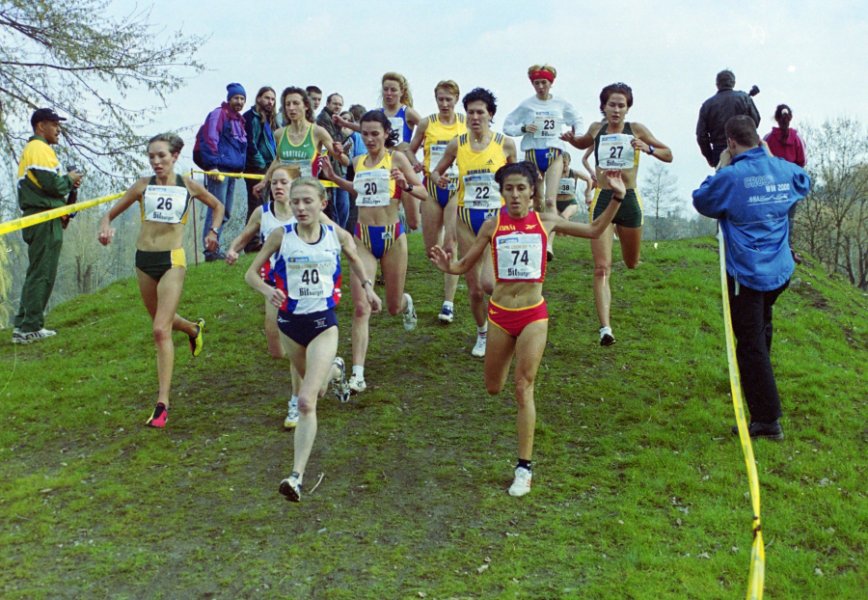
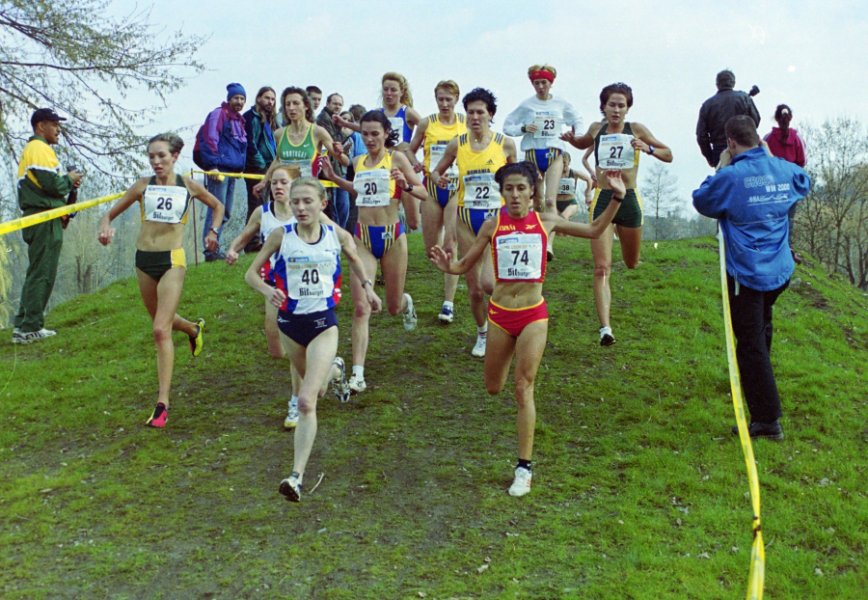
Humans and birds adapt their movement when running on uneven ground. “And even though their adaptation mechanisms and strategies developed completely independently, they do so in very similar ways,” says Dr Roy Müller from the Friedrich Schiller University Jena (Germany). Together with colleagues he has published a review article in the current issue of the Journal of the Royal Society Interface in which they analyse human and avian locomotion on uneven ground.
Credit: FSU Jena
An experience anybody who goes running in the forest has surely had: Running on uneven grounds or cross-country, you suddenly step on a rock or a root crossing your way or you come across a small hollow. You step into an empty space or on an obstacle, either way disrupting your running rhythm. “Yet, even at a rather fast pace, situations like these usually do not make us lose our balance,” says kinesiologist Dr Roy Müller from the Friedrich Schiller University Jena (Germany). The reason: Bipedal runners — and humans count among them — have various adaptation strategies stabilizing movement in their fast locomotion.
Together with his colleague Dr Yvonne Blum and the British researcher Dr Aleksandra Birn-Jeffery, Dr Müller has published a review article in the current issue of the Journal of the Royal Society Interface in which they analyse human and avian locomotion on uneven ground.
“In the course of evolution, bipedal locomotion in birds and humans has evolved independently,” explains Müller. But similarities and differences of their bipedal locomotion on uneven ground have so far hardly been scientifically researched, says Müller explaining the approach of the recent publication. While Müller and his team at the Chair of Motion Science in Jena have collected extensive data on human locomotion over the past few years, British colleagues at the University of Cambridge and the Royal Veterinary College in London dispose of corresponding data on avian locomotion. “In our publication, we have now for the first time brought together these two sets of data,” underlines Müller who is also the lead author of the article.
According to the data, there are indeed differences in the motion patterns of humans and birds due to the anatomical differences in the locomotor systems. The femur orientation in birds, for example, is nearly horizontal — in humans, as we all know, it is vertically orientated. “These differences result in dissimilarities during locomotion, for example in the angles at which our feet touch the ground,” explains Müller. Yet, locomotion patterns of humans and birds can be described sufficiently precise using a simplifying mechanical model, the so called spring-mass model. It simplifies the leg to a single flexible spring which carries the body mass. The model allows scientists to directly compare data collected in running experiments.
Both, humans and birds adapt their movement when running on uneven ground. “And even though their adaptation mechanisms and strategies developed completely independently, they do so in very similar ways,” Müller spells out the findings of their recent study. If there is a small hollow in the ground, the runner retracts the swing leg during the late flight phase leading to a steeper angle of the leg at ground contact. At the same time, the leg is ‘lengthened’ by keeping it straighter at touchdown. “Unlike birds, humans also use leg stiffness to adapt locomotion.”
The authors stress that, first and foremost, their findings are basic research. But in the long run, their findings and the knowledge of locomotor strategies in bipeds can also be of practical use — to improve locomotion of humanoid robots, for example.
Web Source: Friedrich Schiller University Jena.
Journal Reference:
R. Müller, A. V. Birn-Jeffery, Y. Blum. Human and avian running on uneven ground: a model-based comparison. Journal of The Royal Society Interface, 2016; 13 (122): 20160529 DOI: 10.1098/rsif.2016.0529
The post Human and avian running on uneven ground appeared first on Scienmag.