• HOME
  • NEWS
  • EXPLORE
    • CAREER
      • Companies
      • Jobs
    • EVENTS
    • iGEM
      • News
      • Team
    • PHOTOS
    • VIDEO
    • WIKI
  • BLOG
  • COMMUNITY
    • FACEBOOK
    • INSTAGRAM
    • TWITTER
Sunday, June 28, 2026
BIOENGINEER.ORG
No Result
View All Result
  • Login
  • HOME
  • NEWS
  • EXPLORE
    • CAREER
      • Companies
      • Jobs
        • Lecturer
        • PhD Studentship
        • Postdoc
        • Research Assistant
    • EVENTS
    • iGEM
      • News
      • Team
    • PHOTOS
    • VIDEO
    • WIKI
  • BLOG
  • COMMUNITY
    • FACEBOOK
    • INSTAGRAM
    • TWITTER
  • HOME
  • NEWS
  • EXPLORE
    • CAREER
      • Companies
      • Jobs
        • Lecturer
        • PhD Studentship
        • Postdoc
        • Research Assistant
    • EVENTS
    • iGEM
      • News
      • Team
    • PHOTOS
    • VIDEO
    • WIKI
  • BLOG
  • COMMUNITY
    • FACEBOOK
    • INSTAGRAM
    • TWITTER
No Result
View All Result
Bioengineer.org
No Result
View All Result
Home NEWS Science News Chemistry

Hubble observes tiny galaxy with big heart

Bioengineer by Bioengineer
June 13, 2019
in Chemistry
Reading Time: 3 mins read
0
IMAGE
Share on FacebookShare on TwitterShare on LinkedinShare on RedditShare on Telegram

IMAGE

Credit: ESA/Hubble, NASA

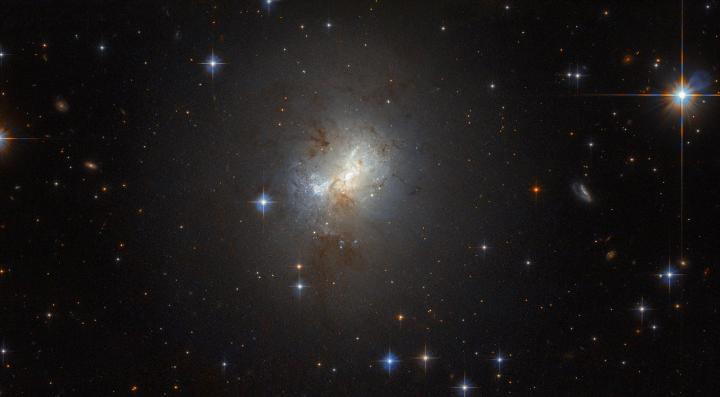
Nestled within this field of bright foreground stars lies ESO 495-21, a tiny galaxy with a big heart. ESO 495-21 may be just 3000 light-years across, but that is not stopping the galaxy from furiously forming huge numbers of stars. It may also host a supermassive black hole; this is unusual for a galaxy of its size, and may provide intriguing hints as to how galaxies form and evolve.

Located about 30 million light-years away in the constellation of Pyxis (The Compass), ESO 495-21 is a dwarf starburst galaxy — this means that it is small in size, but ablaze with rapid bursts of star formation. Starburst galaxies form stars at exceptionally high rates, creating stellar newborns of up to 1000 times faster than the Milky Way.

Hubble has studied the bursts of activity within ESO 495-21 several times. Notably, the space telescope has explored the galaxy’s multiple super star clusters, very dense regions only a few million years old and packed with massive stars. These spectacular areas can have a huge impact on their host galaxies. Studying them allows astronomers to investigate the earliest stages of their evolution, in a bid to understand how massive stars form and change throughout the Universe.

As well as hosting the cosmic fireworks that are super star clusters, ESO 495-21 also may harbour a supermassive black hole at its core. Astronomers know that almost every large galaxy hosts such an object at its centre, and, in general, the bigger the galaxy, the more massive the black hole. Our home galaxy, the Milky Way, houses a supermassive black hole, Sagittarius A*, which is over four million times as massive as the Sun. ESO 495-21, also known as Henize 2-10) is a dwarf galaxy, only three percent the size of the Milky Way, and yet there are indications that the black hole at its core is over a million times as massive as the Sun — an extremely unusual scenario.

This black hole may offer clues as to how black holes and galaxies evolved in the early Universe. The origin of the central supermassive black holes in galaxies is still a matter of debate — do the galaxies form first and then crush material at their centres into black holes, or do pre-existing black holes gather galaxies around them? Do they evolve together — or could the answer be something else entirely?

With its small size, indistinct shape, and rapid starburst activity, astronomers think ESO 495-21 may be an analogue for some of the first galaxies to have formed in the cosmos. Finding a black hole at the galaxy’s heart is therefore a strong indication that black holes may have formed first, with galaxies later developing and evolving around them.

The data comprising this image were gathered by two of the instruments aboard the NASA/ESA Hubble Space Telescope: the Advanced Camera for Surveys and already decommissioned Wide Field Planetary Camera 2/.

###

More information

The Hubble Space Telescope is a project of international cooperation between ESA and NASA.

Image credit: NASA, ESA, W. Vacca

Links

* Images of Hubble – http://www.spacetelescope.org/images/archive/category/spacecraft/

Contacts

Bethany Downer

ESA/Hubble, Public Information Officer

Garching bei München, Germany

Email: [email protected]

Media Contact
Bethany Downer
[email protected]

Original Source

https://www.spacetelescope.org/news/heic1911/

Tags: AstrophysicsSpace/Planetary Science
Share12Tweet8Share2ShareShareShare2

Related Posts

AI and Physics Collaborate to Design Advanced Hydrogen Storage Materials

June 25, 2026

International Team Including Dresden Scientists Develops Novel Designer Proteins for Advanced Study of Living Tissue

June 25, 2026

New Study Uncovers Key Factors Driving Water Chemistry in Nanoscale Environments

June 25, 2026

Plasma Technology Extends Catalyst Lifespan in Hydrogen Production

June 24, 2026
Please login to join discussion

POPULAR NEWS

  • Saying Goodbye to PGY-6: Pediatric Fellowship Realities

    103 shares
    Share 41 Tweet 26
  • Multi-Hospital Study Reveals Long Covid Burden Is Twice as High as Current Estimates

    92 shares
    Share 36 Tweet 23
  • Detection of EDCs in Breast Milk and Infant Urine Up to Six Months Highlights Early Exposure Risks

    77 shares
    Share 31 Tweet 19
  • New Drug Candidate Developed at McMaster Shows Potential for Treating Brain Cancer

    58 shares
    Share 23 Tweet 15

About

We bring you the latest biotechnology news from best research centers and universities around the world. Check our website.

Follow us

Recent News

Tracking Lanthanide-Labeled Microplastics in Plants

POSTECH Researchers Slash Cost of Reconstituted Cell-Free Systems by 95%

AI and Physics Collaborate to Design Advanced Hydrogen Storage Materials

Subscribe to Blog via Email

Success! An email was just sent to confirm your subscription. Please find the email now and click 'Confirm' to start subscribing.

Join 82 other subscribers
  • Contact Us

Bioengineer.org © Copyright 2023 All Rights Reserved.

Welcome Back!

Login to your account below

Forgotten Password?

Retrieve your password

Please enter your username or email address to reset your password.

Log In
No Result
View All Result
  • Homepages
    • Home Page 1
    • Home Page 2
  • News
  • National
  • Business
  • Health
  • Lifestyle
  • Science

Bioengineer.org © Copyright 2023 All Rights Reserved.