Ectopic calcifications represent a recognized part of the natural history of hypophosphatasia, and treatment with the alkaline phosphatase enzyme replacement therapy asfotase alfa is not associated with an increased frequency of these calcifications over time, according to research published in the Orphanet Journal of Rare Diseases. The investigation evaluated real-world data from the Global HPP Registry to characterize how often ectopic calcifications develop in individuals diagnosed with hypophosphatasia. Hypophosphatasia is a rare disease caused by deficient alkaline phosphatase activity, and affected individuals may present with ectopic calcifications across distinct organ systems.
The study protocol assessed registry participants of all ages who completed relevant clinical assessments. Investigators analyzed frequencies and corresponding ninety-five percent confidence intervals for nephrocalcinosis identified through renal ultrasounds, eye ectopic calcifications detected via ophthalmologic examinations, and kidney stones. The research design employed two analytical frameworks: a cross-sectional approach among treatment-naive patients and a longitudinal approach tracking treated patients following the start of therapy. For all eye evaluations, patients in Japan were excluded because data were not collected regarding the performance of their eye examinations. In total, 1,150 patients were eligible for inclusion in the registry analysis. Within this eligible population, 65.7 percent were female and 70.9 percent were White. Among the overall cohort, 509 patients had completed a renal ultrasound with recorded results, and 213 patients had available ophthalmologic examination results.
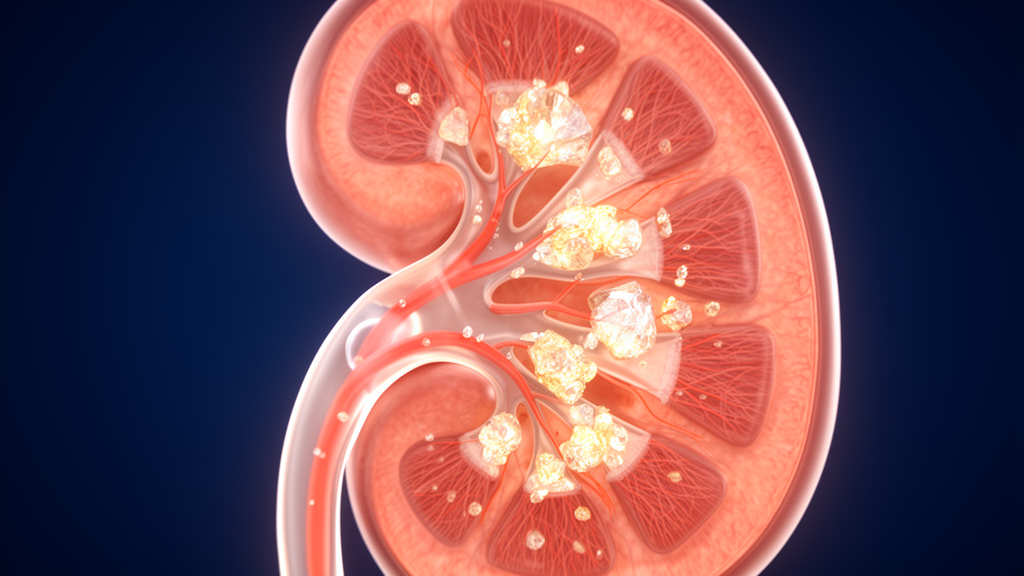
Among treatment-naive individuals with available ultrasound findings, nephrocalcinosis was detected in 12.4 percent of patients, corresponding to 63 out of 509 individuals, with a ninety-five percent confidence interval of 9.6 percent to 15.6 percent. This renal manifestation occurred more frequently within specific patient subsets. Among individuals who later went on to receive asfotase alfa, the treatment-naive frequency of nephrocalcinosis was 17.0 percent, or 38 out of 224 patients, with a ninety-five percent confidence interval of 12.3 percent to 22.5 percent. A higher frequency was recorded among patients with early-onset hypophosphatasia occurring prior to six months of age, where nephrocalcinosis appeared in 30.0 percent of individuals, representing 30 out of 100 patients, with a ninety-five percent confidence interval of 21.2 percent to 40.0 percent.
Other forms of ectopic calcification appeared in smaller proportions of the untreated cohort. Kidney stones were documented in 5.3 percent of treatment-naive patients, representing 45 out of 853 individuals, with a ninety-five percent confidence interval of 3.9 percent to 7.0 percent. Eye ectopic calcifications occurred in 4.2 percent of treatment-naive patients, representing 9 out of 213 individuals, with a ninety-five percent confidence interval of 2.0 percent to 7.9 percent.
Longitudinal renal assessments evaluated 149 ever-treated patients who underwent ultrasounds both prior to and following treatment initiation. At or before treatment start, 33 of these 149 patients, or 22.1 percent with a ninety-five percent confidence interval of 15.8 percent to 29.7 percent, had nephrocalcinosis. At their most recent assessment, 16 of these 33 individuals no longer had nephrocalcinosis. Among the 116 treated patients without nephrocalcinosis prior to treatment start, 112 remained free of nephrocalcinosis at last assessment.
Longitudinal ophthalmologic monitoring evaluated 66 treated patients with examination data. Prior to or at treatment start, 3 of these 66 patients, or 4.5 percent with a ninety-five percent confidence interval of 0.9 percent to 12.7 percent, exhibited eye ectopic calcifications. None of these three patients had eye ectopic calcifications at last assessment, while three patients without baseline ocular calcifications exhibited newly detected eye ectopic calcifications at their final assessment. A clinical trial number was not applicable for the analysis.
Subject of Research: Frequency of ectopic calcifications and nephrocalcinosis in hypophosphatasia patients
Article Title: Frequency of eye ectopic calcifications, nephrocalcinosis, and kidney stones among patients with hypophosphatasia in the global HPP registry
Article References: Linglart, A., Dahir, K. M., Kishnani, P. S., Petryk, A., Fang, S., Burke, L. K., Högler, W., Martos-Moreno, G. Á., Rockman-Greenberg, C., Seefried, L., Ebeling, P. R., & Ozono, K. (2026). Frequency of eye ectopic calcifications, nephrocalcinosis, and kidney stones among patients with hypophosphatasia in the global HPP registry. Orphanet Journal of Rare Diseases. https://doi.org/10.1186/s13023-026-04677-9
Image Credits: AI Generated
DOI: 10.1186/s13023-026-04677-9
Keywords: hypophosphatasia, ectopic calcifications, nephrocalcinosis, kidney stones, eye calcifications, asfotase alfa, enzyme replacement therapy, Global HPP Registry, rare disease, alkaline phosphatase, renal ultrasound, ophthalmologic exam, longitudinal analysis, cross-sectional study, treatment-naive, early-onset HPP, calcium metabolism, clinical registry, Orphanet Journal, patient outcomes
News Source: Ophelia Keating. (November 25, 2026). HPP Registry Study Links Early Onset to Higher Kidney Calcification. Scienmag.