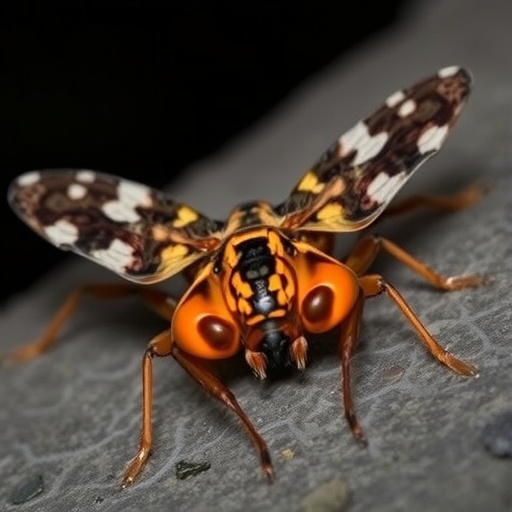
In the face of escalating urbanization and globalization, the enigmatic resilience and adaptability of invasive species continue to challenge ecologists and geneticists alike. Among these species, the spotted lanternfly (Lycorma delicatula) has emerged as a paradigmatic example of biological invasion thriving under anthropogenic pressures. Recent genomic investigations conducted by researchers at New York University and collaborators in Shanghai have illuminated how urban environments function not merely as passive habitats but actively shape the evolutionary trajectory of this invasive insect, facilitating its rapid global proliferation.
Spotted lanternflies, native to parts of China, have become a notorious pest in the northeastern United States over the past decade, inflicting substantial ecological disturbance and economic loss, particularly to viticulture. This invasive species’ ability to acclimate to disparate and challenging urban milieus — characterized by elevated temperatures, extensive pollution, and intensive pesticide application — underscores an adaptive capacity that appears to defy classical expectations of genetic bottlenecks. Genomic sequencing across both native and invaded ranges has revealed a compelling narrative of urban-induced evolutionary dynamics, offering critical insights into the processes fueling successful biological invasions.
The study deployed whole genome sequencing methodologies to decode the genetic architecture of spotted lanternflies sampled from urban and rural environments in Shanghai, alongside populations residing in urbanized regions of the United States, including New York City, Connecticut, and New Jersey. The analytical framework incorporated sophisticated demographic modeling, enabling the reconstruction of historical population bottlenecks associated with discrete invasion events. This approach facilitated a comparative lens to discern patterns of genetic diversity, population structure, and adaptive genomic signatures that distinguish urban-adapted individuals from their rural counterparts.
Strikingly, the research confirmed a precipitous reduction in genetic diversity among lanternfly populations in the United States relative to those in their native Chinese range. Despite this contraction—often an impediment to evolutionary potential—the lanternflies exhibited ongoing adaptive responses to local climatic pressures. This phenomenon exemplifies the “genetic paradox of invasion,” wherein invasive species flourish despite restricted genetic variation that theoretically should limit adaptability. Within the United States, genetic homogeneity was observed across broad geographic spans, suggesting recent colonization paired with continued gene flow, which collectively mitigates differentiation over evolutionary timescales.
In stark contrast, lanternfly populations sampled from urban versus forested sites within Shanghai demonstrated pronounced genetic divergence, despite separations of merely 30 to 40 kilometers. This fine-scale structuring reflects the insect’s limited dispersal capability and specialized ecological niche, reliant on specific host plants such as the tree of heaven (Ailanthus altissima). The localization of populations in proximity to these host substrates likely constrains gene flow, promoting differentiation in response to microhabitat-specific selective pressures inherent to urban versus natural landscapes.
Temporal demographic reconstructions unveiled a tripartite sequence of population bottlenecks aligned with documented invasion pathways: an initial dispersal from China to South Korea circa 2004, followed by a subsequent translocation from South Korea to Pennsylvania around 2014. Intriguingly, a previously undocumented bottleneck was detected dating back over 170 years, coinciding with the epoch of rapid urban development in Shanghai. This historical urbanization may have exerted selective pressures that primed the lanternfly’s genome to better tolerate anthropogenic environmental stressors, thereby facilitating subsequent invasions.
The genetic differentiation observed between urban and rural populations converges on key loci implicated in stress response pathways, including heat tolerance, detoxification mechanisms, and metabolic regulation. These adaptive variations plausibly confer enhanced survivability amidst elevated urban temperatures, pervasive pollutants, and routine pesticide exposure. The consistency of these genomic signatures across both native and invasive populations implies that urban environments serve as evolutionary crucibles, selecting for phenotypes capable of withstanding multifaceted cityscape challenges.
This revelation underscores a paradigm wherein human infrastructure and urban ecosystems do not merely facilitate passive dispersal of invasive organisms but actively sculpt their evolutionary trajectory. By driving genetic adaptations that augment resilience and invasiveness, cities inadvertently catalyze the broader geographic and ecological expansion of species such as the spotted lanternfly. This interplay complicates management strategies, necessitating integration of urban ecological dynamics into surveillance and control frameworks.
From a practical perspective, the findings advocate for an intensification of monitoring efforts focused on urban areas, particularly for early detection of egg masses and nascent populations. Furthermore, a diversified approach to pesticide application, informed by genomic insights into resistance mechanisms, may mitigate the risk of inadvertent selection for resistant genotypes. Updating predictive invasion risk models to incorporate urban adaptation parameters will enhance forecasting accuracy, especially pertinent as spotted lanternflies extend their range into progressively colder northern climates.
Ultimately, this study challenges the bifurcated treatment of urbanization and biological invasion as discrete phenomena. Instead, it posits a synergistic nexus where global change drivers coalesce, producing emergent evolutionary outcomes with profound ecological and economic ramifications. Understanding this nexus not only elucidates the mechanisms underpinning the spotted lanternfly’s invasive success but also equips conservationists and policymakers with the conceptual and empirical tools to devise more effective, anticipatory responses to invasive species in an increasingly urbanized world.
The research landscape ahead beckons further exploration into the molecular underpinnings that enable such rapid urban adaptation. High-resolution genomic analyses paired with environmental monitoring could unravel complex gene-environment interactions, while experimental studies may validate candidate genes’ functionality under urban stress conditions. Bridging these domains promises to enrich our comprehension of invasion biology and urban evolutionary ecology, domains poised for burgeoning scientific inquiry amid accelerating global change.
The implications of this work resonate beyond a single species, highlighting urban ecosystems as active agents of evolutionary change with the potential to modulate the trajectory of global biodiversity. As cities expand and human-mediated biotic exchanges intensify, the evolutionary responses they engender in non-native species will have cascading effects on native communities, ecosystem services, and economic sectors. Awareness and integration of these dynamics into invasive species management represent crucial frontiers in the effort to safeguard ecological and societal well-being in the 21st century.
Subject of Research: Animals
Article Title: Cities as evolutionary incubators for the global spread of the Spotted Lanternfly
News Publication Date: 3-Feb-2026
Web References:
DOI Link: 10.1098/rspb.2025.2292
References:
Published in Proceedings of the Royal Society B: Biological Sciences
Image Credits:
Fallon Meng/NYU
Keywords:
Invasive species, Cities, Urbanization, Invasive animals, Genome sequencing, Genomes, Evolutionary biology, Evolution, Evolutionary ecology
Tags: anthropogenic influences on evolutionclimate change and pest resilienceecological impact of spotted lanternflieseconomic effects of invasive speciesgenetic adaptation of pestsgenomic research on invasive speciesinvasive species management strategiesspotted lanternfly invasionurban ecology and pest controlurban environments and invasive speciesurbanization and biodiversityviticulture and pest challenges