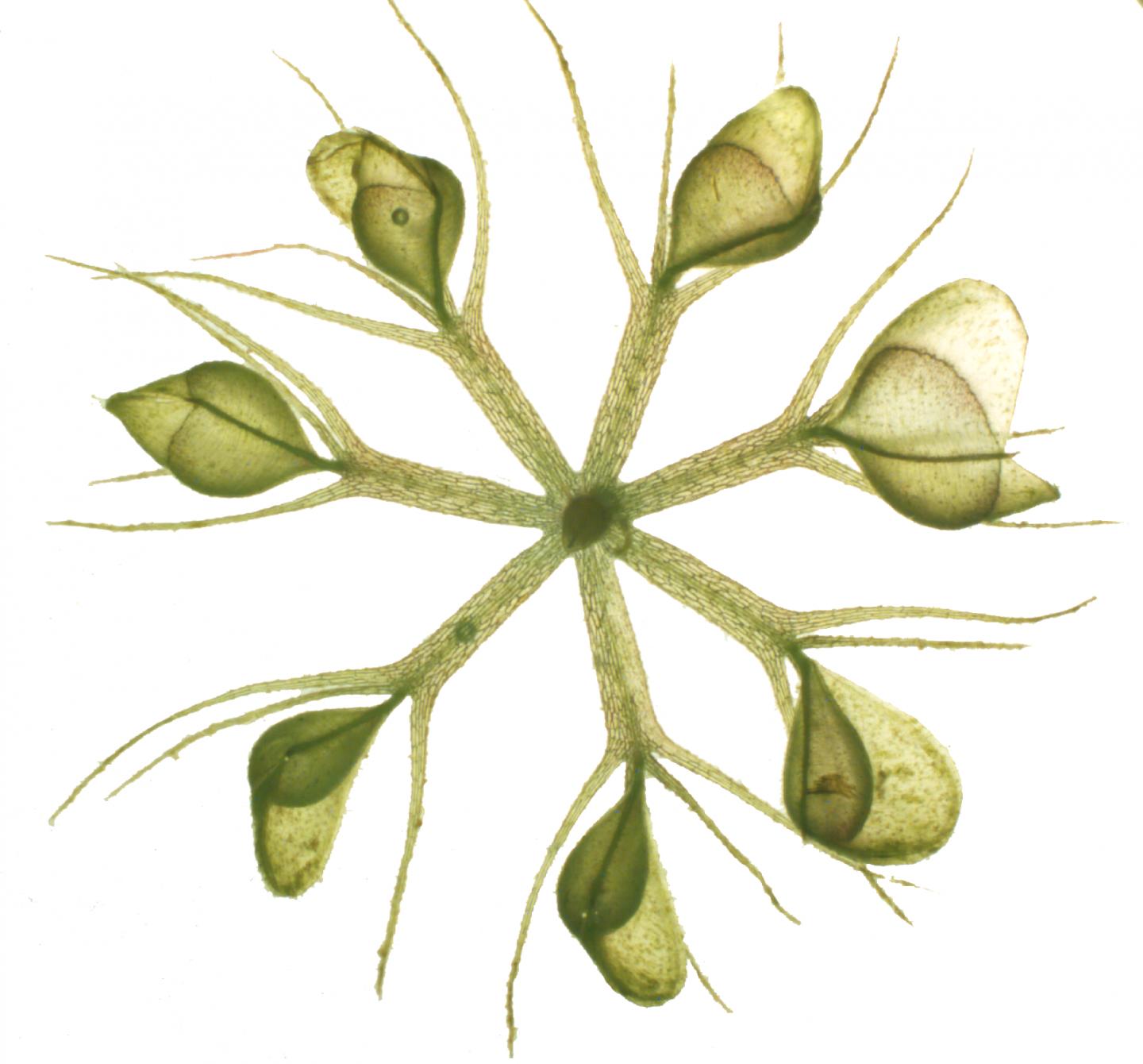
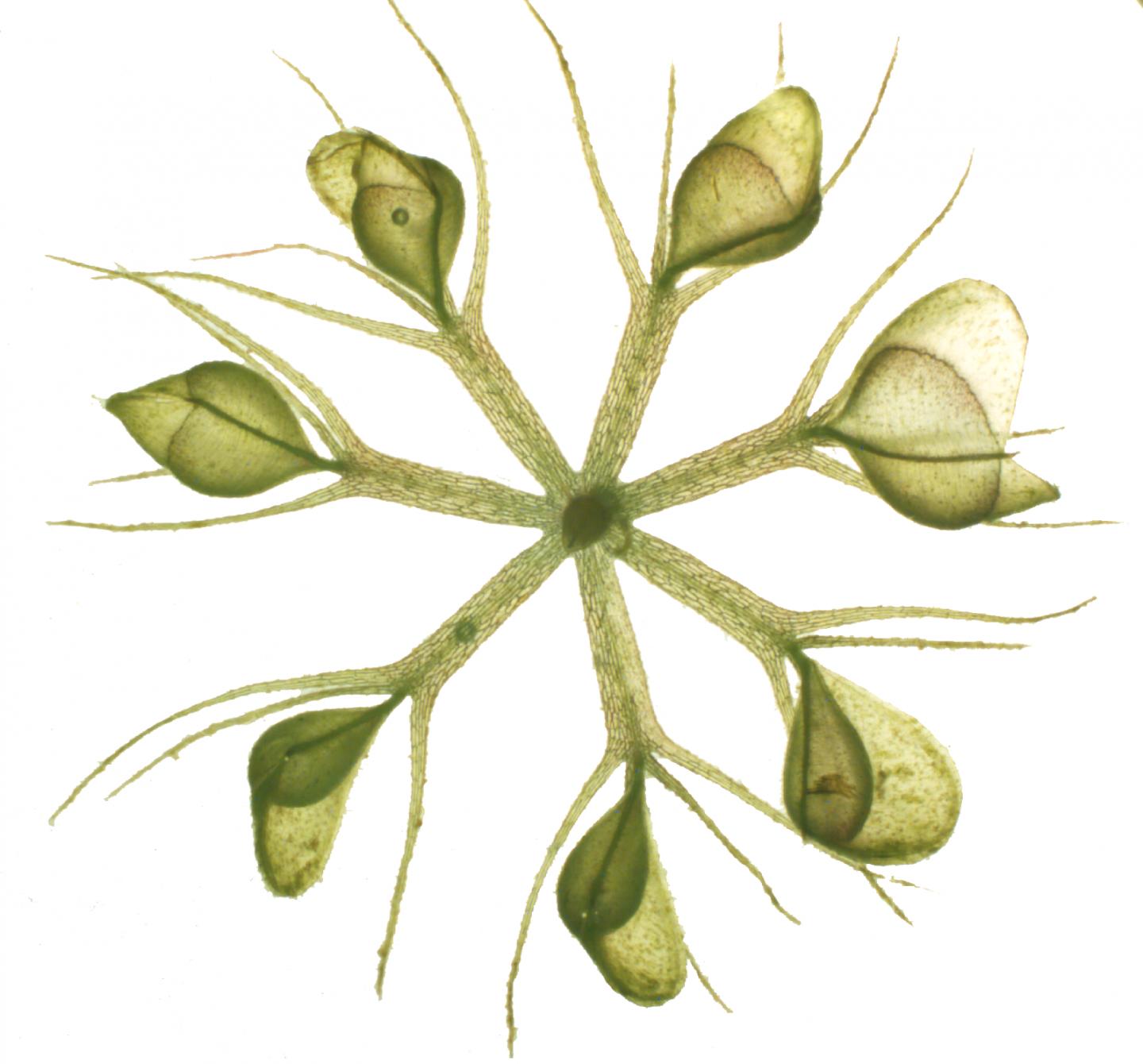
Credit: Photo: Plant Biomechanics Group
The midrib of the leaf (which has been transformed into a snap trap) bends slightly downwards in a flash, the trap halves fold in, and the water flea can no longer escape – as part of an interdisciplinary team Anna Westermeier, Dr. Simon Poppinga and Prof. Dr. Thomas Speck from the Plant Biomechanics Group at the Botanic Garden of the University of Freiburg have discovered how this snapping mechanism, with which the carnivorous waterwheel (Aldrovanda vesiculosa) catches its prey, works in detail. The study was carried out in the Collaborative Research Centre "Biological Design and Integrative Structures: Analysis, Simulation and Implementation in Architecture". In addition to the Freiburg biologists, experts from the Institute of Structural Analysis and Structural Dynamics (IBB) at the University of Stuttgart and from the Institute of Botany at the Czech Academy of Sciences were also involved. The team has published its results in the journal Proceedings of the Royal Society B: Biological Sciences.
The Venus flytrap (Dionaea muscipula) and the far less known aquatic waterwheel are the only carnivorous plants with snap traps. While intensive research on the Venus flytrap has been going on for a long time, the ten times faster underwater snap traps of the waterwheel have so far been little studied. The team led by the Freiburg biologists has now deciphered the underlying movement principle using experiments and computer simulations. The researchers found that the waterwheel snaps shut its trap, which is only three millimetres in size, by actively changing the internal pressure in the cells of the leaf, which leads to the midrib bending, and also by releasing internal prestress, which apparently results in an acceleration effect. The Venus flytrap, on the other hand, employs a hydraulic mechanism to change the curvature of its leaf halves which results in rapid trap closure. Although both plants share many similarities, the mechanics of the traps differ considerably. This finding may not only help understanding the development of snap traps from an evolutionary perspective, but also the adaptation to different habitats – in a terrestrial habitat with the Venus flytrap, under water with the waterwheel.
The team also published a biomimetic implementation of the waterwheel trap movement principle as part of the Collaborative Research Centre at the beginning of 2018 – together with other colleagues from the IBB and the Institute for Load-bearing Structures and Structural Design (ITKE) at the University of Stuttgart and the German Institutes for Textile and Fibre Research (DITF). The facade shading Flectofold© shows the same opening and closing movement as its biological inspiration, the waterwheel, and can also be attached to complex building shells.
###
Original publications
- Westermeier, A. S./Sachse, R./Poppinga, S./Vögele, P./Adamec, L./ Speck, T./Bischoff, M. (2018): How the carnivorous waterwheel plant (Aldrovanda vesiculosa) snaps. In: Proceedings of the Royal Society B: Biological Sciences 285: 20180012. doi: 10.1098/rspb.2018.0012
- Körner, A./Born, L./Mader, A./Sachse, R./Saffarian, S./Westermeier, A. S./Poppinga, S./Bischoff, M./Gresser, G. T./Milwich, M./Speck, T./Knippers, J. (2018): Flectofold – a biomimetic compliant shading device for complex free form facades. In: Smart Materials and Structures 27/1. doi: 10.1088/1361-665X/aa9c2f
Article in Online magazine of the University of Freiburg about the biomimetic facade shading system Flectofold©
Contact: Plant Biomechanics Group
Albert-Ludwigs-Universität Freiburg
Media Contact
Dr. Thomas Speck
[email protected]
49-761-203-2875
Original Source
https://www.pr.uni-freiburg.de/pm-en/press-releases-2018/how-the-waterwheel-plant-snaps?set_language=en http://dx.doi.org/10.1098/rspb.2018.0012