• HOME
  • NEWS
  • EXPLORE
    • CAREER
      • Companies
      • Jobs
    • EVENTS
    • iGEM
      • News
      • Team
    • PHOTOS
    • VIDEO
    • WIKI
  • BLOG
  • COMMUNITY
    • FACEBOOK
    • INSTAGRAM
    • TWITTER
Thursday, June 25, 2026
BIOENGINEER.ORG
No Result
View All Result
  • Login
  • HOME
  • NEWS
  • EXPLORE
    • CAREER
      • Companies
      • Jobs
        • Lecturer
        • PhD Studentship
        • Postdoc
        • Research Assistant
    • EVENTS
    • iGEM
      • News
      • Team
    • PHOTOS
    • VIDEO
    • WIKI
  • BLOG
  • COMMUNITY
    • FACEBOOK
    • INSTAGRAM
    • TWITTER
  • HOME
  • NEWS
  • EXPLORE
    • CAREER
      • Companies
      • Jobs
        • Lecturer
        • PhD Studentship
        • Postdoc
        • Research Assistant
    • EVENTS
    • iGEM
      • News
      • Team
    • PHOTOS
    • VIDEO
    • WIKI
  • BLOG
  • COMMUNITY
    • FACEBOOK
    • INSTAGRAM
    • TWITTER
No Result
View All Result
Bioengineer.org
No Result
View All Result
Home NEWS Science News Health

How socioeconomic status shapes developing brains

Bioengineer by Bioengineer
December 24, 2018
in Health
Reading Time: 2 mins read
0
IMAGE
Share on FacebookShare on TwitterShare on LinkedinShare on RedditShare on Telegram

Research suggests interventions designed to mitigate influence of low SES on brain and mental health may be most beneficial for children younger than age five
IMAGE

Credit: McDermott et al., JNeurosci (2018)


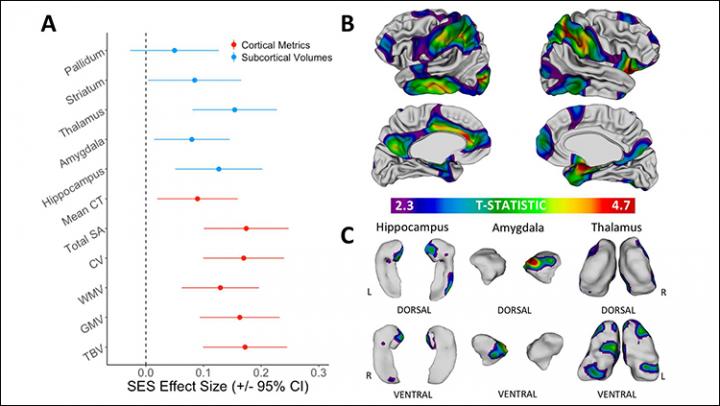
The relationship between socioeconomic status (SES) and brain anatomy is mostly stable from childhood to early adulthood, according to a longitudinal neuroimaging study of more than 600 healthy young people published in JNeurosci. This finding draws attention to the importance of preschool life as a period when associations between SES and brain organization may first develop.

Cassidy McDermott, Armin Raznahan, and colleagues analyzed brain scans of the same individuals collected over time between five and 25 years of age. Comparing this data to parental education and occupation and each participants’ intelligence quotient (IQ) allowed the researchers to demonstrate positive associations between SES and the size and surface area of brain regions involved in cognitive functions such as learning, language, and emotions. In particular, this is the first study to associate greater childhood SES with larger volumes of two subcortical regions – the thalamus and striatum – thereby extending previous SES research that has focused on its relationship to the cortex. Finally, the researchers identify brain regions underlying the relationship between SES and IQ. A better understanding of these relationships could clarify the processes by which SES becomes associated with a range of life outcomes, and ultimately inform efforts to minimize SES-related variation in health and achievement.

###

Article: Longitudinally Mapping Childhood Socioeconomic Status Associations with Cortical and Subcortical Morphology*

DOI: http://www.jneurosci.org/lookup/doi/10.1523/JNEUROSCI.1808-18.2018

Corresponding author: Armin Raznahan (National Institute of Mental Health, Bethesda, MD, USA) [email protected]

*A preprint of this manuscript has been posted on bioRxiv: https://doi.org/10.1101/352187

About JNeurosci

JNeurosci, the Society for Neuroscience’s first journal, was launched in 1981 as a means to communicate the findings of the highest quality neuroscience research to the growing field. Today, the journal remains committed to publishing cutting-edge neuroscience that will have an immediate and lasting scientific impact, while responding to authors’ changing publishing needs, representing breadth of the field and diversity in authorship.

About The Society for Neuroscience

The Society for Neuroscience is the world’s largest organization of scientists and physicians devoted to understanding the brain and nervous system. The nonprofit organization, founded in 1969, now has nearly 37,000 members in more than 90 countries and over 130 chapters worldwide.

Media Contact
David Barnstone
[email protected]
202-962-4000

Related Journal Article

http://dx.doi.org/10.1523/JNEUROSCI.1808-18.2018

Tags: Developmental/Reproductive BiologySocial/Behavioral ScienceSocioeconomics
Share13Tweet8Share2ShareShareShare2

Related Posts

Tracking Lanthanide-Labeled Microplastics in Plants

June 25, 2026

Neural Design Enables Zero-Shot Drug-Binding Proteins

June 25, 2026

Genomic Insights into Human Skin Fungi Diversity

June 25, 2026

Chiral Laser Gyroscopes Surpass Lock-In Limit

June 25, 2026
Please login to join discussion

POPULAR NEWS

  • Saying Goodbye to PGY-6: Pediatric Fellowship Realities

    103 shares
    Share 41 Tweet 26
  • Multi-Hospital Study Reveals Long Covid Burden Is Twice as High as Current Estimates

    92 shares
    Share 36 Tweet 23
  • Detection of EDCs in Breast Milk and Infant Urine Up to Six Months Highlights Early Exposure Risks

    77 shares
    Share 31 Tweet 19
  • New Drug Candidate Developed at McMaster Shows Potential for Treating Brain Cancer

    58 shares
    Share 23 Tweet 15

About

We bring you the latest biotechnology news from best research centers and universities around the world. Check our website.

Follow us

Recent News

Tracking Lanthanide-Labeled Microplastics in Plants

POSTECH Researchers Slash Cost of Reconstituted Cell-Free Systems by 95%

AI and Physics Collaborate to Design Advanced Hydrogen Storage Materials

Subscribe to Blog via Email

Enter your email address to subscribe to this blog and receive notifications of new posts by email.

Join 82 other subscribers
  • Contact Us

Bioengineer.org © Copyright 2023 All Rights Reserved.

Welcome Back!

Login to your account below

Forgotten Password?

Retrieve your password

Please enter your username or email address to reset your password.

Log In
No Result
View All Result
  • Homepages
    • Home Page 1
    • Home Page 2
  • News
  • National
  • Business
  • Health
  • Lifestyle
  • Science

Bioengineer.org © Copyright 2023 All Rights Reserved.