


New work uncovers how a specific epigenetic mark is reset in sperm
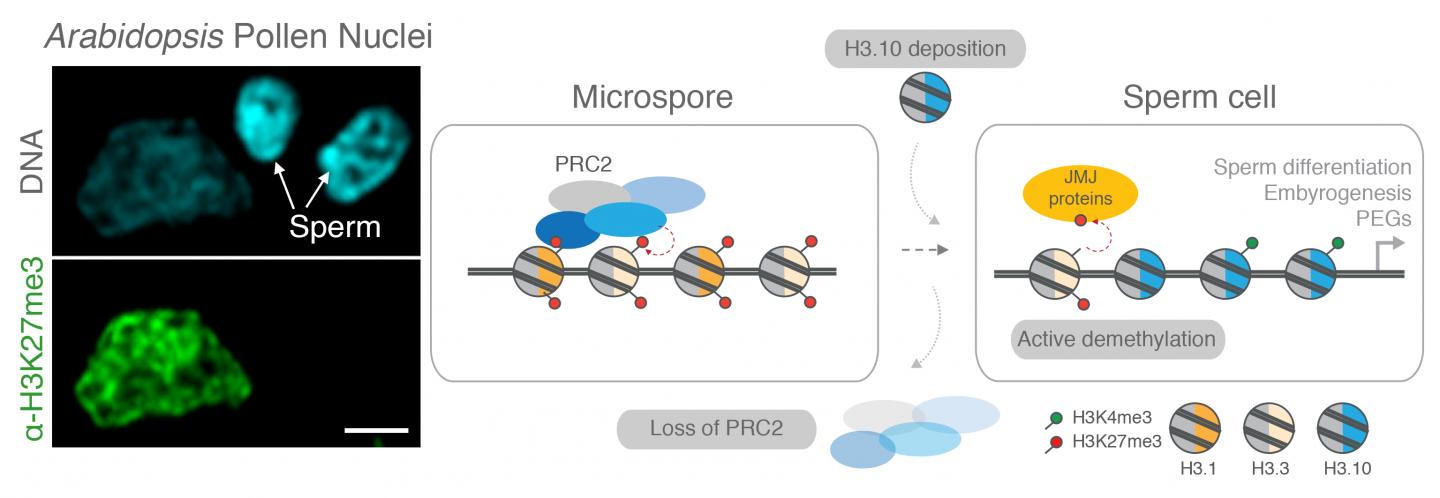
Credit: Michael Borg
Although they do it differently than humans, plants also have memories. For example, many plants can sense and remember prolonged cold in the Winter to ensure they flower at the right time during the Spring. This so-called “epigenetic memory” occurs by modifying specialized proteins called histones, which are important for packaging and indexing DNA in the cell. One such histone modification, called H3K27me3, tends to mark genes that are turned off. In the case of flowering, cold conditions cause H3K27me3 to accumulate at genes that control flowering. Previous work from the Berger lab has shown how H3K27me3 is faithfully transmitted from cell to cell so that in the Spring, plants will remember that it was cold and that winter is over, allowing them to flower at the right time. But just as importantly, once they’ve flowered and made seeds, the seeds need to forget this ‘memory’ of the cold so that they do not flower too soon once winter comes around again. Since H3K27me3 is faithfully copied from cell to cell, how do plants go about forgetting this memory in seeds?
To answer this question, an international team lead by Dr. Michael Borg, a postdoc in the lab of Dr. Frédéric Berger at the Gregor Mendel Institute of the Austrian Academy of Sciences, set out to analyse histones in pollen, hypothesizing that the process of forgetting would most likely occur in the embedded sperm. The researchers were surprised to find that H3K27me3 completely disappeared in sperm. They found that sperm accumulate a special histone that is unable to carry H3K27me3. This ensures that this modification is erased from hundreds of genes, not only those that prevent flowering but also ones which control a large array of important functions in seeds, which are produced once the sperm is carried by the pollen to fuse with the plant egg cell. This phenomenon is called “epigenetic resetting” and is akin to erasing and reformatting data on a hard drive.
“This actually makes a lot of sense from an ecological perspective” says Dr. Borg. “Since pollen can spread over long distances, by wind or bees for example, and much of the “memory” carried by H3K27me3 is related to environmental adaptation, it makes sense that seeds should “forget” their dad’s environment and instead remember their mother’s, since they are most likely to spread and grow next to mom.”
According to Dr. Berger “Like plants, animals also erase this epigenetic memory in sperm, but they do it by replacing histones with a completely different protein. This is one of the first examples of how a specialized histone variant can help reprogram and reset a single epigenetic mark while leaving others untouched. There are many more unstudied histone variants in both plants and animals, and we expect that aspects of this resetting mechanism we have discovered will be found in other organisms and developmental contexts.”
###
This work was carried out by an international team with members from the Gregor Mendel Institute in Austria, the Cold Spring Harbor Laboratory, Yale University, University of Kentucky, and Purdue University in the USA, Nagoya University in Japan, University of Edinburg in the UK, and the Instituto.
Gulbenkian Ciência in Portugal. Funding was provided by the Austrian Science Fund, ERA-CAPS, the Howard Hughes Medical Institute, NIH, the Japan Society for the Promotion of Science, the Wellcome Trust, and the European Research Council.
Borg M, Jacob Y, Susaki D, et al. (2020) Targeted reprogramming of H3K27me3 resets epigenetic memory in plant paternal chromatin. Nature Cell Biology. https:/
For more information, please contact: Matt Watson [email protected] +43 1 79044 9101
About the GMI The Gregor Mendel Institute of Molecular Plant Biology (GMI) was founded by the Austrian Academy of Sciences in 2000 to promote research excellence in plant molecular biology. It is the only international center dedicated to basic plant research in Austria and one of very few throughout the world. Nine research groups study many aspects of plant molecular genetics, including epigenetics, cell biology, plant-pathogen interactions, developmental biology, and population genetics. The GMI is part of the Vienna BioCenter, one of Europe’s foremost life science research locations.
Media Contact
Matt Watson
[email protected]
Original Source
https:/
Related Journal Article
http://dx.



