• HOME
  • NEWS
  • EXPLORE
    • CAREER
      • Companies
      • Jobs
    • EVENTS
    • iGEM
      • News
      • Team
    • PHOTOS
    • VIDEO
    • WIKI
  • BLOG
  • COMMUNITY
    • FACEBOOK
    • INSTAGRAM
    • TWITTER
Saturday, July 4, 2026
BIOENGINEER.ORG
No Result
View All Result
  • Login
  • HOME
  • NEWS
  • EXPLORE
    • CAREER
      • Companies
      • Jobs
        • Lecturer
        • PhD Studentship
        • Postdoc
        • Research Assistant
    • EVENTS
    • iGEM
      • News
      • Team
    • PHOTOS
    • VIDEO
    • WIKI
  • BLOG
  • COMMUNITY
    • FACEBOOK
    • INSTAGRAM
    • TWITTER
  • HOME
  • NEWS
  • EXPLORE
    • CAREER
      • Companies
      • Jobs
        • Lecturer
        • PhD Studentship
        • Postdoc
        • Research Assistant
    • EVENTS
    • iGEM
      • News
      • Team
    • PHOTOS
    • VIDEO
    • WIKI
  • BLOG
  • COMMUNITY
    • FACEBOOK
    • INSTAGRAM
    • TWITTER
No Result
View All Result
Bioengineer.org
No Result
View All Result
Home NEWS Science News

How plants find their symbiotic partners

Bioengineer by Bioengineer
May 3, 2021
in Science News
Reading Time: 3 mins read
0
IMAGE
Share on FacebookShare on TwitterShare on LinkedinShare on RedditShare on Telegram

IMAGE

Credit: Photo: Pengbo Liang/University of Freiburg

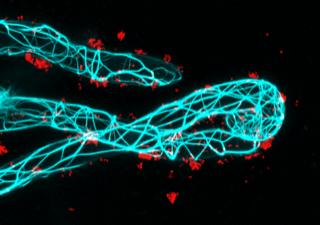
What would it be like to produce fertilizer in your own basement? Leguminous plants, like peas, beans, and various species of clover, obtain the organic nitrogen they need for their growth from symbiotic soil bacteria via specialized structures in their roots. A team led by the cell biologist Prof. Dr. Thomas Ott from the University of Freiburg’s Faculty of Biology has now detected a factor in the root cells that the plants need for the initial contact with these so-called root-associated bacteria, which live in the soil. They discovered a protein found only in legumes called symbiotic formin 1 (SYFO1) and demonstrated the essential role it plays in symbiosis. Together with the molecular biologist Prof. Dr. Robert Grosse University of Freiburg’s Faculty of Medicine and the evolutionary biologist Dr. Pierre-Marc Delaux from the Laboratoire de Recherche en Sciences Végétales (LRSV) in Toulouse/France, the team published their results in the journal Current Biology.

When a root nodule bacterium encounters the roots of a leguminous plant in the soil, the SYFO1 protein causes the tiny hairs of the root to change the direction of their growth. They thus wrap themselves around the potential symbiotic partner. Thanks to these bacterial helpers, legumes do not need any nitrogenous fertilizer, in contrast to other plants. “If we understood precisely how the symbiosis comes into being, we could give crop plants back this special property they have lost in the course of evolution,” says Ott. Both he and Grosse are members of the Cluster of Excellence CIBSS – Centre for Integrative Biological Signalling Studies. Ott’s research at CIBSS involves studying the spatial organization of the signaling paths that enable the symbiotic relationship with symbiotic bacteria in the first place. Grosse, on the other hand, focuses in his work in Freiburg on the cytoskeleton of animal cells. “In our collaboration, which was made possible by CIBSS, we were able to contribute our expertise in different areas of specialization in the best possible way,” says Ott.

The team demonstrated in the legume Medicago truncatula (barrel medic) that the root hairs of plants in which the gene for SYFO1 has been switched off are practically no longer capable of wrapping themselves around the bacteria. In further studies, the researchers discovered that the protein binds to actin, a component of the cytoskeleton, and at the same time to the cell wall outside the cells, thus changing the direction of its growth: Instead of growing straight, the tiny hairs now change their direction and form a loop around the bacterium.

“SYFO1 constitutes a special innovative step in the evolution of the plants,” explains Ott. “While formin proteins are present in many forms in cells and interact with actin, this special type only responds to symbiotic signals from the bacteria.”

###

CIBSS – Centre for Integrative Biological Signalling Studies
https://www.cibss.uni-freiburg.de

Media Contact
Prof. Dr. Thomas Ott
[email protected]

Original Source

https://www.pr.uni-freiburg.de/pm-en/press-releases-2021/how-plants-find-their-symbiotic-partners

Related Journal Article

http://dx.doi.org/10.1016/j.cub.2021.04.002

Tags: BiologyCell BiologyMolecular BiologyPlant Sciences
Share12Tweet8Share2ShareShareShare2

Related Posts

Quasi-Bound States Boost Quantum Well Photoresponse — Technology and Engineering

Quasi-Bound States Boost Quantum Well Photoresponse

July 4, 2026

Lysine Pyruvylation Links Glycolysis to Epigenetics

July 4, 2026

Multiphysics Coupling: Single vs. Multiple DeepONet Branches

July 4, 2026

Personalized Neoantigen Dendritic Cell Vaccine in Glioblastoma

July 4, 2026
Please login to join discussion

POPULAR NEWS

  • Detection of EDCs in Breast Milk and Infant Urine Up to Six Months Highlights Early Exposure Risks

    77 shares
    Share 31 Tweet 19
  • Saying Goodbye to PGY-6: Pediatric Fellowship Realities

    103 shares
    Share 41 Tweet 26
  • New Drug Candidate Developed at McMaster Shows Potential for Treating Brain Cancer

    58 shares
    Share 23 Tweet 15
  • KTU Researchers Explore Ultrasound’s Role in Enhancing Blood Flow Beyond Diagnostics

    53 shares
    Share 21 Tweet 13

About

We bring you the latest biotechnology news from best research centers and universities around the world. Check our website.

Follow us

Recent News

Quasi-Bound States Boost Quantum Well Photoresponse

Lysine Pyruvylation Links Glycolysis to Epigenetics

Multiphysics Coupling: Single vs. Multiple DeepONet Branches

Subscribe to Blog via Email

Enter your email address to subscribe to this blog and receive notifications of new posts by email.

Join 83 other subscribers
  • Contact Us

Bioengineer.org © Copyright 2023 All Rights Reserved.

Welcome Back!

Login to your account below

Forgotten Password?

Retrieve your password

Please enter your username or email address to reset your password.

Log In
No Result
View All Result
  • Homepages
    • Home Page 1
    • Home Page 2
  • News
  • National
  • Business
  • Health
  • Lifestyle
  • Science

Bioengineer.org © Copyright 2023 All Rights Reserved.