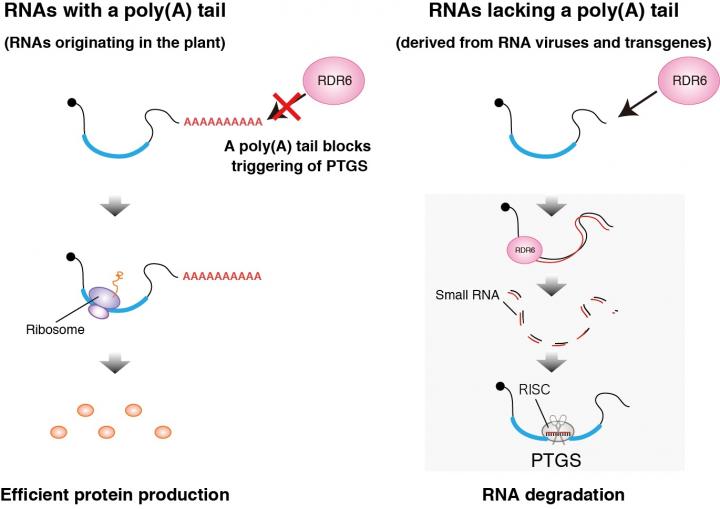
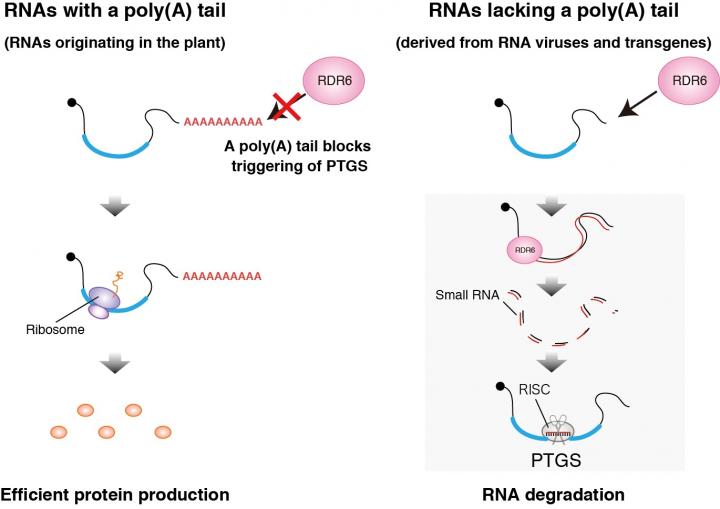
Credit: 2017 Kyungmin Baeg, Hiro-oki Iwakawa, and Yukihide Tomari.
The plant's immune system can recognize whether a piece of RNA is an invader or not based on whether the RNA has a threaded bead-like structure at the end, say University of Tokyo researchers. Their finding provides an answer to the quarter-century-old question of why RNAs belonging to the plant escape its self-defense mechanism, paving the way for future biotechnological techniques to modify crops.
Our immune system protects us from diseases and infections by fighting off viruses and other foreign substances. Plants also have a mechanism that fends off invaders, called post-transcriptional gene silencing, which attacks foreign RNA by distinguishing them from non-foreign ones, but does not fight against RNAs originating in the plant.
"While previous research has suggested that a long chain of adenosine nucleotides at the end of the RNA, called the poly(A) tail, and/or a distinctive structure at the beginning of the RNA, the cap structure, could be the flags that dictate whether or not to trigger the plant immune system, no research until now was able to provide definitive evidence," explains Assistant Professor Hiro-oki Iwakawa of the University of Tokyo's Institute of Molecular and Cellular Biosciences, co-author of the study to appear in Nature Plants.
"Classical biochemistry techniques are one of our lab's strengths. With classical biochemistry, we can replicate biological processes in test tubes, and identify and describe the molecules involved. And this is exactly what we have done," says Professor Yukihide Tomari, also of the University of Tokyo's Institute of Molecular and Cellular Biosciences.
Tomari and lab members Iwakawa and PhD student Kyungmin Baeg produced an RNA-dependent RNA polymerase 6 (RDR6) protein, a key enzyme in initiating the defense mechanism, from Arabidopsis thaliana, a small flowering plant, and observed how RDR6 behaves when mixed with foreign RNA containing a poly(A) tail of varying length.
The research group found that if the RNAs contained a poly(A) tail at their ends, the immune system did not consider the RNA an invader, while RNAs lacking the tail were perceived as foreign, triggering a defense response.
"Initially, we hypothesized that multiple proteins would be involved in discriminating the two RNAs," says Baeg. He continues, "To our surprise, it turned out that RDR6 itself can discriminate the presence of the poly(A) tail and this single-enzyme system is much simpler and more elegant than we initially thought."
###
Journal article: Kyungmin Baeg, Hiro-oki Iwakawa, and Yukihide Tomari, The poly(A) tail blocks RDR6 from converting self mRNAs into substrates for gene silencing, Nature Plants, Online Edition, March 2017
URL: http://dx.doi.org/10.1038/nplants.2017.36
DOI: 10.1038/nplants.2017.36
Links: Institute of Molecular and Cellular Biosciences, The University of Tokyo
Lab of RNA Function (Tomari Lab), Institute of Molecular and Cellular Biosciences, The University of Tokyo
Research contact: Professor Yukihide Tomari
Institute of Molecular and Cellular Biosciences, The University of Tokyo, 1-1-1, Yayoi, Bunkyo-ku, Tokyo 113-0032, Japan
Tel: +81-3-5841-7839
Fax: +81-3-5841-8485
Email: [email protected]
Press officer contact: Ms. Midori Kamohara
General Affairs Team, Institute of Molecular and Cellular Biosciences, The University of Tokyo, 1-1-1, Yayoi, Bunkyo-ku, Tokyo 113-0032, Japan
Tel: +81-3-5841-7803
Fax: +81-3-5841-8465
Email: [email protected]
Funding: This research was supported in part by Grants-in-Aid for Scientific Research on Innovative Areas ('Non-coding RNA neo-taxonomy') 26113007 (to Y.T.) and ('Nascent-chain Biology') 26116003 (to H.I), Grant-in-Aid for Young Scientists (A) 16H06159 (to H.I.), Grant-in-Aid for Challenging Exploratory Research 15K14444 (to H.I.) and Grant-in-Aid for JSPS Fellows 16J07290 (to K.B.).
About the University of Tokyo: The University of Tokyo is Japan's leading university and one of the world's top research universities. The vast research output of some 6,000 researchers is published in the world's top journals across the arts and sciences. Our vibrant student body of around 15,000 undergraduate and 15,000 graduate students includes over 2,000 international students. Find out more at http://www.u-tokyo.ac.jp/en/ or follow us on Twitter at @UTokyo_News_en
Media Contact
Midori Kamohara
[email protected]
@UTokyo_News_en
http://www.u-tokyo.ac.jp
############
Story Source: Materials provided by Scienmag