Credit: Trevor Lithgow, …
In a new study, researchers identify important new insights into a survival mechanism of the bacteria that cause rotting in certain plants, including some highly invasive weeds. The study, publishing on August 2 in the Open-Access journal PLOS Biology, demonstrates for the first time exactly how the bacterium Pectobacterium obtains the iron vital to its survival and replication: by pirating it from iron-bearing proteins in the host plants. The study was led by Dr. Rhys Grinter and Prof. Trevor Lithgow at the Biomedicine Discovery Institute of Monash University. The team used comparative genomics to forensically track the origins of an enzyme, called FusC, that turned out to be the key factor for the import and acquisition of iron.
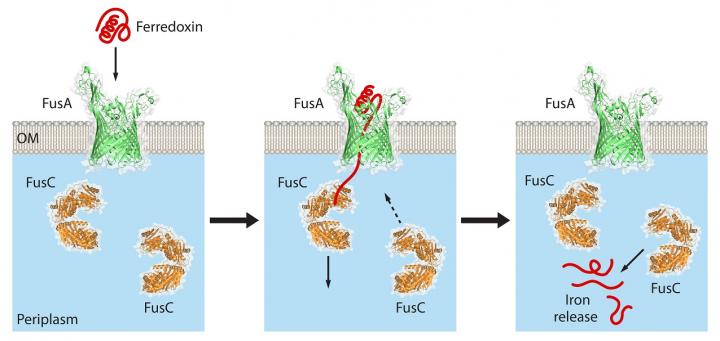
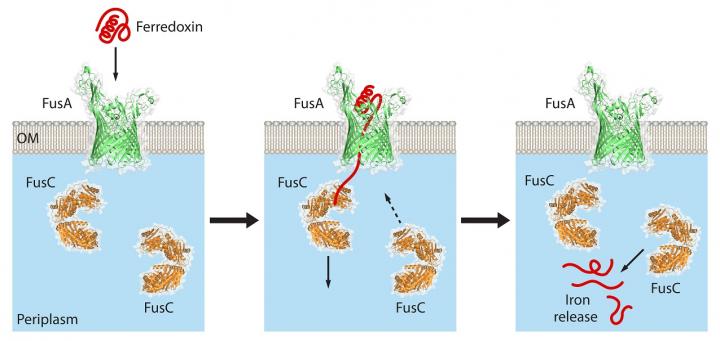
The authors propose that plant ferredoxin, a protein loaded with iron, is imported into the bacterial cell through a membrane channel called FusA; when it arrives in the cell interior FusC grabs it and dismembers the ferredoxin to release the iron. "This is the first example of bacterium taking a protein from its host, importing it into the bacterial cell then processing it inside the cell," Dr. Grinter said. Pectobacterium is of increasing scientific interest for its potential as a biological control agent against invasive weeds such as Allium triquetrum (angled onion), which can smother native ground flora such as orchids, lilies and grasses, leaving large infested areas bare of natural vegetation.
"Knowing exactly how the bacterium obtains iron adds to the knowledge needed to maximise the potential of Pectobacterium as a biocontrol agent," Dr. Grinter said. The study also reveals new insights into the evolution of this bacteria, finding that it 're-evolved' the iron-importing mechanism in a way that paralleled the protein import pathways evolved in mitochondria and chloroplasts, the energy centers of plant cells.
"Rhys' work is a remarkable example of how fundamental discoveries in biological science have far-reaching impact," senior author Prof. Trevor Lithgow said. "The study not only elucidates the mechanism of how this bacterium imports iron-loaded proteins, with its obvious practical applications, but also reveals a new paradigm for how bacteria evolve protein transport pathways in general. This will include the bacteria that infect humans and animals, not just plants," he said.
Adapted by PLOS Biology from release provided by Monash University.
###
Peer-reviewed/ Experimental Study/ Plants
In your coverage please use this URL to provide access to the freely available article in PLOS Biology: http://journals.plos.org/plosbiology/article?id=10.1371/journal.pbio.2006026
Citation: Grinter R, Hay ID, Song J, Wang J, Teng D, Dhanesakaran V, et al. (2018) FusC, a member of the M16 protease family acquired by bacteria for iron piracy against plants. PLoS Biol 16(8): e2006026. https://doi.org/10.1371/journal.pbio.2006026
Image Caption: Mechanism for the import of the plant protein ferredoxin (red) across the bacterial outer membrane and into the periplasm of Pectobacterium.
Image Credit: Trevor Lithgow, http://journals.plos.org/plosbiology/article?id=10.1371/journal.pbio.2006026
Funding: Australian Research Council (grant number FL130100038). Awarded to TL. The funder had no role in study design, data collection and analysis, decision to publish, or preparation of the manuscript. National Health & Medical Research Council (grant number 1092262). Awarded to TL, RAS, GD. The funder had no role in study design, data collection and analysis, decision to publish, or preparation of the manuscript. Wellcome Trust (grant number 106077/Z/14/Z). Sir Henry Wellcome Fellowship awarded to RG. The funder had no role in study design, data collection and analysis, decision to publish, or preparation of the manuscript.
Competing Interests: The authors have declared that no competing interests exist.
Media Contact
PLOS Biology
[email protected]
Related Journal Article
http://dx.doi.org/10.1371/journal.pbio.2006026