Researchers from Kiel control the size of molecular superstructures on surfaces
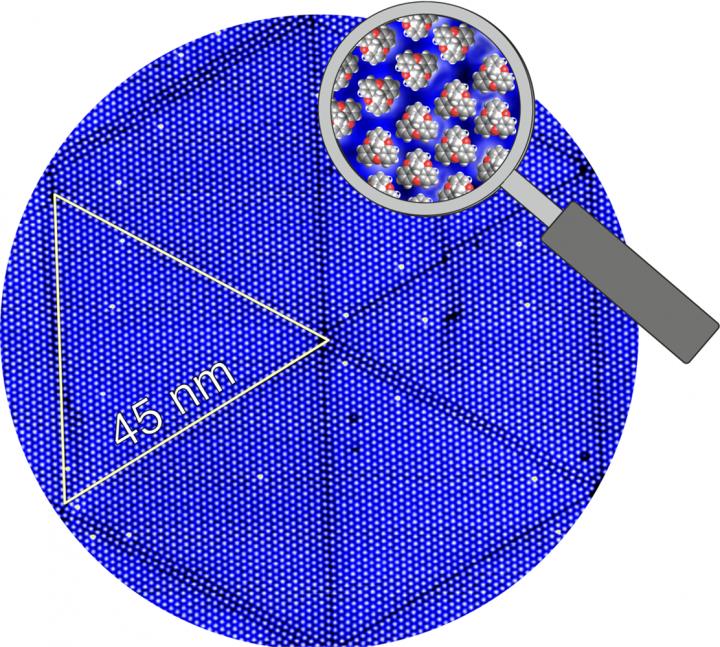
Credit: Manuel Gruber and Torben Jasper-Toennies
Most technical functional units are built bit by bit according to a well-designed construction plan. The components are sequentially put in place by humans or machines. Life, however, is based on a different principle. It starts bottom-up with molecular self-assembly. The crystallization of sugar or salt are simple examples of self-assembly processes, where almost perfect crystals form from molecules that randomly move in a solution. To better understand the growth of macroscopic structures from molecules, a research team of physicists and chemists of Kiel University has mimicked such processes with custom-made molecules. As recently reported in the journal Angewandte Chemie they fabricated a variety of patterns over a wide range of sizes including the largest structures reported so far.
The researchers deposited triangular molecules (methyltrioxatriangulenium) on gold and silver surfaces and observed their self-assembly into honeycomb superstructures using a scanning tunneling microscope. The structures are comprised of periodic patterns with controllable sizes. “Our largest fabricated patterns contain subunits of 3.000 molecules each, which is approximately 10 times more than previously reported”, says Dr. Manuel Gruber, a physicist from Kiel University. The team also developed a model of the intermolecular forces that drive the self-assembly. “The unique feature of our results is that we can explain, predict and even control their size”, Gruber continues.
The detailed understanding of the driving forces controlling the size of the patterns holds promises for nanotechnology applications, and in particular for functionalization of surfaces. It may be envisioned to tune various physical properties like electronic, optical or reactivity to gases of a material by controlling the size of the superstructures on its surface.
###
The work was supported by the German Research Foundation within the Collaborative Research Centre 677 “Function by Switching” and the Priority Program 1928 “Coordination Networks: Building Blocks for Functional Systems”.
Original publication:
T. Jasper-Toennies, M. Gruber, S. Ulrich, R. Herges and R. Berndt, Coverage?Controlled Superstructures of C3 Symmetric Molecules: Honeycomb versus Hexagonal Tiling, Angew. Chem. Int. Ed. https:/
Photos are available for download:
https:/
Caption: Scanning tunneling microscopy (STM) image of a self-assembly of triangular molecules on a silver surface. The repeated pattern (half of a pattern is indicated in yellow) has a size of 45 nanometers. Each dot corresponds to a molecule with a diameter of ~ 1nm.
Copyright: Manuel Gruber and Torben Jasper-Tönnies
Contact:
Prof. Dr. Rainer Herges
Otto Diels Institute of Organic Chemistry
Phone: +49 (0)431 880 2440
Mail: [email protected]
Web: http://www.
Dr. rer. nat. Manuel Gruber
Surface Physics
Phone: +49 (0)431 880 5091
Mail: [email protected]
Web: http://www.
More information:
Details, which are only a millionth of a millimetre in size: this is what the priority research area “Kiel Nano, Surface and Interface Science – KiNSIS” at Kiel University has been working on. In the nano-cosmos, different laws prevail than in the macroscopic world – those of quantum physics. Through intensive, interdisciplinary cooperation between physics, chemistry, engineering and life sciences, the priority research area aims to understand the systems in this dimension and to implement the findings in an application-oriented manner. Molecular machines, innovative sensors, bionic materials, quantum computers, advanced therapies and much more could be the result.
Media Contact
Dr. rer. nat. Manuel Gruber
[email protected]
49-043-188-05091
Original Source
https:/
Related Journal Article
http://dx.