• HOME
  • NEWS
  • EXPLORE
    • CAREER
      • Companies
      • Jobs
    • EVENTS
    • iGEM
      • News
      • Team
    • PHOTOS
    • VIDEO
    • WIKI
  • BLOG
  • COMMUNITY
    • FACEBOOK
    • INSTAGRAM
    • TWITTER
Thursday, June 25, 2026
BIOENGINEER.ORG
No Result
View All Result
  • Login
  • HOME
  • NEWS
  • EXPLORE
    • CAREER
      • Companies
      • Jobs
        • Lecturer
        • PhD Studentship
        • Postdoc
        • Research Assistant
    • EVENTS
    • iGEM
      • News
      • Team
    • PHOTOS
    • VIDEO
    • WIKI
  • BLOG
  • COMMUNITY
    • FACEBOOK
    • INSTAGRAM
    • TWITTER
  • HOME
  • NEWS
  • EXPLORE
    • CAREER
      • Companies
      • Jobs
        • Lecturer
        • PhD Studentship
        • Postdoc
        • Research Assistant
    • EVENTS
    • iGEM
      • News
      • Team
    • PHOTOS
    • VIDEO
    • WIKI
  • BLOG
  • COMMUNITY
    • FACEBOOK
    • INSTAGRAM
    • TWITTER
No Result
View All Result
Bioengineer.org
No Result
View All Result
Home NEWS Science News Biology

How light triggers brain activity

Bioengineer by Bioengineer
April 23, 2019
in Biology
Reading Time: 2 mins read
0
IMAGE
Share on FacebookShare on TwitterShare on LinkedinShare on RedditShare on Telegram

Protein research

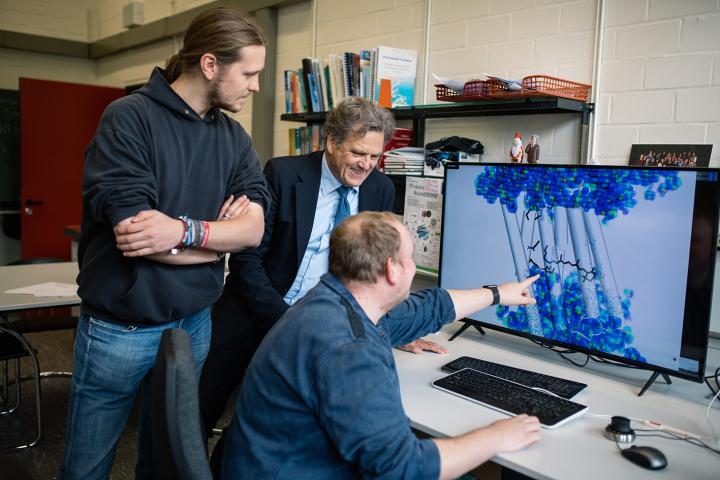
IMAGE

Credit: RUB, Kramer

Enormous therapeutic potential

Researchers consider optogenetics to have enormous therapeutic potential. “It is feasible that light might be used to make blind people see or to treat agitated paralysis in Parkinson’s patients,” explains Klaus Gerwert.

Discovered by Peter Hegemann, channelrhodopsin-2 is the central light-activated protein in optogenetics. If this ion channel is applied to nerve cells, the channels can be opened by light, thus activating the cell.

In the past scientists could not agree on how the channel is activated. “But it is precisely the understanding of the molecular reactions in the protein and of the ionic conductivity resulting thereof that is essential for optimising the protein for its potential applications,” says Gerwert.

Two parallel paths

With joined forces, the researchers from Bochum and Berlin figured out how the channel is activated in detail. By combining time-resolved Fourier Transform Infrared Spectroscopy, biomolecular simulations, and electrophysiological experiments, they demonstrated that photoexcitation triggers two different structures – and not, as previously assumed, only one. One of them results in the required channel activation that is used in optogenetics. The parallel path provides merely a weak proton stream; however, the longer exposure, the more it gains the upper hand and suppresses the required channel activation. Accordingly, the optogenetic tool soon starts to lose its effectiveness. “If we block the unwanted parallel path by implementing specific protein design, we could optimise the optogenetic tool considerably,” concludes Gerwert.

Conducting research into channelrhodopsin, the Bochum-based researchers drew on their extensive experience regarding the mechanism of the light-driven proton pump bacteriorhodopsin, which they solved in detail several years ago. “Just as in bacteriorhodopsin, protein-bound water molecules play a crucial role in proton conductivity,” explains Klaus Gerwert.

###

Funding

The project was funded by the German Research Foundation as part of the Priority Programme 1926 and Collaborative Research Centre 1078 as well as in the Cluster of Excellence Unifying Concepts in Catalysis and by the Berlin International Graduate School of Natural Science and Engineering.

Original publication

Jens Kuhne, Johannes Vierock, Stefan Alexander Tennigkeit, Max-Aylmer Dreier, Jonas Wietek, Dennis Petersen, Konstantin Gavriljuk, Samir F. El-Mashtoly, Peter Hegemann, Klaus Gerwert: Unifying photocycle model for light adaptation and temporal evolution of cation conductance in channelrhodopsin-2, in: PNAS, April 2019, DOI: 10.1073/pnas.1818707116

Media Contact
Klaus Gerwert
[email protected]

Original Source

https://news.rub.de/english/press-releases/2019-04-23-protein-research-how-light-triggers-brain-activity

Related Journal Article

http://dx.doi.org/10.1073/pnas.1818707116

Tags: BiologyBiomechanics/Biophysics
Share12Tweet8Share2ShareShareShare2

Related Posts

Natural Hallucinogens: Evolution’s Ecological Tools, Not Mere Chemical Byproducts

June 25, 2026

This Famous Butterfly Revealed: Three Distinct Species Hidden in One

June 25, 2026

Scientists Attack Soybean Cyst Nematode by Starving Its Food Source

June 25, 2026

Decoding the Secret Code of a Crucial Immune Sensor

June 24, 2026
Please login to join discussion

POPULAR NEWS

  • Saying Goodbye to PGY-6: Pediatric Fellowship Realities

    103 shares
    Share 41 Tweet 26
  • Multi-Hospital Study Reveals Long Covid Burden Is Twice as High as Current Estimates

    92 shares
    Share 36 Tweet 23
  • Detection of EDCs in Breast Milk and Infant Urine Up to Six Months Highlights Early Exposure Risks

    77 shares
    Share 31 Tweet 19
  • New Drug Candidate Developed at McMaster Shows Potential for Treating Brain Cancer

    58 shares
    Share 23 Tweet 15

About

We bring you the latest biotechnology news from best research centers and universities around the world. Check our website.

Follow us

Recent News

Tracking Lanthanide-Labeled Microplastics in Plants

POSTECH Researchers Slash Cost of Reconstituted Cell-Free Systems by 95%

AI and Physics Collaborate to Design Advanced Hydrogen Storage Materials

Subscribe to Blog via Email

Enter your email address to subscribe to this blog and receive notifications of new posts by email.

Join 82 other subscribers
  • Contact Us

Bioengineer.org © Copyright 2023 All Rights Reserved.

Welcome Back!

Login to your account below

Forgotten Password?

Retrieve your password

Please enter your username or email address to reset your password.

Log In
No Result
View All Result
  • Homepages
    • Home Page 1
    • Home Page 2
  • News
  • National
  • Business
  • Health
  • Lifestyle
  • Science

Bioengineer.org © Copyright 2023 All Rights Reserved.