• HOME
  • NEWS
  • EXPLORE
    • CAREER
      • Companies
      • Jobs
    • EVENTS
    • iGEM
      • News
      • Team
    • PHOTOS
    • VIDEO
    • WIKI
  • BLOG
  • COMMUNITY
    • FACEBOOK
    • INSTAGRAM
    • TWITTER
Friday, April 3, 2026
BIOENGINEER.ORG
No Result
View All Result
  • Login
  • HOME
  • NEWS
  • EXPLORE
    • CAREER
      • Companies
      • Jobs
        • Lecturer
        • PhD Studentship
        • Postdoc
        • Research Assistant
    • EVENTS
    • iGEM
      • News
      • Team
    • PHOTOS
    • VIDEO
    • WIKI
  • BLOG
  • COMMUNITY
    • FACEBOOK
    • INSTAGRAM
    • TWITTER
  • HOME
  • NEWS
  • EXPLORE
    • CAREER
      • Companies
      • Jobs
        • Lecturer
        • PhD Studentship
        • Postdoc
        • Research Assistant
    • EVENTS
    • iGEM
      • News
      • Team
    • PHOTOS
    • VIDEO
    • WIKI
  • BLOG
  • COMMUNITY
    • FACEBOOK
    • INSTAGRAM
    • TWITTER
No Result
View All Result
Bioengineer.org
No Result
View All Result
Home NEWS Science News Chemistry

How is ceviche ‘cooked?’ (video)

Bioengineer by Bioengineer
September 11, 2023
in Chemistry
Reading Time: 2 mins read
0
How is ceviche ‘cooked?’ (video)
Share on FacebookShare on TwitterShare on LinkedinShare on RedditShare on Telegram

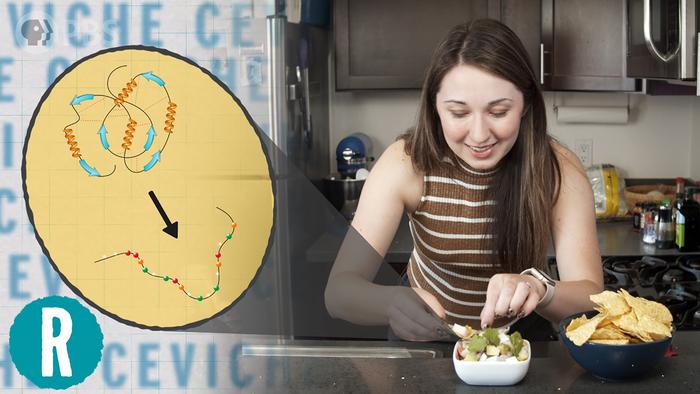
WASHINGTON, Sept. 11, 2023 — What does it mean to have “cooked” something? Is heat the only way to break down proteins and transform raw ingredients? If you love ceviche, you know that’s not true … but how exactly does ceviche get “cooked?” No heat source is used, but it still undergoes a process in which proteins are denatured. We’re taking a closer look at proteins, how they denature and what that means for the food on your plate. https://youtu.be/Pw6apr3TBzY?si=RdIYP5j3B0daGtxw
How is ceviche ‘cooked?’ (video)

Credit: The American Chemical Society

WASHINGTON, Sept. 11, 2023 — What does it mean to have “cooked” something? Is heat the only way to break down proteins and transform raw ingredients? If you love ceviche, you know that’s not true … but how exactly does ceviche get “cooked?” No heat source is used, but it still undergoes a process in which proteins are denatured. We’re taking a closer look at proteins, how they denature and what that means for the food on your plate. https://youtu.be/Pw6apr3TBzY?si=RdIYP5j3B0daGtxw

Reactions is a video series produced by the American Chemical Society and PBS Digital Studios. Subscribe to Reactions at http://bit.ly/ACSReactions and follow us on Twitter @ACSReactions.

The American Chemical Society (ACS) is a nonprofit organization chartered by the U.S. Congress. ACS’ mission is to advance the broader chemistry enterprise and its practitioners for the benefit of Earth and all its people. The Society is a global leader in promoting excellence in science education and providing access to chemistry-related information and research through its multiple research solutions, peer-reviewed journals, scientific conferences, eBooks and weekly news periodical Chemical & Engineering News. ACS journals are among the most cited, most trusted and most read within the scientific literature; however, ACS itself does not conduct chemical research. As a leader in scientific information solutions, its CAS division partners with global innovators to accelerate breakthroughs by curating, connecting and analyzing the world’s scientific knowledge. ACS’ main offices are in Washington, D.C., and Columbus, Ohio.

To automatically receive news releases from the American Chemical Society, contact [email protected].

Follow us: Twitter | Facebook | Instagram



Share12Tweet8Share2ShareShareShare2

Related Posts

Novel Domino Polymerization Enables Versatile, Degradable Polymers

Novel Domino Polymerization Enables Versatile, Degradable Polymers

April 3, 2026
Engineered Biochar Harnesses Soil Chemistry to Degrade Antibiotic Pollution

Engineered Biochar Harnesses Soil Chemistry to Degrade Antibiotic Pollution

April 2, 2026

From Coffee Waste to Cutting-Edge Biodegradable Insulation: A Green Innovation

April 2, 2026

Study Uncovers Early Origins of Atypical Alterations in Dalí’s The Temptation of St. Anthony (1946), Highlighting Crucial Roles of Amber and Zinc White

April 2, 2026

POPULAR NEWS

  • blank

    Revolutionary AI Model Enhances Precision in Detecting Food Contamination

    96 shares
    Share 38 Tweet 24
  • Imagine a Social Media Feed That Challenges Your Views Instead of Reinforcing Them

    1007 shares
    Share 398 Tweet 249
  • Promising Outcomes from First Clinical Trials of Gene Regulation in Epilepsy

    51 shares
    Share 20 Tweet 13
  • Popular Anti-Aging Compound Linked to Damage in Corpus Callosum, Study Finds

    44 shares
    Share 18 Tweet 11

About

We bring you the latest biotechnology news from best research centers and universities around the world. Check our website.

Follow us

Recent News

Obesity Links γδ T Cell Exhaustion in Type 2 Diabetes

Tech Workers Drive Ethnic, Class Urban Segregation

Space Travel: A Model for Accelerated Aging

Subscribe to Blog via Email

Enter your email address to subscribe to this blog and receive notifications of new posts by email.

Join 78 other subscribers
  • Contact Us

Bioengineer.org © Copyright 2023 All Rights Reserved.

Welcome Back!

Login to your account below

Forgotten Password?

Retrieve your password

Please enter your username or email address to reset your password.

Log In
No Result
View All Result
  • Homepages
    • Home Page 1
    • Home Page 2
  • News
  • National
  • Business
  • Health
  • Lifestyle
  • Science

Bioengineer.org © Copyright 2023 All Rights Reserved.