Credit: Credit: Hua Yang
BUFFALO, N.Y. — It's winter, and your head is stuffed up from the cold or flu. Everything sounds muffled.
If this has ever happened to you, you may have experienced conductive hearing loss, which occurs when sound can't travel freely from the outer and middle ear to the inner ear. Other common causes include ear infections in children, or a build-up of earwax in older adults.
Even short-term blockages of this kind can lead to remarkable changes in the auditory system, altering the behavior and structure of nerve cells that relay information from the ear to the brain, according to a new University at Buffalo study.
The research, published online Dec. 1 in the Journal of Neuroscience, looked at what happened when mice had their ears surgically blocked for a period of three days to over a week, dampening hearing.
"We wanted to know what happens at the brainstem, in the cells coming from the ear," says Matthew Xu-Friedman, PhD, the lead researcher and an associate professor of biological sciences in UB's College of Arts and Sciences.
"What we saw is that some significant changes do occur within a few days.
"What's still unclear, however, is whether the cells return to their normal state when acoustic conditions return to normal. We see in our research that the cells do seem to mostly bounce back, but we don't yet know whether they completely recover."
A smaller 'gas tank'
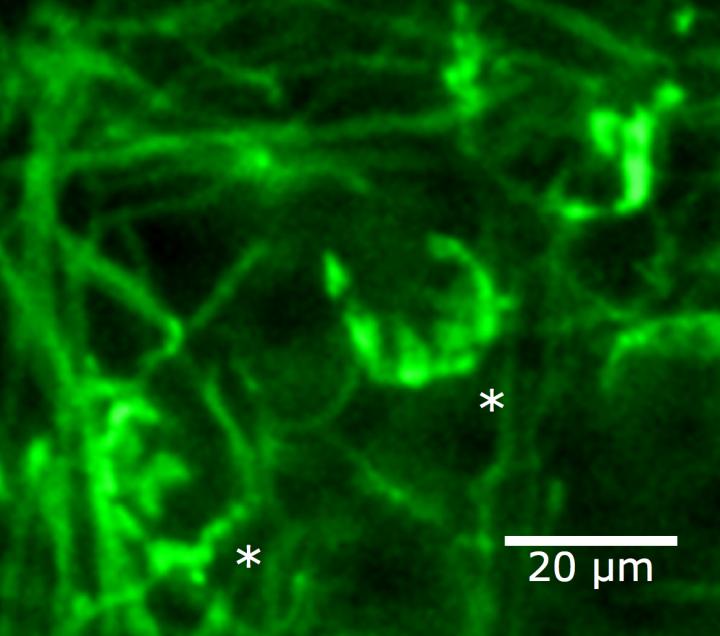
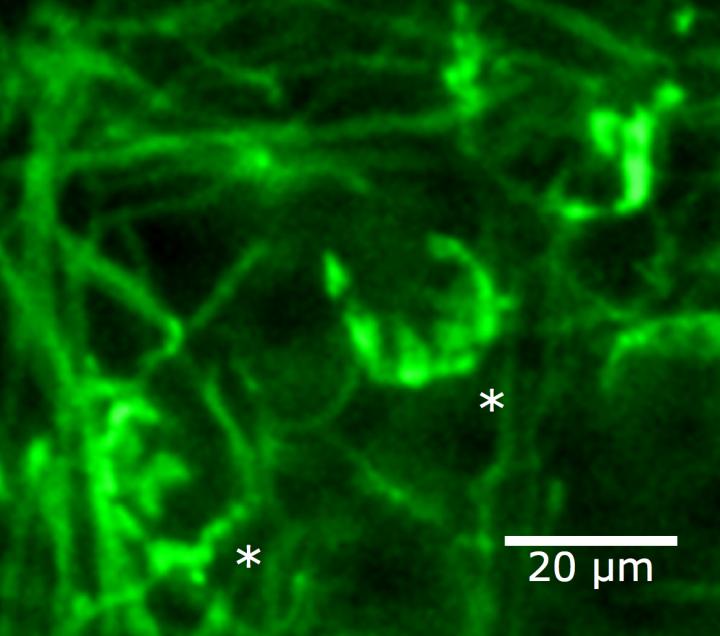
The changes the research team observed had to do with neurotransmitters — chemicals that help send signals from the ear to the brain.
In mice whose ears were blocked, cells in the auditory nerve started to use their supplies of neurotransmitter more freely. They depleted their reserves of these chemicals rapidly each time a new auditory signal came in, and they decreased the amount of space within the cells that housed sac-like structures called vesicles — biological storage tanks where neurotransmitter chemicals are kept.
"When it's quiet, the demands on the auditory nerve cells are not as great," Xu-Friedman says. "So it makes sense that you would see these changes: You no longer need as much neurotransmitter, so why invest in a lot of storage? If you're not that active, you don't need a big gas tank. And you're not as afraid to use up what you have. This is one plausible explanation for what we observed."
The changes in cellular structure and behavior were the opposite of what Xu-Friedman team's saw in a previous study that placed mice in a consistently noisy environment. In that project — faced with an unusually high level of noise — the mice's auditory nerve cells started to economize their resources, conserving supplies of neurotransmitter while increasing the storage capacity for the chemicals.
"It looks like these effects are two sides of the same coin, and they might be the first hints of a general rule that nerve cells regulate their connections based on how active they are," Xu-Friedman says.
Many questions remain
In the more recent study, cellular changes began to reverse themselves when the mice's ears were unplugged.
"When you undo the treatment, the cells start to go back to what they were like before," Xu-Friedman says. "However, it's not clear that they completely recover, so we need to do more research to see if that's the case."
He also wants to study what happens when cells are exposed to conductive hearing loss over and over again, as happens in some small children.
"When she was young, my daughter had ear infections constantly. It seemed like she would get one every time she had a cold," Xu-Friedman says. "I have no idea what this did to her hearing, whether there are lasting effects from this repeated plugging of the ears, or whether any impacts are temporary. If the nerve cells don't go back completely to the way they were, it could have a permanent influence on the way you perceive sound."
###
Xu-Friedman's co-authors on the paper were first author Xiaowen Zhuang, a UB PhD student in biological sciences, and Wei Sun, PhD, UB associate professor of Communicative Disorders and Sciences. The research was suported by the National Science Foundation.
Media Contact
Charlotte Hsu
[email protected]
716-645-4655
@UBNewsSource
http://www.buffalo.edu
############
Story Source: Materials provided by Scienmag