Leipzig. Intense fishing and overexploitation have led to evolutionary changes in fish stocks like cod, reducing both their productivity and value on the market. These changes can be reversed by more sustainable and far-sighted fisheries management. The new study by researchers from the German Centre for Integrative Biodiversity Research (iDiv), Leipzig University and the Institute of Marine Research in Tromsø, which was published in Nature Sustainability, shows that reversal of evolutionary change would only slightly reduce the profit of fishing, but would help regain and conserve natural genetic diversity.
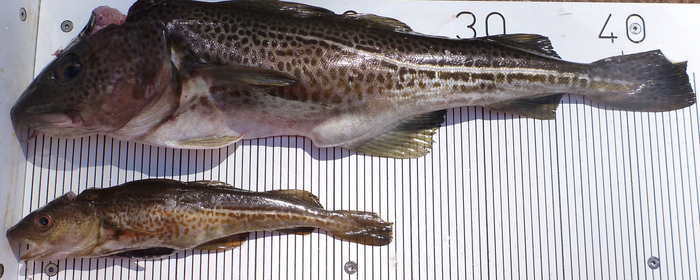
Credit: Jan Dierking, GEOMAR Helmholtz Centre for Ocean Research Kiel
Leipzig. Intense fishing and overexploitation have led to evolutionary changes in fish stocks like cod, reducing both their productivity and value on the market. These changes can be reversed by more sustainable and far-sighted fisheries management. The new study by researchers from the German Centre for Integrative Biodiversity Research (iDiv), Leipzig University and the Institute of Marine Research in Tromsø, which was published in Nature Sustainability, shows that reversal of evolutionary change would only slightly reduce the profit of fishing, but would help regain and conserve natural genetic diversity.
The impact of global fisheries on marine ecosystems is severe: fish stocks have declined and the degradation of marine habitats as well as the loss of biodiversity have been accelerated. Less visible, intense fishing has also affected the age and size structure of fish stocks and caused evolutionary change, often towards lower growth rates, smaller maturation sizes and earlier reproduction age. For example, cod in the North Sea, which has been heavily exploited in the past, matures at sizes just above 50 cm, compared to more than 70 cm expected in an unfished population.
Earlier reproduction can increase stock resilience in the short-term, but over time results in populations with smaller fish that have less offspring. “At the end of the day, this can reduce both the productivity of a stock and the value on the market,” says first author Hanna Schenk from iDiv and Leipzig University. “Apart from this, we don’t know much about potential consequences such as trophic cascades and other ecosystem changes that feed back onto the harvested species and may interfere with critical ecological functions.”
Only long-term planning can reverse evolutionary decline
But evolution is not a one-way street. This is why the researchers from iDiv, Leipzig University and the Institute of Marine Research in Tromsø (Norway) wanted to find out what it takes to reverse evolutionary decline after decades of intensive exploitation, in particular with regard to planning horizons in fisheries management. For this, they developed a model that took various processes into account: Biological growth and reproduction as well as economic harvesting costs and consumer preferences. The researchers also analysed potential trade-offs between economic profit and conservation targets.
They found that evolutionary decline is profitable to reverse under century-long planning horizons. With more typical short-term planning, stock recovery in terms of biomass is achieved, but evolutionary decline continues, albeit at much lower rates. “Fisheries typically consider short planning horizons of a few years. This stands in contrast to long-term sustainability and biodiversity targets”, says Hanna Schenk. The researchers found that more far-sighted planning horizons would help to rebuild the stock but evolutionary decline continues. According to Schenk, reversing this process takes much longer than the recovery of the stock biomass and is only achieved with century-long planning horizons.
Appropriate conservation targets only slightly reduce profit
The researchers also show that setting conservation targets for restoring not only fish stocks, but also their genetic composition would only slightly reduce profits. The cost and time of evolutionary reversal could be reduced further if fisheries can select fish depending on their genes, which may be possible to some extent by choosing the time and place of harvest. However, current conservation agendas do not include the restoration of genetic diversity, for example target 14 of the Sustainable Development Goals (SGDs), which calls for an end to overfishing.
“More selective fishing could reverse evolutionary decline in the long term”, says senior author Professor Martin Quaas from iDiv and Leipzig University. Economic incentives alone may not be sufficient to achieve these sustainability goals, which is why genetic diversity and conservation should be included explicitly in sustainable development goals and UN biodiversity targets. “From an economist’s perspective, fishing should have largely avoided undesired evolutionary changes. Now that these changes have taken place, they are costly to reverse in the short run, but in the long run, this would pay off in economic terms.”
Journal
Nature Sustainability
DOI
10.1038/s41893-023-01078-9
Method of Research
Computational simulation/modeling
Subject of Research
Not applicable
Article Title
The Economics of reversing fisheries-induced evolution
Article Publication Date
16-Mar-2023