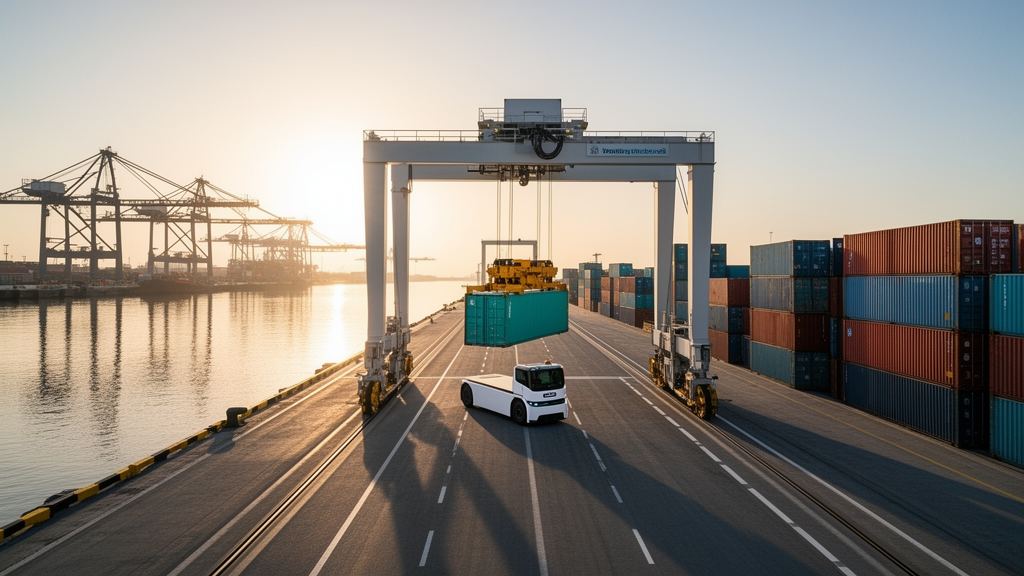
Researchers Yihan Liu and Rauno Heikkilä have published a comprehensive structured literature review in European Transport Research Review evaluating equipment-level port automation. While previous investigations predominantly emphasized overarching terminal-level smart port architectures, this study provides a detailed device-level analysis of how individual machines—such as quay cranes, automated guided vehicles, and automated stacking cranes—evolve, interact, and coordinate across modern container terminals. Moving beyond historical reliance on standalone mechanical hardware, contemporary terminals are steadily transitioning toward data-driven, cyber-physical ecosystems where artificial intelligence, Internet of Things sensors, and digital twin simulations govern physical workflows. By synthesizing evidence from dozens of core conceptual and empirical publications, the researchers reveal that substantial operational gains stem not merely from advancing the standalone autonomy of single machines, but from establishing predictable, synchronized hand-offs across heterogeneous equipment interfaces. This operational shift directly addresses mounting trade pressures, enabling maritime facilities to handle increasing container volumes and larger vessels while reducing carbon emissions and enhancing workplace safety.
To systematically assess technological progression across diverse machinery categories, the authors adapted the widely recognized SAE J3016 vehicle automation taxonomy into a dedicated five-level framework for container port operations. Under this standardized scheme, Level 1 designates fully manual operations where human operators directly maneuver conventional machines, such as traditional reach stackers. Level 2 introduces operator assistance systems, including mechanized features like anti-sway controls on quay cranes and tele-operated yard tractors, which the authors explicitly distinguish as human-computer interaction rather than autonomous driving. Level 3 encompasses semi-automation, where machinery executes designated tasks autonomously within tightly restricted, structured zones while remaining under human supervision, exemplified by automated stacking cranes operating within dedicated yard blocks. Level 4 represents high automation, permitting machines like automated guided vehicles to operate across broader terminal areas with human intervention needed only during rare exceptions. Finally, Level 5 describes complete full automation, where heterogeneous machines execute end-to-end workflows across mixed-traffic yards under pure oversight or emergency control.
Establishing this comprehensive evaluation required an objective three-stage literature screening workflow that drew primarily upon the Web of Science database between January 2010 and February 2025. The initial query targeted peer-reviewed English journal articles and reviews using fielded conditions combining port-related title terms, automation expressions, and equipment terminology, initially identifying 705 relevant records. Cross-checking these parameters against Scopus, IEEE Xplore, and Google Scholar confirmed that no additional core review articles on equipment-level automation were omitted. The second phase eliminated non-port domains such as mining, warehouses, and factories, retaining 494 records within pertinent transportation and engineering disciplines. These records were systematically evaluated using three specialized keyword counters focused on conceptual contributions, equipment types, and integration or sustainability, preserving the top scoring quartile of 124 publications for bibliometric mapping. Full texts were subsequently evaluated using a four-dimensional scoring rubric measuring equipment depth, conceptual contribution, integration or sustainability, and transferability, yielding a refined core of 47 articles for qualitative thematic synthesis.
Triangulating these findings involved keyword co-occurrence analysis via VOSviewer, qualitative thematic coding using NVivo, and Python-driven term-frequency analysis across the broader 705-record corpus. The bibliometric mapping demonstrated that while general review literature is heavily dominated by broad terminal-level concepts such as container terminal operations and algorithmic optimization, machine-specific terms appear only within distinct, specialized clusters. Qualitative coding of the 47-article core established five cross-cutting categories: technological innovation, sustainability, interoperability, human-machine collaboration, and system-level integration. Stability was confirmed through pilot evaluations and a stability recode demonstrating intra-coder agreement of at least 85 percent. Meanwhile, longitudinal term-frequency counts revealed steady growth in research dedicated to fully automated systems, which now outpaces discussions of traditional mechanized equipment. Geographically, research output has surged dramatically in Asia in recent years while remaining consistently elevated across Europe. Corpus-wide topic distributions indicated heavy concentrations in scheduling, dispatch, energy management, and conflict avoidance, while perception-heavy subjects like computer vision and simultaneous localization and mapping remain relatively under-represented.
In tracing specific equipment trajectories, the review documents how quay cranes evolved from manual cabs requiring seasoned operators to overcome wind shifts and vessel movement into sophisticated AI-assisted systems. Early electro-mechanical updates in the 1980s integrated anti-sway features, followed by remote-control camera stations in the early 2000s, while contemporary units deploy cameras, lidar, and infrared detectors to pinpoint container positions accurately. Modern cranes, such as those installed at the Antwerp Gateway terminal, interface directly with terminal operating systems to dynamically modulate crane velocity based on vessel schedules and yard capacity, using continuous wear monitoring for predictive maintenance. Where human-driven yard trucks once dominated quayside transfers, early automated guided vehicles emerged on rigid magnetic or embedded tracks. By the mid-2010s, sensor fusion, radar, and reinforcement learning enabled dynamic routing. Over the past three years, widespread electrification has accelerated, seen in autonomous straddle carriers and battery-electric fleets at facilities like Singapore’s Tuas Port that recharge automatically during off-peak windows.
Automated stacking cranes have similarly transformed from rigid, PLC-governed machines into adaptive, data-centric yard management engines that balance storage density and throughput. In early deployments during the 1990s, automated yard cranes relied on basic programmable logic controllers, leaving critical sequencing decisions to human dispatchers. By the mid-2010s, terminals deployed advanced allocation algorithms that evaluated dwell durations, vessel departure times, and outbound schedules to minimize yard congestion. Recent advancements highlight three foundational developments: the integration of digital twins to simulate alternative stacking configurations without operational interruption, the adoption of artificial-intelligence-driven smart stacking that segregates high-turnover containers from long-term storage to curtail crane travel, and tighter coordination between stacking cranes and automated guided vehicles.
Despite rapid automation in quay and yard crane corridors, the review emphasizes that conventional yard vehicles—including reach stackers, terminal tractors, and wheel loaders—remain significantly neglected in academic literature and commercial deployment. These utility machines continue to operate predominantly between Level 2 operator assistance and Level 3 semi-automation, constrained by the highly irregular, unstructured environments in which they function. Unlike cranes moving along fixed rails or automated guided vehicles traversing designated pathways, utility vehicles must execute complex manipulation tasks, such as container lifting, trailer hookup, and coupling, within cluttered, mixed-traffic zones shared with human workers. While computer-vision assistance and automated reach stacker prototypes have emerged, alongside autonomous terminal tractor trials and restricted wheel loader tests, real-world deployment remains constrained. Key engineering hurdles include dynamic collision avoidance, precise mechanical manipulation, continuous low-latency wireless communication, and an absence of unified interface standards, though emerging frameworks like VDA 5050 seek to standardize control communications across heterogeneous vehicle fleets.
Expanding beyond primary cargo-handling machines, ports increasingly turn to specialized autonomous systems to handle hazardous maintenance and vessel mooring duties. Historically, inspecting massive quayside infrastructure, gantry structures, and submerged berths required human personnel to scale towering heights or execute dangerous underwater dives, frequently triggering complete operational shutdowns. The literature reveals a notable surge in maintenance robotics research since 2021, driven by unmanned aerial vehicles and remotely operated underwater vehicles equipped with advanced artificial intelligence perception.
As individual machines become increasingly sophisticated, the authors argue that terminal performance hinges primarily upon cross-cutting enablers: system interoperability, deterministic network communications, and cybersecurity resilience. Proprietary vendor ecosystems, non-standardized application programming interfaces, and fragmented data schemas frequently impede end-to-end automation, forcing disparate machines to operate with disconnected logic. To resolve these friction points, ports require open APIs, vendor-neutral middleware, and standardized data models that align timestamps, message syntax, and event semantics across quay, vehicle, and yard layers. Furthermore, wireless network instability represents a critical vulnerability, as signal jitter and unpredictable latency can destabilize remote crane control and vehicle trajectory coordination. Recent industry workshops involving major technology providers like Kalmar highlight that automation requires robust, deterministic network architectures that prioritize real-time control traffic over best-effort data streams. Simultaneously, increased network connectivity amplifies exposure to cyber threats, where malicious interruptions to crane controllers or dispatch algorithms could paralyze terminal operations, necessitating layered defenses, multi-factor authentication, and anomaly detection focused on system availability.
Synthesizing these insights for European port authorities, the review underscores that terminal modernization should follow an interface-first deployment strategy rather than chasing isolated machine autonomy. Because the majority of European developments occur within brownfield sites characterized by legacy infrastructure and mixed-traffic constraints, planning must prioritize stable hand-off procedures, verified interoperability standards, and charging-aware scheduling algorithms that harmonize electric equipment dispatch with local grid capacities. The authors acknowledge key study limitations, including the reliance on English-language Web of Science records, single-researcher qualitative coding, and a persistent scarcity of multi-vendor operational data for automated mooring and mixed-traffic vehicles. Looking ahead, the researchers call for the publication of de-identified multi-vendor event logs and standardized key performance indicators, the establishment of rigorous commissioning test suites covering data schemas and latency envelopes, and focused field pilots evaluating automated yard vehicles under realistic operational conditions, ensuring future maritime infrastructure achieves both operational reliability and environmental sustainability.
Subject of Research: Equipment-level automation developments and integration challenges in container ports
Article Title: Port automation equipment: current developments, challenges, and future directions
Article References: Liu, Y., & Heikkilä, R. (2026). Port automation equipment: current developments, challenges, and future directions. European Transport Research Review, 18(1), Article 66. https://doi.org/10.1186/s12544-026-00816-2
Image Credits: AI Generated
DOI: 10.1186/s12544-026-00816-2
Keywords: port automation, container terminals, quay cranes, automated guided vehicles, automated stacking cranes, terminal operating systems, interoperability, maritime logistics, Port, automation, equipment, current
News Source: Denise Maddox. (November 10, 2026). How Equipment Level Port Automation Reshapes Maritime Cargo Operations. Scienmag.