Credit: SHI Aijuan
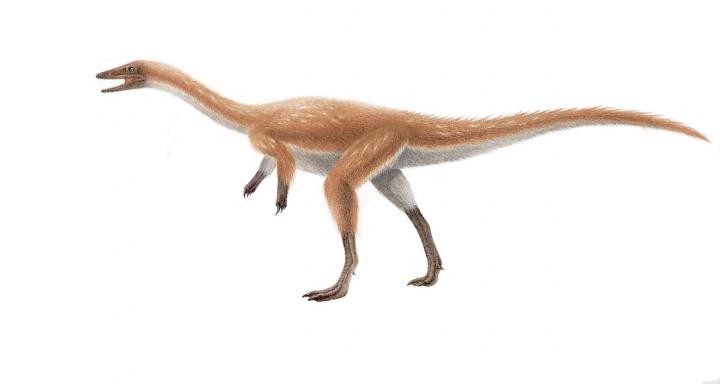
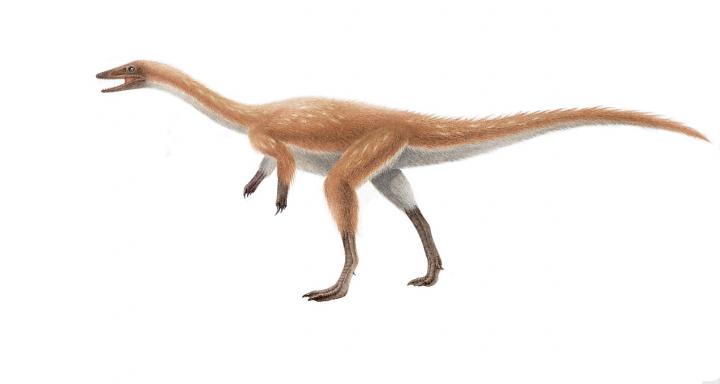
Digit reduction occurs many times in tetrapod evolution, and the most famous example is the 'horse series' of North America. An international research team announced the discovery of two new Chinese dinosaurs: Bannykus and Xiyunykus, in the journal Current Biology, which shed light on how alvarezsaurian dinosaurs reduced and lost their fingers.
The new dinosaurs are based on two fossils collected by a joint research team led by XU Xing from the Institute of Vertebrate Palaeontology and Palaeoanthropology (IVPP) of the Chinese Academy of Sciences. Xiynykus was discovered in 2005 in Zhunggar Basin, northwestern China, and Bannykus was discovered a few years later in 2009 in western Inner Mongolia, north-central China.
The new Alvarezsaurian dinosaurs are among the most bizarre groups of theropods, with extremely short, robust forelimbs with a single functional claw and gracile, bird-like skulls and hindlimbs. These specializations have led to controversy about their phylogenetic placement, biogeographic history, and ecological role in Mesozoic ecosystems.
AT early times, unspecialized alvarezsaur fossils were the key to resolving this controversy, but until recently the group had at least a 90 million year gap in its fossil record, especially during the Early Cretaceous.
The new dinosaurs fall nearly at the midpoint of the 90-million year temporal gap between the earliest and latest alvarezsaurs. They contribute key phylogenetic and biogeographic information that firmly resolves Alvarezsauria as a monophyletic clade originating in Asia and dispersing to other continents.
The new findings show that clear anatomical specializations also present in later members of the clade, such as a hypertrophied first digit, mechanically efficient forearm, and robust humerus. However, they preserve plesiomorphic forelimb proportions not present in later-branching members.
Together, these observations document a major macroevolutionary shift from the plesiomorphic theropod condition of a relatively long arm and grasping hand in the earliest alvarezsaurs (e.g., Haplocheirus), to a long arm with a specialized hand in Bannykus and Xiyunykus, to the highly specialized short-limbed, functionally monodactyl hand in the latest evolving members of the clade. "This transition plays out in an incremental fashion over more than 50 million years," said XU, "it could one day potentially serve as a classic example of macroevolution akin to the 'horse series' of North America." "Alvarezsaurs are weird animals," said Dr. Jonah Choiniere from the University of the Witwatersrand of South Africa, a co-author of the report, "with their strong, clawed hands and weak jaws, they appear to be the dinosaurian analogue to today's aardvarks and anteaters."
But the earliest alvarezsaurs had more typical, meat-eating teeth and hands useful for catching small prey, and only later-evolving alvarezsaurs evolved a hand with a huge, single claw capable perhaps of tearing open rotting logs and anthills. Bannykus and Xiyunykus are important because they show transitional steps in the process of alvarezsaurs adapting to new diets. "The fossil record is the best source of information about how anatomical features evolve," said James Clark from George Washington University, "and like other classic examples of evolution such as the 'horse series,' these dinosaurs show us how a lineage can make a major shift in its ecology over time."
Dr. Roger Benson from the University of Oxford said, "The new fossils have long arms, showing that alvarezsaurs evolved short arms only later in their evoutionary history, in species with small body sizes. This is quite different to what happens in the classic example of tyrannosaurs, which have short arms and giant size."
###
Media Contact
XU Xing
[email protected]
http://english.cas.cn/
Original Source
http://english.cas.cn/