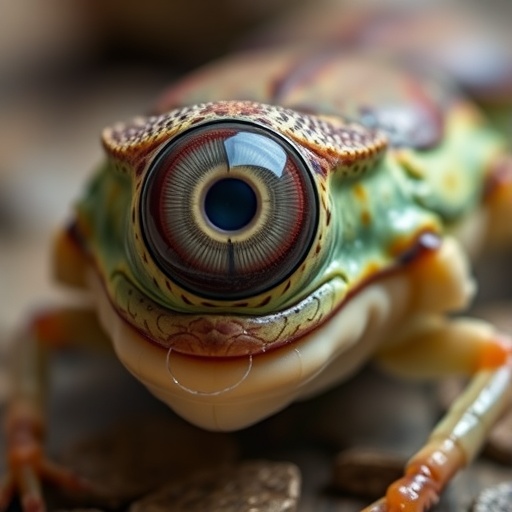
Recent groundbreaking research has upended long-standing beliefs about the evolutionary origins of the vertebrate eye, revealing an astonishing ancestral legacy shared by all vertebrates—including humans—that traces back nearly 600 million years. Scientists from Sweden’s Lund University, in collaboration with the University of Sussex, have unearthed compelling evidence demonstrating that the vertebrate eye evolved from a peculiar cyclopean ancestor possessing a single, median eye atop its head. This remarkable finding challenges traditional views and provides profound new insights into sensory biology and brain evolution.
The ancestor at the heart of this revelation was an inconspicuous, worm-like creature with a sedentary lifestyle, feeding by filtering microscopic plankton from ancient seas. Unlike the diverse paired eyes commonly found across many animal phyla, this primordial organism lacked the usual bilateral arrangement of eyes. Instead, it retained a singular, centralized light-sensitive organ—the median eye—that served rudimentary but essential functions such as regulating circadian rhythms and spatial orientation.
Dan-E Nilsson, professor emeritus at Lund University and lead author of the study, highlights the startling implications of the findings: “Our results invert the classical understanding of eye evolution and the complexities of neural development in vertebrates.” Unlike insects and cephalopods, whose eyes originate from epidermal tissues and develop externally, the vertebrate retina uniquely derives from neural tissues embryonically linked to the brain itself. This evolutionary detour, mediated by the ancient median eye, accounts for fundamental structural and functional distinctions that have long puzzled biologists.
The cyclopean ancestor’s evolutionary trajectory began with paired eyes which were subsequently lost as the creature’s lifestyle calmed, negating the immediate need for complex visual organs. The single median eye remained, consisting of photoreceptive cells capable of detecting light intensity and directionality, essential for maintaining the fundamental day-night cycle in its environment. Such a simplified organ represented a functional compromise: eliminating the resource-intensive complexity of paired eyes while preserving essential light sensitivity.
Over millions of years, environmental pressures shifted, driving this distant relative back to an active, mobile lifestyle that necessitated renewed visual acuity. Intriguingly, the research suggests that through a process of repurposing and developmental innovation, paired image-forming eyes emerged anew from portions of the ancestral median eye rather than evolving independently. This evolutionary novelty underscores the median eye’s pivotal role in vertebrate visual system elaboration.
Mechanistically, the vertebrate retina’s neural architecture exhibits a unique origin; it is evolutionarily an outgrowth of the brain’s forebrain region, as opposed to surface ectodermal derivatives seen in other eye types. Consequently, vertebrate eyes are equipped with complex layered structures—rods, cones, bipolar cells, ganglion cells—that enable sophisticated image processing directly within the eye, feeding integrated signals to the brain’s visual centers.
Further highlighting the evolutionary continuity, remnants of the median eye persist in modern vertebrates as the pineal gland—an enigmatic, light-sensitive structure within the brain. This gland synthesizes melatonin, a hormone integral to modulating circadian rhythms and sleep-wake cycles, providing a molecular and functional link to the ancient light-sensing organ. Nilsson marvels at this connection, emphasizing the “mind-boggling” persistence of this primordial feature that regulates fundamental biological rhythms in humans today.
The study’s conclusions are founded on comprehensive comparative analyses of light-sensitive cell types across a broad spectrum of animal taxa, scrutinizing their physiological roles, anatomical placements, and developmental genetics. This integrative approach not only elucidates the morphological transformations from median to paired eyes but also clarifies the neural circuit evolution responsible for visual signal transduction and interpretation within vertebrate retinas.
These insights redefine the evolutionary narrative for the vertebrate visual system, providing a cohesive framework that resolves longstanding enigmas regarding the dichotomy between vertebrate and invertebrate eye development. For instance, the distinct embryological origins explain why invertebrate eyes lack the layered, centralized neural processing found in vertebrates, resulting in variations in visual acuity, field of view, and functionality adapted to each lineage’s ecological needs.
The implications extend beyond basic science, potentially influencing biomedical fields exploring developmental eye disorders and neurodegenerative diseases affecting vision. Understanding the evolutionary provenance of retinal structures and neural pathways may open avenues for regenerative medicine, whereby ancestral genetic programs could be harnessed to restore or replicate intricate visual functions.
Moreover, this evolutionary perspective invites broader reflection on how sensory systems evolve through complex pathways involving loss, repurposing, and innovation. The once-overlooked median eye, often regarded as a vestigial or rudimentary organ, now emerges as a cornerstone of vertebrate eye evolution. Its legacy strings through hundreds of millions of years to connect primitive aquatic life forms to the sophisticated visual capacities of modern vertebrates, including humans.
In sum, the discovery of the vertebrate eye’s origins from a single median eye in a cyclopean ancestor commands a reevaluation of sensory biology textbooks and highlights the deep evolutionary roots that shape our own perception of the world. This narrative of evolutionary innovation—loss followed by creative repurposing—embodies the dynamic complexity of life’s history, exemplifying how ancient adaptations continue to influence current biological functions.
Subject of Research: Evolutionary origins of the vertebrate eye and brain visual circuits
Article Title: Evolution of the vertebrate retina by repurposing of a composite ancestral median eye
Web References: 10.1016/j.cub.2025.12.028
Keywords: Vertebrate eye evolution, median eye, pineal gland, retina development, circadian rhythm, sensory biology, Dan-E Nilsson, neural circuits, image processing, photoreceptors, evolutionary neurobiology, ancestral sensory organs
Tags: ancestral eye originsancestral sensory organ evolutionbrain evolution in animalscircadian rhythm regulation in ancient speciesevolution of vertebrate eyesevolutionary biology discoveriesLund University eye researchmedian eye in vertebratesone-eyed cyclopean ancestorsensory biology researchsingle median eye functionvertebrate eye development