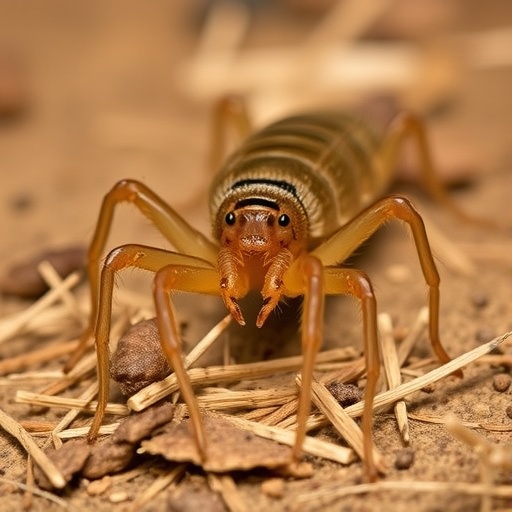
In a remarkable new study, researchers Barutia and Sombke focus on the intriguing world of house centipedes, specifically the species Scutigera coleoptrata, and present evidence of their extraordinary capacity for regeneration and unique growth patterns. This article, published in Front Zool, unveils the mechanisms behind the centipede’s ability to regenerate lost limbs and the processes that govern their unusual anamorphic development. The results are not only a source of fascination for zoologists and entomologists but also challenge existing paradigms of regeneration in arthropods.
House centipedes, with their long, segmented bodies and numerous legs, have always piqued scientific interest. What sets Scutigera coleoptrata apart from other arthropods is its capability to regenerate lost limbs with astonishing efficiency. This capability raises numerous questions about the biological processes involved in regeneration and how these processes might be exploited for scientific advancements in regeneration research. The researchers’ examination provides a comprehensive overview of the cellular and molecular underpinnings of limb regeneration in these creatures, presenting vital insights that may answer long-standing questions in the field of regenerative biology.
The study elucidates how Scutigera coleoptrata exhibits not merely a regenerative ability but an explosive one. The speed and efficiency with which these centipedes can regrow lost legs are impressive. Using state-of-the-art imaging techniques and genetic analyses, Barutia and Sombke explore the various stages of limb regeneration. They identify significant cellular behaviors and growth factors that are activated during limb regrowth, suggesting a complex interplay of biological signals that facilitate rapid healing and reconstruction of these structures.
Another fascinating aspect of this research is the exploration of anamorphosis—the process where an organism grows and develops by sequentially adding segments. In the case of house centipedes, this process manifests as the shedding of exoskeletons and the emergence of new limbs, which are vital for their survival and mobility. The work highlights that their regenerative abilities extend not just to one segment at a time but can involve multiple limbs regenerated simultaneously, revealing a remarkable level of biological control and adaptation.
The findings presented by Barutia and Sombke also delve into the evolutionary implications of such regenerative capabilities. This research suggests that the remarkable regeneration in Scutigera coleoptrata might be a result of evolutionary pressures that favored survival traits among centipedes. Understanding the evolutionary framework behind these traits could provide a pivotal context for future studies aimed at uncovering how regeneration evolved across different species and taxa, enhancing our comprehension of evolutionary biology.
Moreover, the implications of this research extend beyond the realm of entomology. The potential applications of regenerative biology gleaned from centipedes are vast, ranging from medical advances in limb regeneration for humans to exploring tissue repair mechanisms in other organisms. By examining how Scutigera coleoptrata mobilizes its regenerative pathways, researchers hope to discern biological mechanisms that could potentially be translated into regenerative medicine, an area that holds great promise for future therapeutic interventions.
This research adds another intricate layer to our understanding of how life adapts to predation and environmental stressors. In the complex web of life, Scutigera coleoptrata demonstrates resilience through its regenerative adaptations, allowing it not only to survive but to thrive in various habitats, from damp basements to decaying leaf litter. By investigating the developments within this species, the researchers shed light on the ecological dynamics of ecosystems where these centipedes play a crucial role as both predators and prey.
As the study gains traction, it promises to inspire a new generation of scientists interested in the fields of regenerative medicine and evolutionary biology. The academic community’s attention is now captivated by the enigmatic life cycle of house centipedes, leading to exploratory research on their behaviors and adaptations. Their regenerative prowess may hold keys to understanding not only arthropod biology but also the fundamental questions surrounding growth, adaptation, and survival in the animal kingdom.
In conclusion, the research led by Barutia and Sombke serves as a significant contribution to the field of zoology, providing essential insights into the explosive regenerative abilities and anamorphic development of Scutigera coleoptrata. As researchers continue to decode the mysteries of limb regeneration, the hope is to unlock the potential for similar biological phenomena in other species through comparative studies, bridging the gap between arthropods and higher organisms. This pioneering work promises to set the stage for an exciting future in understanding regeneration, providing a deeper appreciation for the extraordinary capabilities inherent within the animal kingdom.
The exploration of such an exciting topic exemplifies the richness of biodiversity and the wonders that lie within mechanisms of survival and adaptation. The study reaffirms the age-old adage that nature is often the best teacher, encouraging researchers to delve deeper into the myriad forms of life that share our planet.
The groundbreaking findings on Scutigera coleoptrata are bound to resonate across various academic fields, opening a plethora of research avenues that may transform our understanding of both evolutionary processes and regenerative biology. As more light is shed on these intriguing centipedes, the implications of this research will undoubtedly ripple through scientific discourse, paving the way for future innovations inspired by nature’s marvels.
Subject of Research: House centipede regeneration mechanisms
Article Title: Explosive regeneration and anamorphic development of legs in the house centipede Scutigera coleoptrata
Article References:
Barutia, I., Sombke, A. Explosive regeneration and anamorphic development of legs in the house centipede Scutigera coleoptrata. Front Zool 21, 23 (2024). https://doi.org/10.1186/s12983-024-00544-0
Image Credits: AI Generated
DOI: https://doi.org/10.1186/s12983-024-00544-0
Keywords: regeneration, Scutigera coleoptrata, anamorphosis, evolutionary biology, tissue repair, arthropods.
Tags: arthropod limb regeneration studiesbiological processes of regenerationcellular mechanisms of regenerationentomology and regenerationhouse centipede regenerationmolecular insights into limb regenerationrapid limb regrowth in arthropodsregenerative biology researchscientific advancements in regenerationScutigera coleoptrata growth patternsunique growth in centipedeszoology of house centipedes