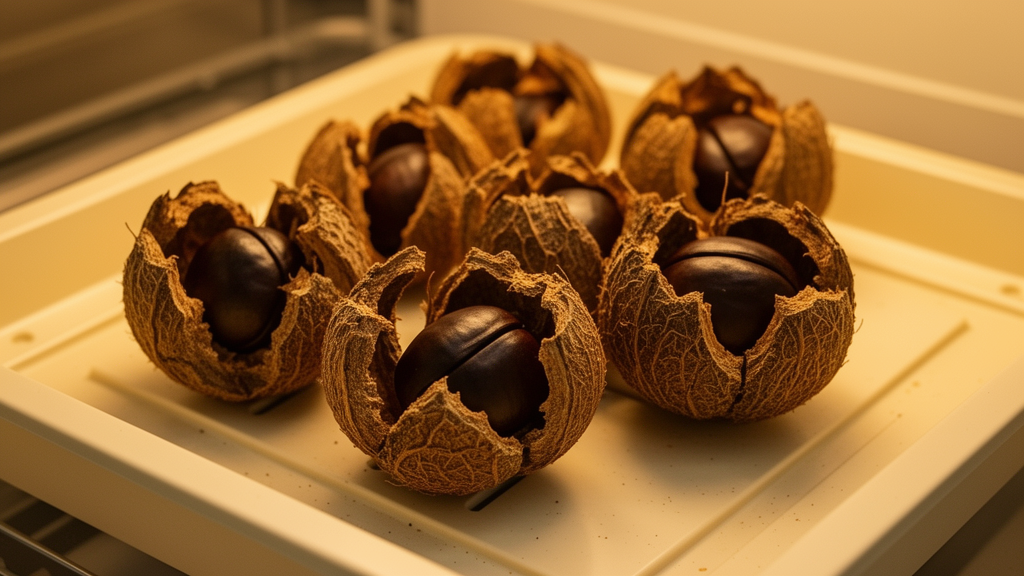
Drying Camellia oleifera fruit under hot air at seventy degrees Celsius substantially speeds up shell explosion and reaches a complete cracking rate while starting forty-four percent earlier than processing at fifty degrees Celsius, according to a systematic study of moisture migration dynamics published in Food Production, Processing and Nutrition. The investigation revealed that the shell explosion rate achieved at fifty degrees Celsius reached only eight point three percent of the level attained at seventy degrees Celsius after four hundred and twenty minutes of drying, demonstrating the decisive role of operational temperature in controlling physical rupture. Agricultural engineers constructed a specialized hot air drying system to monitor heat and mass transfer within the fruit shell, tracking the evolution of internal moisture content, surface steam partial pressure, moisture binding energy, and volumetric shrinkage.
The spherical fruit consists of protective outer pericarp shells wrapping inner seeds that contain substantial concentrations of fats, starches, and proteins utilized for commercial oil extraction. Historically, farmers relied on direct solar radiation over three to five days to dry harvested fruit until the shells naturally ruptured along longitudinal seams, releasing intact seeds without internal mechanical bruising. However, sun drying demands vast floor space, incurs elevated labor costs, proceeds at low processing efficiency, and remains highly vulnerable to shifting local weather and rain damage during harvest seasons.
Thermal shell explosion using convective hot air has emerged as an automated alternative that exploits natural dehiscence mechanisms without imposing destructive external contact forces on internal seeds. Heating the moist fruit drives thermodynamic moisture migration across the pericarp wall, setting up internal moisture gradients that generate differential mechanical strain, localized stress concentrations, and directional shrinkage along preexisting biological sutures. Despite practical deployments, the underlying heat and mass transfer phenomena governing shell explosion have lacked comprehensive mathematical descriptions and quantitative physical constants. The shell material differs markedly from standard cereal grains or sliced vegetables in density, fibrous lignocellulose composition, and biological moisture retention.
To establish these baseline characteristics, researchers evaluated fresh Changlin Number Four Camellia oleifera fruits harvested in Jiangxi Province, choosing specimens with transverse diameters between thirty-five and forty millimeters and longitudinal diameters between thirty and thirty-five millimeters. Fresh shells presented an average initial moisture content of one hundred forty point twelve percent on a dry basis and were split along longitudinal seams into uniform segments having thicknesses between two point five and four millimeters. Experimental runs were performed in a fabricated thin-layer hot air drying chamber supplied by an automated heating unit and an electric blower maintaining a uniform medium velocity of one point nine meters per second. Environmental conditions inside the test chamber spanned air temperatures from twenty to ninety degrees Celsius and relative humidity levels between thirty and eighty percent, continuously logged by an integrated sensor positioned directly beneath a perforated one hundred fifty millimeter stainless steel material tray.
Mathematical modeling of drying kinetics began with the thin-layer exponential equation to extract equilibrium moisture content across distinct thermal and humidity regimes. The resulting data points were fitted to the modified Henderson model, a three-parameter formulation recognized for its fidelity in describing moisture sorption phenomena in solid agricultural materials. Non-linear regression determined the empirical model coefficients as six point four two four times ten to the negative fourth for parameter A, thirty-eight point eight for parameter B, and one point two one three for exponent n. Statistical evaluation confirmed high predictive fidelity, yielding a correlation coefficient of zero point nine nine zero one and a root mean square error of zero point three six four seven during initial model construction. Independent validation trials under varied ambient drying conditions corroborated this accuracy, demonstrating a correlation coefficient of zero point nine nine three and a low root mean square error of zero point two two four four.
Thermodynamic analysis showed that the equilibrium moisture content of the shell increased alongside rising relative humidity at any fixed drying temperature, reflecting reduced moisture absorption capacity in vapor-saturated air streams. Conversely, elevating drying medium temperature under constant relative humidity consistently depressed equilibrium moisture values because heightened thermal excitation allowed internal water molecules to overcome local sorption barriers and disperse into the surrounding environment. Drying progression plots revealed that moisture loss proceeded almost entirely within the falling-rate drying section, characterized by an initial steep decline in moisture content followed by gradual asymptotic flattening. Surface temperature measurements obtained with calibrated infrared pyrometry indicated that the shell absorbed sensible heat rapidly during early drying, steadily approaching the temperature of the drying medium as water evaporation rates slowed down and consumed less internal latent heat.
Surface steam partial pressure followed a distinctive nonlinear trajectory throughout convective hot air exposure, initially climbing to an absolute maximum before declining steadily across extended drying intervals. In high moisture states, the pericarp exterior retained a continuous liquid film whose thermodynamic vapor pressure mimicked an open water surface, generating a stable horizontal plateau on pressure-moisture plots. As thermal exposure raised shell temperatures, internal water molecules acquired greater kinetic velocity, intensifying outward diffusion toward the outer boundary and increasing surface vapor pressure. However, ongoing dehydration eventually desorbed free moisture from surface pores, causing the biological evaporation boundary to recede inward into the cellular matrix. The resulting formation of a dense, compacted dried outer layer substantially heightened internal mass transfer resistance, producing the observed secondary reduction in surface steam partial pressure during advanced dehydration stages.
Calculations grounded in the Gibbs-Helmholtz free energy framework and ideal gas laws elucidated the moisture binding energy holding water molecules to the lignocellulosic cellular matrix of the shell. When dry-basis moisture content exceeded or equaled seventy percent, calculated moisture binding energy remained exceptionally low and approached zero kilojoules per kilogram, indicating that water existed in an unbound, freely diffusible state. As desiccation progressed below this threshold, moisture binding energy increased rapidly, demonstrating that residual water molecules were strongly bound to cell wall components and required significantly higher energy inputs to volatilize. Moisture binding energy also exhibited an inverse relationship with operating temperature, dropping as thermal energy increased water molecule mobility.
Volumetric shrinkage measurements conducted with an automated gas displacement true density meter demonstrated that shell deformation correlated positively with hot air drying temperatures between forty-five and eighty-five degrees Celsius. When samples dried down to a residual moisture content of fifteen percent on a dry basis, total volumetric shrinkage varied between forty-three point one percent and sixty-five point three percent across the investigated temperature span. Scanning electron microscopy confirmed that specimens retained intact, densely packed cell structures with dispersed surface oil droplets at higher moisture contents, but exhibited collapsed cell walls, ruptured membranes, and enlarged cellular voids when dried to five point four percent moisture. During rapid early heating, surface evaporation greatly outpaced internal liquid diffusion, establishing severe capillary tension and moisture gradients between inner and outer tissue layers that drove intense cellular deformation and accelerated macroscopic physical shrinkage.
The interaction between internal moisture migration and physical deformation ultimately dictated the kinetics of shell dehiscence in whole Camellia oleifera fruits. At fifty degrees Celsius, slow moisture diffusion and muted shrinkage delayed shell rupture, leaving the fruit intact across initial drying hours and achieving only an eight point three percent explosion rate relative to seventy-degree processing after four hundred and twenty minutes. Raising convective drying temperatures to seventy degrees Celsius elevated surface steam partial pressure, lowered moisture binding energy, and intensified directional shrinkage gradients, driving complete one hundred percent fruit dehiscence within the identical operating window while initiating shell cracking forty-four percent earlier. By identifying the critical seventy percent moisture threshold and establishing precise governing equations for equilibrium moisture content, this research provides the empirical foundation necessary to design intelligent hot air drying equipment that maximizes seed separation efficiency while preventing kernel damage.
Subject of Research: Moisture migration characteristics and shell explosion dynamics of Camellia oleifera under hot air drying
Article Title: Revealing moisture migration characteristics of Camellia Oleifera shell in hot air drying through steam partial pressure, moisture binding energy, shrinkage
Article References: Li, T., Zhang, J., Tang, X., Liu, M., Ai, Z., Xiao, Z., Mowafy, S., & Tong, J. (2026). Revealing moisture migration characteristics of Camellia Oleifera shell in hot air drying through steam partial pressure, moisture binding energy, shrinkage. Food Production, Processing and Nutrition, 8(1), Article 40. https://doi.org/10.1186/s43014-026-00388-7
Image Credits: AI Generated
DOI: 10.1186/s43014-026-00388-7
Keywords: Camellia oleifera, hot air drying, moisture migration, shell explosion, equilibrium moisture content, modified Henderson model, moisture binding energy, steam partial pressure, shrinkage rate, agricultural processing, woody oil plants, seed separation, thermal drying kinetics, scanning electron microscopy, free energy thermodynamics, drying kinetics, Jiangxi agriculture, Changlin No 4
News Source: Alan Morgan. (November 17, 2026). Hot Air Drying Accelerates Camellia Oleifera Shell Explosion at Seventy Degrees. Scienmag.