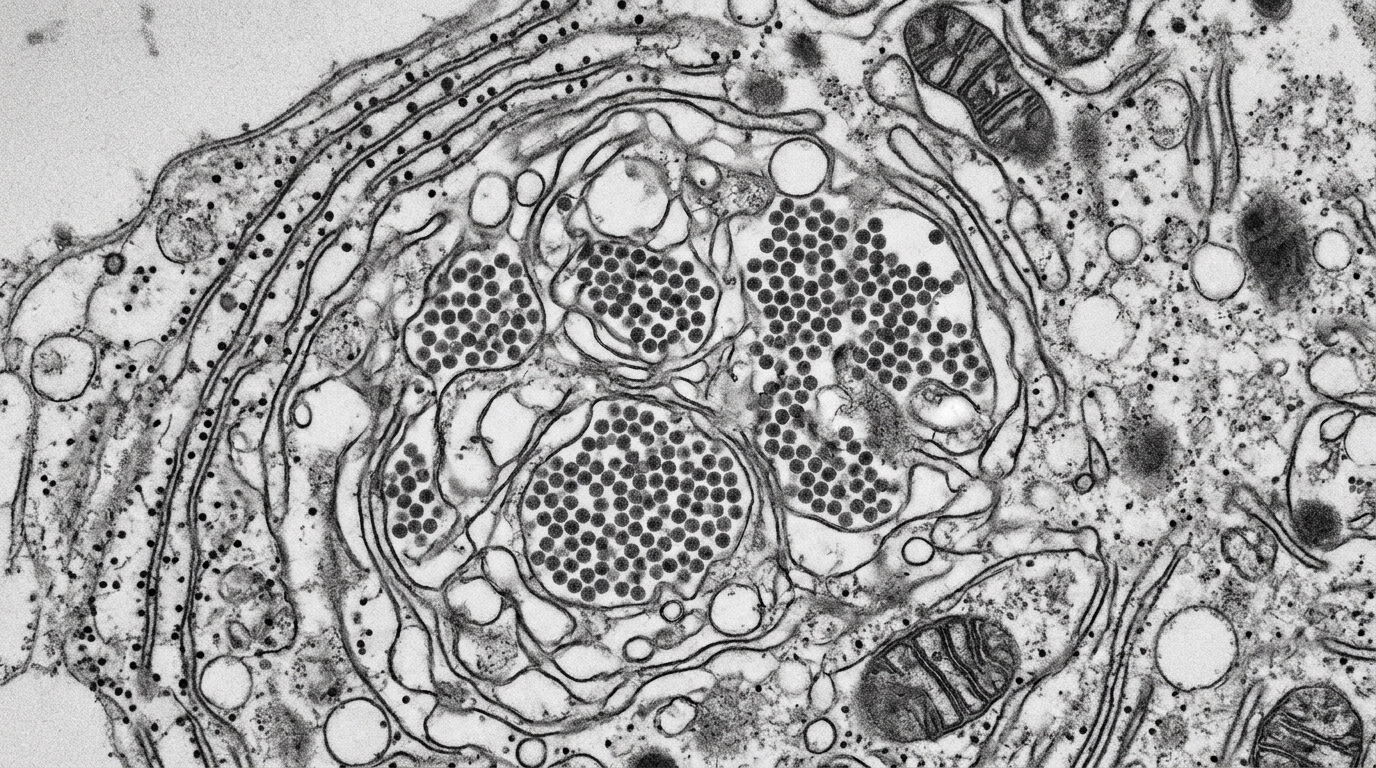
Drosophila C virus replication and experimental evolutionary trajectories are shaped directly by host cell identity, according to a study investigating viral dynamics across distinct fruit fly cell lines. RNA viruses routinely encounter diverse cellular environments within their host organisms, yet how different host cell types influence viral evolution has remained poorly understood. To evaluate this question, researchers examined the replication dynamics and experimental evolution of Drosophila C virus in three cell lines: glial cells, mesodermal cells, and hemocyte-derived S2 cells. Mesodermal cells proved remarkably permissive, supporting substantially higher viral RNA accumulation, greater viral protein production, and markedly elevated infectivity compared to either glial cells or S2 cells, establishing pronounced cell type-dependent permissiveness during infection.
To clarify why mesodermal cells proved so hospitable to viral proliferation, the authors performed comparative transcriptomic and proteomic analyses across the infected cell cultures. These molecular profiles revealed distinct host responses to Drosophila C virus infection across the different cell types, despite the shared mesodermal developmental origin of mesodermal cells and hemocyte-derived S2 cells. The investigators then carried out targeted functional analyses to determine whether specific cellular pathways or defense mechanisms explained the observed replication differences. These functional evaluations demonstrated that RNA interference pathways, cGLR–STING signaling, initial viral binding and entry, and cellular ATP abundance could not account for the enhanced replication of Drosophila C virus in mesodermal cells.
Although those evaluated pathways did not explain the elevated replication observed in mesodermal cultures, host defense responses diverged noticeably across the tested cell types. In particular, hemocyte-derived S2 cells displayed substantially stronger cGLR–STING and JAK–STAT signaling responses following infection with Drosophila C virus. These distinct immune reactions demonstrated that differentiated cell lines originating from a common mesodermal lineage establish fundamentally different intracellular defense environments. While S2 cells mounted robust cGLR–STING and JAK–STAT responses to counter infection, mesodermal cells permitted high viral accumulation through mechanisms that operate independently of these classical antiviral and metabolic pathways.
The researchers subsequently examined viral adaptation over extended propagation by conducting serial passage experiments across 15 generations in either mesodermal cells or S2 cells. This serial passage regimen resulted in rapid phenotypic adaptation within the evolving viral populations. Over the course of the 15 generations, the evolved viruses exhibited improved replication specifically within their corresponding host cell type. Notably, while the evolved viral populations acquired distinct fitness advantages in their specific cell culture environments, these cellular adaptations occurred without altering viral infectivity in adult fruit flies, demonstrating that in vitro specialization did not compromise or alter whole-organism infection capability.
Whole-genome sequencing of the passaged lineages revealed starkly contrasting evolutionary patterns between nonstructural and structural protein-coding regions of the viral genome. Coding regions for nonstructural proteins remained highly conserved across passages, showing limited evidence of parallel evolution among the experimental lines. In contrast, structural protein-coding regions accumulated a larger number of mutations and exhibited broader signatures of positive selection. These genetic findings demonstrated that the structural components of the viral capsid faced far greater intracellular selective pressures than nonstructural proteins as the virus adapted to distinct host cell environments.
Among the genomic alterations identified through sequencing, a recurrent mutation within the structural protein VP3, designated G8089A (R270H), independently emerged in three separate S2-passaged lineages. This amino acid substitution represented the only mutation consistently associated with adaptation to a specific cell type in the investigation. Structural modeling suggested that this substitution is unlikely to substantially alter interactions between VP2 and VP3 proteins, implying that its adaptive effect involves more subtle modifications to capsid function. Together, the findings demonstrate that different Drosophila cell types impose distinct intracellular selective pressures that shape viral replication and evolutionary trajectories, highlighting host cell identity as an important determinant of RNA virus evolution.
Subject of Research: Cell type-dependent replication and experimental evolution of Drosophila C virus
Article Title: Host cell identity shapes the replication and evolution of Drosophila C virus
Article References: Liang, Q., Liu, J., Huang, Y., Yuan, X., & Kadowaki, T. (2026). Host cell identity shapes the replication and evolution of Drosophila C virus. npj Viruses. https://doi.org/10.1038/s44298-026-00256-8
Image Credits: AI Generated
DOI: 10.1038/s44298-026-00256-8
Keywords: Drosophila C virus, viral evolution, host cell identity, RNA viruses, experimental evolution, cGLR-STING, JAK-STAT, VP3 mutation, Host, cell, identity, shapes
News Source: Kristina Jarvis. (November 7, 2026). Host Cell Identity Shapes Replication and Evolution in Drosophila C Virus. Scienmag.