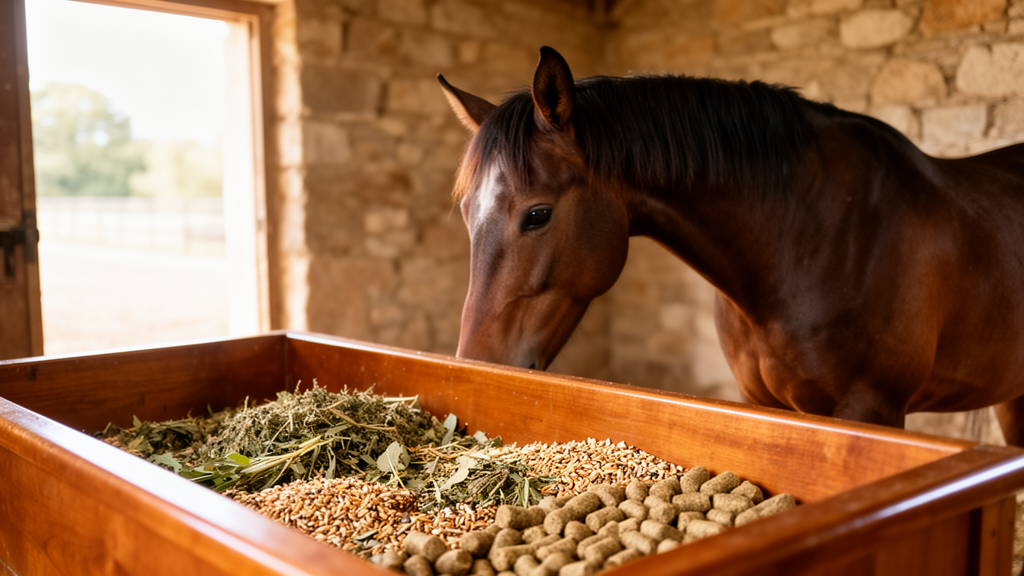
A new evaluation of equine feeding behavior demonstrates that horses exhibit a coherent, multidimensional behavioral and consumption-related response when presented with botanical feed additives. Rather than being adequately reflected by feeding speed alone, reduced palatability manifests across multiple distinct behavioral domains, most notably marked by a highly reproducible low-acceptance tail among less favored supplements.
Herbal and macroalgal materials are increasingly incorporated into equine diets as nutritional supplements, yet their distinctive sensory properties frequently influence whether horses consume supplemented rations. To determine whether commercially sourced botanical materials differ systematically in short-term acceptance and whether feed hesitation follows consistent behavioral patterns, researchers conducted controlled dietary evaluations in twenty adult warmblood horses.
The experimental protocol tested fifty dried dietary materials, including forty-nine plant-derived substances and one macroalgal supplement, Ascophyllum nodosum. During testing, ten grams of an assigned botanical material was thoroughly blended with five hundred grams of oats and fifty milliliters of water, and each prepared ration was offered across three routine daily feeding intervals to evaluate intake under standard management conditions.
To capture equine feeding reactions comprehensively, the investigators recorded three core response domains: the occurrence of leftovers, pre-ingestive olfactory exploration, and overall completion time among finished feeding trials. These observational endpoints were evaluated using Bayesian mixed models, and model-adjusted material effects were subsequently integrated using principal component analysis.
Statistical modeling revealed that the first principal component accounted for 70.2 percent of the between-material variation, functioning as a composite metric where elevated values indicated less favorable behavioral and intake profiles. Material-level effects correlated positively across all measured domains, with pre-ingestive olfactory exploration linked to significantly higher odds of feed refusal and leftovers, yielding an odds ratio of 2.29 with a 95 percent credible interval between 1.28 and 4.07.
Across the fifty evaluated materials, six were categorized as clearly favorable relative to the broader test group, while ten emerged as clearly unfavorable, including Zingiber officinale, Pimpinella anisum, and Ascophyllum nodosum. The unfavorable spectrum proved considerably more reproducible than the favorable end, remaining robust against individual horse variation, statistical priors, incomplete feeding trials, feeding sequence, hypothetical calendar effects, and exposure opportunities.
A crucial interpretive qualification highlighted by the researchers concerns the exact baseline against which the six favorable botanicals were judged. While six materials demonstrated comparatively favorable behavioral profiles within the experimental group, this classification was established solely relative to the fifty tested dietary additives, rather than in comparison to an unsupplemented ration of oats alone. Because the experimental design mixed each additive into standard oats and water, the evaluation did not assess whether horses preferred the added botanicals over plain feed. Instead, the favorable designation indicates that within a broad collection of candidate plant supplements, these six substances prompted the least behavioral hesitation and disruption to consumption.
In evaluating the practical utility of their statistical framework, the authors underscored that the most robust outcome was the persistence of a reproducible low-acceptance tail rather than the exact ordinal ranking of every evaluated material. Rather than attempting to establish an immutable hierarchy across all fifty substances, the analytical models demonstrated that individual rankings across the moderate and favorable ranges showed greater variability. By contrast, the clustering of poorly accepted materials at the unfavorable end remained distinctly stable. This distinction demonstrates that equine feeding evaluations are most dependable for isolating clear material avoidances, as the low-acceptance tail remained consistent across diverse statistical specifications and trial conditions.
The research team also emphasized that equine feeding reactions cannot be adequately captured through single-variable measurements, such as consumption time alone. While feeding studies may focus on how quickly an animal consumes feed, the findings demonstrate that reduced acceptance is inherently multidimensional. When horses encounter less acceptable botanical additives, reduced palatability manifests across distinct, concurrent behavioral responses. In addition to differences in completion time among completed trials, less favored materials trigger increased pre-ingestive olfactory exploration and a higher frequency of leftovers. Because olfactory exploration directly correlated with an elevated occurrence of leftovers, relying solely on completion time would overlook the behavioral hesitation occurring prior to ingestion.
These conclusions directly support targeted future research into the specific sensory, chemical, and experiential factors that drive reduced acceptance of botanical additives in equines. Rather than assuming how horses will respond to herbal supplements, the authors emphasized that investigating the sensory properties and chemical attributes underlying dietary hesitation remains essential. The peer-reviewed research was conducted by Ewelina Tkaczyk, Jan Kita, Wiktoria Janicka, Jarosław Łuszczyński, and Iwona Janczarek, and published in the open-access journal BMC Veterinary Research on 13 October 2026. Made available as an early citable version with a permanent digital object identifier, the study establishes an empirical behavioral foundation for evaluating commercial botanical materials in equine diets.
Subject of Research: Equine behavioral and consumption responses to botanical feed additives
Article Title: Short-term acceptance of botanical feed additives by horses: a multidimensional behavioural and consumption analysis
Article References: Tkaczyk, E., Kita, J., Janicka, W., Łuszczyński, J., & Janczarek, I. (2026). Short-term acceptance of botanical feed additives by horses: a multidimensional behavioural and consumption analysis. BMC Veterinary Research. https://doi.org/10.1186/s12917-026-06007-4
Image Credits: AI Generated
DOI: 10.1186/s12917-026-06007-4
Keywords: equine nutrition, botanical feed additives, horse behavior, warmblood horses, feed acceptance, palatability, Ascophyllum nodosum, Zingiber officinale, Pimpinella anisum, pre-ingestive olfactory exploration, feed leftovers, consumption time, Bayesian mixed models, principal component analysis, sensory properties, dietary supplementation, animal feed intake
News Source: William Thompson. (November 11, 2026). Horses Show Multidimensional Behavioral Responses When Rejecting Botanical Feed Additives. Scienmag.