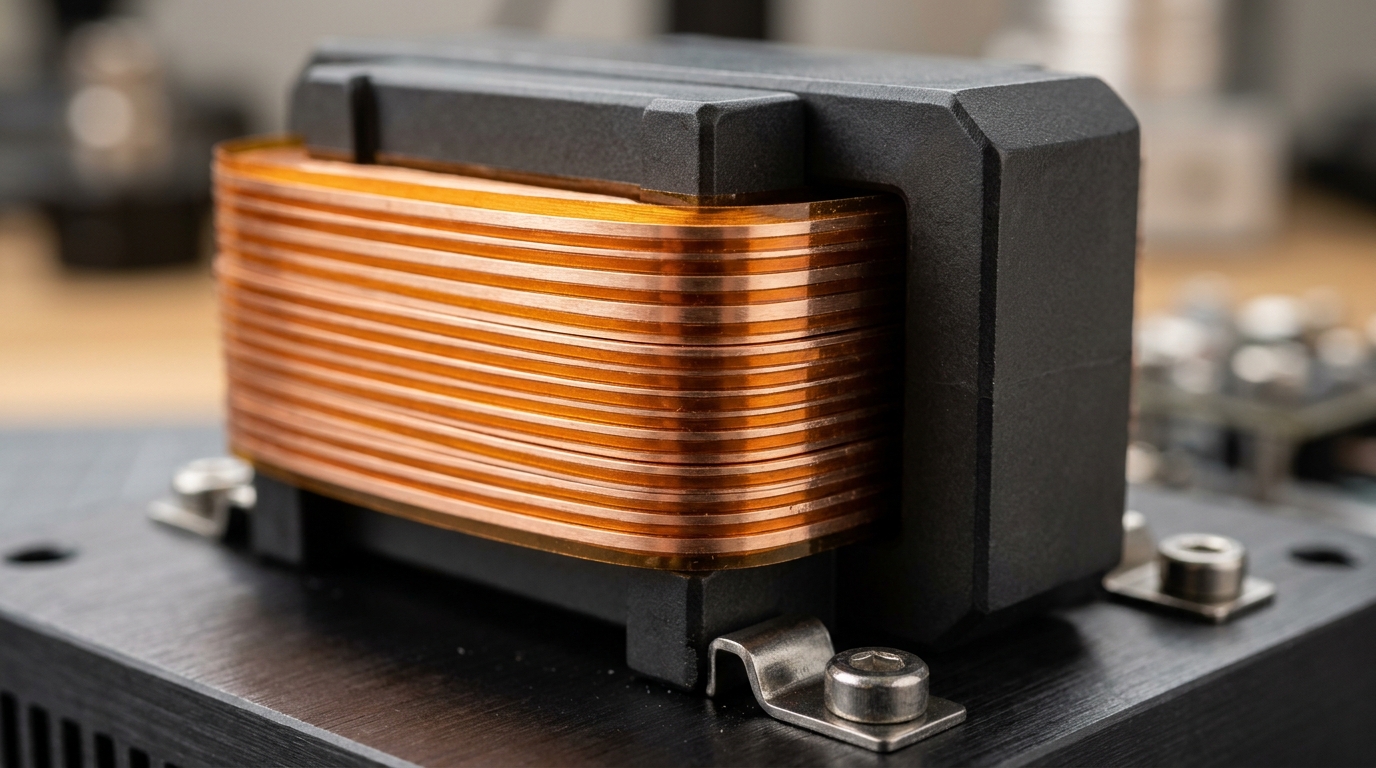
Engineers and computational researchers Silas Weinert, Jonas Bundschuh, Yvonne Späck-Leigsnering, and Herbert De Gersem have established a coupled numerical simulation framework designed to predict the combined electromagnetic and thermal behavior of homogenized foil windings. In electric components such as inductors and transformers used within direct current to direct current power converters, foil windings offer an alternative to traditional solid wire or litz wire windings. Built by winding continuous conducting foil sheets separated by thin insulating layers rather than drawing insulated circular wire, foil windings exhibit unique physical characteristics. Compared directly to standard wire configurations, foil constructions provide lower direct current resistance, enhanced mechanical properties, simpler manufacturing at lower expense, and superior heat transfer characteristics. The wide conducting foil sheets form direct, highly conductive thermal pathways running from the internal core out to external surfaces, enabling far more effective cooling than wire bundles where internal thermal conduction paths are hindered by insulation.
Despite these physical advantages, engineering foil windings for high-frequency electrical apparatus requires simultaneous consideration of both electromagnetic and thermal performance. Thin conducting layers subjected to alternating magnetic fields experience induced eddy currents and localized resistive Joule dissipation. These physical regimes do not operate in isolation: volumetric Joule losses generated within the electromagnetic field serve as distributed heat sources in the thermal conduction field, while the resulting temperature rise alters the material’s electrical conductivity. Analyzing these coupled dynamics numerically poses significant mathematical challenges. Because practical foil windings consist of dozens or hundreds of tightly wrapped, microscopically thin turns, standard brute-force finite element simulations that resolve every individual conductor and insulator layer require massive computational meshes and impractical runtimes. To overcome this limitation, the authors developed a dual-homogenization approach that replaces the discrete layered structure with a continuous, artificial homogenized material across both the electromagnetic and thermal domains.
The mathematical formulation relies on treating the multi-turn foil winding as an equivalent anisotropic continuum defined over a local coordinate system. By establishing an invertible mapping from a standardized reference domain to the physical geometry of the winding, local coordinate directions are assigned perpendicular to the foil layers, along the winding path, and parallel to the turn edges. Material properties within the homogenized domain are derived using analytical mixing rules based on the fill factor, which quantifies the volume ratio of the conductor thickness to the total turn thickness including insulation. In the local orthogonal coordinate frame, these macroscopic parameters form diagonal tensors. Because the electrical conductivity of the insulation is zero, the homogenized cross-layer electrical conductivity drops strictly to zero, preventing unphysical current leakage across turns while preserving thermal conduction.
For the electromagnetic sub-problem, the researchers implemented a magnetic vector potential and electric scalar potential formulation of the magnetoquasistatic Maxwell equations. Within the homogenized domain, the external excitation voltage is modeled using a dedicated voltage function that depends solely on the local coordinate perpendicular to the turns and on time. This voltage function is multiplied by a directional spatial distribution vector, enforcing the physical condition that the specified total circuit current flows uniformly through every turn of the winding without requiring explicit geometric separation of the turns. To capture temperature feedback, the electrical conductivity of the conducting copper foil is explicitly defined as a temperature-dependent function using a reference value of sixty megasiemens per meter at 293.15 Kelvin alongside a temperature coefficient of 0.00393 per Kelvin. The thermal sub-problem is governed by the transient heat conduction equation, where the volumetric heat source is defined directly by the time-averaged scalar product of the total electric field and current density.
To manage the disparate time scales characteristic of electromagnetic oscillations and thermal accumulation, the authors implemented a staggered weak coupling algorithm. Alternating magnetic fields often oscillate over microseconds or milliseconds, whereas bulk thermal transport and temperature rise take minutes or hours to develop. Under the weak coupling scheme, the magnetic sub-problem is evaluated over several small time steps while keeping the spatial temperature distribution frozen. Once these high-frequency electromagnetic steps are completed, the resulting localized Joule losses are calculated and averaged over the elapsed interval. This averaged heat source is then transferred to the thermal solver, which executes a substantially larger thermal time step to update the spatial temperature field. The updated temperature is subsequently returned to the magnetic solver to recalculate the temperature-dependent electrical conductivity. This partitioned stepping allows the thermal sub-problem to advance on a much coarser temporal grid than the electromagnetic sub-problem without compromising solution stability.
Spatial discretization of the governing partial differential equations was executed using the Ritz-Galerkin finite element method. The magnetic vector potential was discretized using lowest-order edge shape functions, specifically Nédélec finite elements, while the scalar temperature field was discretized using lowest-order nodal Lagrange finite elements. The auxiliary voltage function describing the foil winding was expanded using specialized one-dimensional basis functions that vary only across the turn coordinate and remain constant along the winding length and height.
The validity and numerical accuracy of the homogenized formulation were first established against a fully resolved reference model computed using Comsol Multiphysics. The verification test case comprised a foil winding placed in the center of an air-filled enclosure. In the magnetic domain, the boundaries were set to a homogeneous electric boundary condition, while an isothermal ambient boundary condition was enforced for the thermal sub-problem. The electromagnetic sub-problem was evaluated in the frequency domain at a peak operating frequency of 50 Hertz, while transient heat transfer was solved over a ten-hour period using a constant two-minute thermal time step. A systematic mesh refinement study evaluating the relative error of the thermal internal energy between the fully resolved and homogenized representations demonstrated asymptotic convergence, exhibiting a convergence rate bounded between the inverse square root and the inverse of the total number of mesh elements.
Following verification, the researchers applied their coupled methodology to investigate a more complex and realistic pot transformer. The geometry featured an inner primary foil winding with one hundred turns and an eighty percent conductor fill factor, alongside an outer secondary wire winding with five hundred turns and an equivalent eighty percent fill factor, both housed within a magnetic yoke containing a central air gap. The transformer was monolithically coupled to an external driving circuit supplied by a 50-volt sinusoidal source operating at a high frequency of 5 kilohertz, terminated by a series resistance of one ohm and a load resistance of two hundred ohms. Both physical domains were simulated in the time domain over a duration of ten hours. The electromagnetic field resolved two hundred discrete steps per excitation period, corresponding to a fine magnetic time step of one microsecond, whereas the thermal solver utilized an adaptive stepping scheme beginning at thirty seconds and expanding as temperatures approached steady state.
At thermal steady state, the overall temperature profile remained relatively uniform across the windings, with the primary foil winding operating at 77 degrees Celsius and the secondary wire winding settling at 60 degrees Celsius. However, spatial inspection of heat generation showed marked non-uniformities. While Joule losses in the secondary wire winding were smoothly distributed due to the omission of wire eddy currents, the primary foil winding exhibited severe localized loss peaks in immediate proximity to the yoke’s central air gap. These localized losses were driven by strong fringing magnetic flux crossing the air gap and inducing intense eddy currents in the adjacent foil layers.
Consequently, the coupled simulation successfully mapped a distinct thermal hot spot within the foil winding directly bordering the magnetic air gap, demonstrating the model’s capacity to resolve local field concentrations without meshing individual thin laminations. The authors note that the validity of the underlying homogenized foil model is constrained by the skin depth criterion, requiring the physical foil thickness to remain significantly smaller than the electromagnetic penetration depth at the excitation frequency, as well as the geometric condition that total winding height substantially exceeds individual turn width. Within these analytical boundaries, the weakly coupled, dual-homogenization approach provides a computationally efficient and predictive tool for evaluating high-frequency electromagnetic components subjected to severe thermal and magnetic stress.
Subject of Research: Coupled magneto-thermal field simulation of homogenized foil windings
Article Title: Magneto-thermally coupled field simulation of homogenized foil winding models
Article References: Weinert, S., Bundschuh, J., Späck-Leigsnering, Y., & De Gersem, H. (2025). Magneto-thermally coupled field simulation of homogenized foil winding models. Advanced Modeling and Simulation in Engineering Sciences, 12(1), Article 31. https://doi.org/10.1186/s40323-025-00315-4
Image Credits: AI Generated
DOI: 10.1186/s40323-025-00315-4
Keywords: foil windings, magneto-thermal simulation, homogenization method, pot transformer, finite element method, eddy currents, Joule losses, multiphysics modeling, Magneto-thermally, coupled, field, simulation
News Source: Denise Maddox. (November 8, 2026). Homogenized Simulation Accurately Predicts Magneto-Thermal Behavior in High-Frequency Foil Windings. Scienmag.