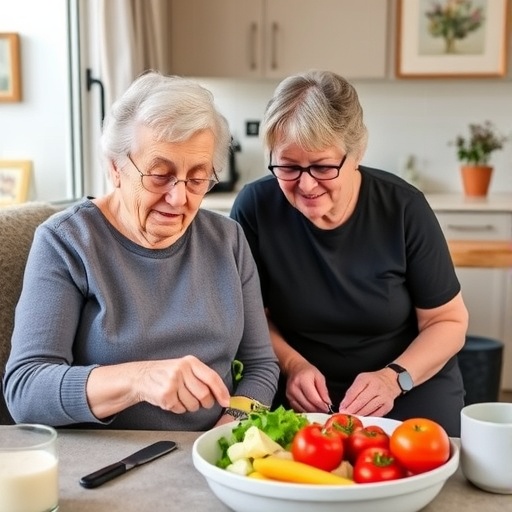
In a groundbreaking approach set to redefine geriatric care, the integration of home-visit programs led by professional dieticians is emerging as a pivotal intervention following discharge from acute care wards. Recent research focuses on evaluating the impact of these community-based nutritional interventions on older adults’ weight trajectories during the critical recovery period. This innovative model offers hope for mitigating the often overlooked but serious issue of malnutrition and weight fluctuations in the elderly, which can drastically influence outcomes such as mortality, morbidity, and quality of life.
The study in question meticulously explores the baseline characteristics of patients within this program, analyzing the patterns of weight change observed over a defined follow-up period. Nutrition, particularly in geriatric populations, is a multifaceted variable that directly correlates with clinical stability and functional independence. The weight variations post-discharge act as a proxy for nutritional status changes and can signal either recovery or the onset of secondary complications. Understanding these dynamics is crucial for developing targeted interventions that prevent deleterious health consequences.
Acute care wards for the elderly often prioritize immediate medical stabilization but may inadvertently overlook comprehensive nutritional evaluation and follow-up. This gap presents a critical juncture where patients are vulnerable to muscle wasting, energy imbalance, and insufficient nutrient intake — factors contributing to frailty and readmission. The role of dieticians as community-based caregivers has traditionally been limited, but this program embarks on shifting from hospital-centered care to a continuum involving home-based nutritional support.
The mechanics of the home visit program are grounded in personalized, patient-centered care principles. Dieticians conduct thorough assessments at patients’ residences, allowing for an intimate understanding of their dietary habits, social determinants of health, and possible barriers to adequate nutrition. These visits provide opportunities for tailored nutritional counseling, adjustments in dietary plans, and coordination with other healthcare professionals, thereby fostering a holistic approach to recovery.
Quantitative measurement of weight changes during the follow-up, stratified by initial baseline profiles, gives insight into patient demographics, comorbidities, and potential predictors of nutritional risk. Weight loss in the elderly is often a hallmark of poor prognosis, frequently linked to underlying pathologies, depression, or socioeconomic challenges. Conversely, weight gain or stabilization may indicate effective intervention, improved symptom control, or unintended consequences such as fluid retention, which also require clinical vigilance.
The research underscores the importance of integrating nutritional interventions within the discharge planning and transitional care frameworks. The dieticians’ ability to intervene early and adapt care plans through monitoring permits dynamic responses to patients’ evolving needs. Moreover, their presence in the community setting facilitates bridging gaps related to accessibility and continuity of care, which are commonly encountered in traditional healthcare pathways.
In addition to individual patient benefits, the program holds broader implications for health system efficiency and resource allocation. Hospital readmissions, often fueled by preventable nutritional complications, impose substantial burdens on healthcare infrastructure. Proactive home visit interventions may prove instrumental in reducing these rates by ensuring adequate nutrition and functional recovery, thus alleviating pressures on acute services.
The study employs robust methodological design, including longitudinal tracking and stratified analyses, enhancing the reliability of results. By focusing on a vulnerable cohort post-discharge, the findings resonate with wider public health goals directed at aging populations. The elucidation of baseline characteristics associated with varying weight change patterns provides valuable markers for risk stratification and personalized care pathways.
From a mechanistic standpoint, the interplay between geriatric physiology, disease state, and nutritional dynamics is profoundly complex. Age-related reductions in metabolic rate, appetite dysregulation, and altered gastrointestinal function all contribute to challenges in maintaining nutritional homeostasis. The dieticians’ expertise in maneuvering through these physiological challenges ensures intervention strategies that are both scientifically grounded and pragmatically feasible.
Social and psychological dimensions also permeate the discourse on nutrition and weight in elderly patients. Isolation, cognitive impairments, and financial constraints can severely limit the capacity to consume adequate and appropriate food. Home visits enable assessment beyond mere clinical parameters, incorporating psychosocial supports into the nutritional care model. This multidimensional approach could be a critical factor in the program’s success.
Technology integration, though not explicitly detailed, is another avenue for enhancing the efficacy of such home-visit programs. Digital tools facilitating remote monitoring, teleconsultations, and dietary tracking could complement face-to-face interventions. This synergy between traditional home care and innovative tech solutions represents a forward-looking paradigm for geriatric nutrition management.
Future directions arising from the study indicate the necessity for larger trials that examine long-term outcomes including functional status, quality of life metrics, and health economics. The scalability of the program across diverse healthcare settings and populations remains an open question. Moreover, incorporating interdisciplinary collaboration among dieticians, physicians, social workers, and rehabilitative therapists promises a comprehensive approach to elderly care post-acute hospitalization.
Ultimately, this research shines a spotlight on the crucial role nutrition plays in recovering from acute illness among aging individuals. The dedication of trained dieticians conducting home visits emphasizes patient empowerment, individualized care, and proactive management. As global demographics shift towards older populations, innovations such as these will be indispensable in ensuring sustainable, high-quality healthcare systems.
By harnessing a combination of clinical expertise, community engagement, and rigorous scientific methodology, the described program paves the way for a transformation in post-discharge care paradigms. Its implications extend beyond weight change monitoring, touching on fundamental aspects of aging, disease prevention, and health maintenance. The lessons learned here are poised to influence policy, clinical guidelines, and everyday practices within geriatric medicine.
This compelling evidence advocates for health policy makers to incorporate nutritional home visits by dieticians into standard care models following geriatric acute care admissions. The multidimensional benefits underscore a shift towards anticipatory, preventive healthcare strategies rather than reactive treatment. This shift is not only clinically prudent but presents an ethical imperative to optimize the lives of our aging populations.
In conclusion, the community program featuring dietician-led home visits post-discharge highlights a critical intervention with significant clinical and social ramifications. Its capacity to track, manage, and improve weight outcomes in older adults presents a vital step forward in addressing a pervasive issue within geriatric healthcare. As the field evolves, such integrative models will become cornerstones in the advancement of holistic, patient-centered care.
Subject of Research: Post-discharge home-visit nutrition programs by dieticians targeting weight changes in geriatric patients from acute care wards.
Article Title: A community programme of home visits by dieticians after discharge from geriatric acute care wards: baseline characteristics according to weight change during follow-up.
Article References:
Sanchez, M., Courtois-Amiot, P., Götze, K. et al. A community programme of home visits by dieticians after discharge from geriatric acute care wards: baseline characteristics according to weight change during follow-up. BMC Geriatr (2026). https://doi.org/10.1186/s12877-026-07242-y
Image Credits: AI Generated
Tags: community-based dietitian programselderly weight fluctuations after hospital dischargefunctional independence through nutritiongeriatric care and dietitian home visitsgeriatric nutritional interventions at homehome visits by dietitians for elderlyimpact of nutrition on elderly recoveryimproving quality of life for elderly patientsmalnutrition prevention in elderlymuscle wasting prevention in seniorspost-acute care nutritional supportweight tracking in older adults