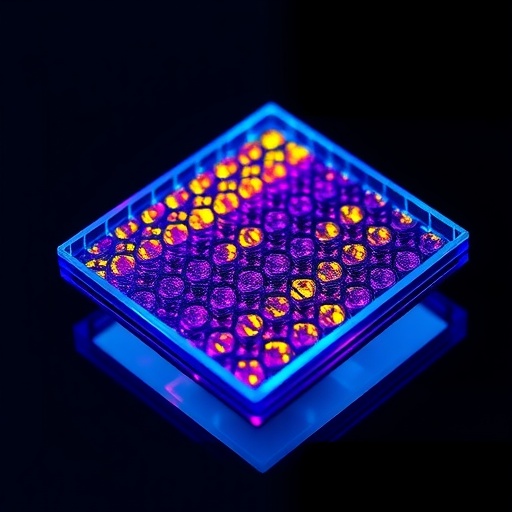
A groundbreaking advancement in perovskite solar cell technology has emerged from The Hong Kong University of Science and Technology (HKUST), promising to redefine the manufacturing landscape for next-generation photovoltaic devices. This breakthrough centers around an innovative multi-source co-evaporation technique that significantly elevates the crystal quality of vacuum-deposited perovskite films, overcoming long-standing challenges in producing high-performance, stable cells via solvent-free methods. Published in Nature Materials, the study titled “Crystal-facet-directed all-vacuum-deposited perovskite solar cells” showcases crucial progress toward scalable and industrially viable perovskite solar technology.
Perovskite materials have revolutionized the photovoltaic arena, surging in efficiency and attracting widespread attention for their cost-effective and versatile applications in renewable energy. Traditionally, the highest power conversion efficiencies have been achieved through solution-based deposition of perovskite “inks.” However, such methods face inherent limitations, including challenges in uniform large-area coating and solvent handling. Vacuum deposition, prevalent in producing other thin-film devices like OLED displays, offers a clean, solvent-free, and highly uniform alternative. Yet, all-vacuum-deposited perovskite films have struggled with poor crystallinity, leading to higher defect densities and pronounced instability under operational stresses such as heat and intense illumination.
The HKUST-led research team, under Prof. Lin Yen-Hung in collaboration with the University of Oxford’s Prof. Henry Snaith, tackled this fundamental materials-science challenge. By incorporating a lead chloride (PbCl₂) co-source into their thermal co-evaporation process, they successfully steered the crystallization pathway of the perovskite. This adjustment resulted in an exceptional orientation of wide-bandgap perovskite films (with a bandgap of 1.67 eV), where grains predominantly aligned in the (100) “face-up” configuration—a crystal facet orientation recognized for enhanced photostability and thermal endurance.
The distinct crystal orientation achieved here is not merely aesthetic; it drastically reduces defect states that typically act as traps for charge carriers or sites for degradation reactions. The films’ robust alignment confers resistance against light- and heat-induced damage, significantly extending operational lifetime. These improvements directly translated into superior optoelectronic characteristics, pushing the limits of all-vacuum processed solar cells closer to practical application benchmarks.
Using this proprietary deposition protocol, the research team achieved a certified maximum power point tracking (MPPT) efficiency of 18.35% on a small 0.25 cm² perovskite device—an impressive feat for an all-vacuum-deposited, wide-bandgap solar cell. Laboratory measurements further demonstrated a peak power conversion efficiency of 19.3%, and an 18.5% efficiency was sustained on a more industry-relevant 1 cm² device size, underscoring the scalability and reproducibility of the technique.
Durability testing followed rigorous International Summit on Organic Photovoltaic Stability (ISOS) standards, focusing on the ISOS-L-2 accelerated ageing protocol. The encapsulated perovskite cells maintained 80% of their initial efficiency after 1080 hours under challenging conditions: continuous full-spectrum illumination equivalent to one sun intensity, operated at open circuit, at elevated temperatures of 75 ± 5 °C in ambient air. This stability milestone rivals or exceeds many state-of-the-art solution-processed perovskite devices, highlighting the potential of vacuum-deposited films for long-term reliability in commercial environments.
To unravel the underlying device physics during operation, the team deployed operando hyperspectral imaging—a sophisticated technique developed at HKUST. This method enables spatially and temporally resolved mapping of optical signals within the functional solar cells, revealing microscopic phenomena such as halide segregation and trap-assisted recombination. These insights elucidated the relationship between crystal quality, defect states, and performance degradation, providing a powerful diagnostic framework to hone future device optimization strategies in real time.
Beyond single-junction cells, the research tackles a pivotal industry goal: producing high-efficiency tandem solar cells. Tandems, combining perovskites atop silicon substrates, can surpass the theoretical efficiency limits of individual technologies. Utilizing the finely tuned vacuum deposition approach, the team fabricated perovskite-on-silicon tandem cells with 27.2% efficiency on 1 cm² devices. Critically, these tandem cells displayed promising stability, retaining approximately 80% of their initial efficiency after eight months of outdoor operation in the variable climate of Italy — a significant stride toward commercialization of durable tandem photovoltaics.
This study signifies a paradigm shift in fabricating perovskite solar cells, bridging the gap between laboratory achievements and industrial manufacturing requirements. Prof. Lin underscored that the co-evaporation methodology is fully compatible with existing thin-film deposition infrastructure widely used in semiconductors and display industries. By converting vacuum deposition from a compromised alternative into a front runner for producing high-performance and stable perovskite-based solar devices, the path from research to factory implementation becomes markedly clearer.
The collaborative nature of this breakthrough extended internationally, involving partner institutions such as the University of Oxford, the National Thin-Film Facility for Advanced Functional Materials at Oxford, Eurac Research, and Université Grenoble Alpes in association with France’s Alternative Energies and Atomic Energy Commission (CEA). At HKUST, the research was spearheaded by Prof. Lin’s group within the Department of Electronic and Computer Engineering and the State Key Laboratory of Displays and Opto-Electronics, with key contributions from postdoctoral researcher Dr. Shen Xinyi and senior manager Dr. Fion Yeung.
The implications of this advancement go beyond isolated devices; it represents a crucial step toward integrating vacuum-deposited perovskites into large-scale production lines. The inherent advantages of vacuum deposition—environmental cleanliness, batch uniformity, and process control—combined with the newfound crystal engineering approach, position this technology as a viable contender in the competitive renewable energy market. As the global demand for sustainable, high-efficiency solar energy solutions intensifies, innovations like this may accelerate the transition to cleaner energy infrastructure worldwide.
Ultimately, the demonstration of extended operational stability, high efficiency, and compatibility with silicon tandem architectures manifests a holistic solution that addresses critical bottlenecks in perovskite solar cell commercialization. This refined understanding of crystal facet orientation via multi-source co-evaporation opens new avenues for tailoring thin-film materials to unprecedented performance and durability benchmarks, heralding a new era for perovskite photovoltaics fabricated with industrial scalability in mind.
Subject of Research: Not applicable
Article Title: Crystal-facet-directed all-vacuum-deposited perovskite solar cells
News Publication Date: 23-Feb-2026
Web References:
https://www.nature.com/articles/s41563-026-02494-w
http://dx.doi.org/10.1038/s41563-026-02494-w
Image Credits: HKUST
Keywords
Energy resources
Tags: crystal quality improvement in perovskiteshigh-performance perovskite photovoltaicsHKUST solar cell breakthroughindustrial perovskite solar technologymulti-source co-evaporation techniquenext-generation photovoltaic devicesperovskite solar cell technologyrenewable energy innovationsscalable perovskite solar manufacturingsolvent-free perovskite solar cellsstable perovskite solar cellsvacuum-deposited perovskite films