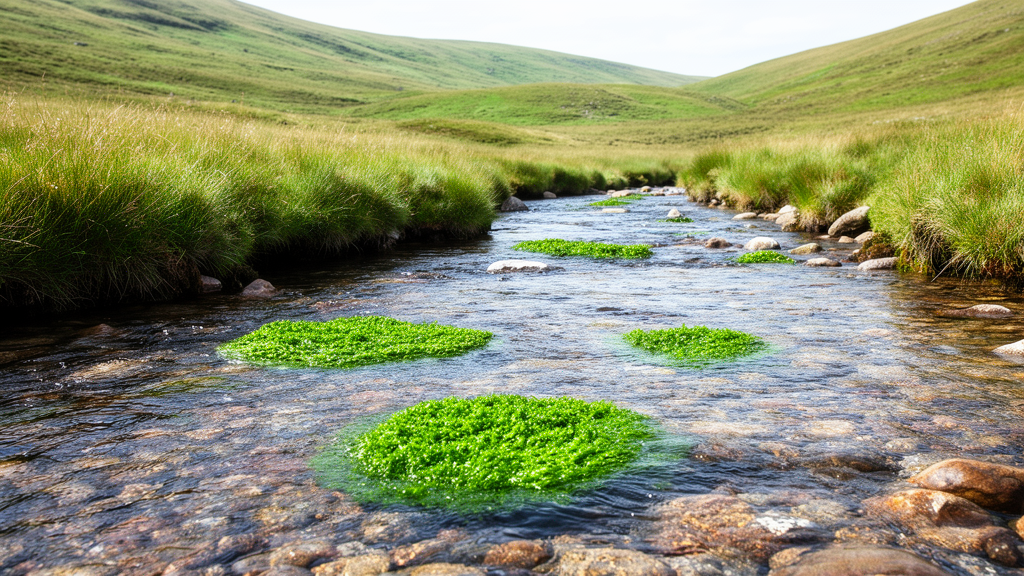
Stream macroalgal communities across highland grassland ecosystems in southeastern Brazil are structured primarily by extreme spatial turnover rather than nested species subsets, operating ecologically as isolated mountaintop islands. In an extensive field assessment examining fifty-eight stream sites across four federal protected areas, researchers documented that taxonomic beta diversity reached extraordinarily elevated levels, with Sørensen dissimilarity recorded at 0.97 and Simpson dissimilarity at 0.96. Concurrently, the nestedness component accounted for an exceptionally minor fraction of overall diversity variation at just 0.01. Rather than forming orderly subsets of communities found in species-rich stream segments, the composition of benthic macroalgae diverged almost entirely from one protected area to another. This biological divergence was governed by species replacement linked to local environmental filtering across distinct mountain chains. These empirical findings substantiate the biogeographic hypothesis that high-elevation grasslands act as functional archipelagos, where physical separation among mountain systems preserves comparable levels of local alpha diversity while driving remarkably elevated beta diversity across the wider regional landscape.
The comprehensive multi-park survey encompassed four protected conservation units situated within distinct mountain ranges of the Brazilian Highlands, each preserving expansive tracts of high-elevation grasslands surrounded by lower terrain and adjacent biomes. The study sites included Serra da Canastra National Park, located in southwestern Minas Gerais within its own discrete range; Serra do Cipó National Park, situated along the southern extension of the Espinhaço Range; Itatiaia National Park, set within the prominent Serra da Mantiqueira; and Caparaó National Park, positioned in the Serra do Caparaó subrange. Across their geographical footprints, these parks either encompass or interface directly with two major South American biomes, specifically the Cerrado savanna and the Atlantic rainforest. Fifty-eight distinct stream segments spanning first-order headwaters through fifth-order rivers were systematically surveyed based on regional representativeness and logistical accessibility, capturing the macroalgal flora during winter periods when lotic macroalgal diversity, biomass, and stream bed coverage typically attain their seasonal maxima across tropical highland catchments.
To rigorously evaluate community assembly and environmental associations, field teams established standardized ten-meter sampling reaches along stream banks across each of the fifty-eight selected sites. Researchers thoroughly inventoried benthic substrates for macroalgae displaying macroscopic mature thalli recognizable without optical magnification, distinguishing these forms from microscopic periphyton in accordance with established morphological criteria. Stream bed percentage cover was quantified at each location, and algal specimens were preserved in four-percent formaldehyde solution before deposit in the SJRP Herbarium at Universidade Estadual Paulista in São José do Rio Preto. Alongside biological collections, the investigators measured eight key physical and chemical habitat parameters across every station, evaluating water temperature, electrical conductivity, turbidity, current velocity, pH, dissolved oxygen concentration, chemical oxygen demand, and visual water color. These parameters captured sharp limnological contrasts, providing an empirical baseline to test how microhabitat conditions govern macroscopic benthic autotrophs responsible for localized primary production and nutrient assimilation.
Statistical evaluations using one-way analysis of variance and Tukey multiple comparison tests demonstrated that environmental conditions diverged significantly across the four highland grassland parks, underscoring high systemic heterogeneity among lotic habitats. The most pronounced statistical differences occurred in water temperature, specific conductivity, turbidity, pH, water color, and chemical oxygen demand, all yielding significance levels below one tenth of one percent. Streams in Caparaó and Itatiaia, which occupy the highest elevations within the Mantiqueira system, exhibited the lowest recorded water temperatures. In contrast, streams traversing Canastra and Cipó featured acidic pH values and yellowish to brownish coloration indicative of humic water bodies. Dissolved oxygen and current velocity also exhibited significant inter-park differences at the five-percent significance threshold. Despite these substantial environmental gradients, macroalgae in the four parks did not align with a universal physicochemical profile, as sampling sites within individual parks were dispersed broadly across total environmental parameter space.
Biological metrics likewise demonstrated significant variation among the four national parks, particularly regarding community diversity and species richness. Shannon-Wiener diversity values differed significantly across parks at a significance level below one tenth of one percent, while taxonomic richness varied at the five-percent level. Caparaó supported both the highest Shannon-Wiener diversity values and the greatest site-level species richness, whereas Itatiaia exhibited the lowest species richness among the surveyed regions. Total percent cover across all fifty-eight sites averaged 16.3 percent with a standard deviation of 13.7 percent, ranging from complete absence to forty-two percent, though mean cover did not differ significantly among the parks. Across the entire sampling network, species richness per reach ranged from zero to eight taxa, averaging 4.0 species with a standard deviation of 2.3, while Shannon-Wiener diversity indices ranged from zero to 1.26 with a mean of 0.47. Correlation analyses confirmed a positive relationship between species richness and percent cover, alongside a strong positive association between richness and Shannon-Wiener diversity.
Principal Component Analysis integrating biological and physicochemical parameters across all fifty-eight sampling locations demonstrated considerable ecological dispersion, with the first two ordination axes accounting for forty-eight percent of total variance. The first principal component axis was positively correlated with stream water pH and Shannon-Wiener diversity, while displaying a negative correlation with water color. The second axis correlated positively with electrical conductivity and negatively with species richness, algal percent cover, and water temperature. Biplots revealed substantial overlap among sampling sites, indicating that no single park was completely isolated in total multivariate environmental-biological space. Sites within Canastra and Cipó were dispersed broadly along ordination axes, reflecting wide local variations in habitat chemistry and biological structure. Conversely, Caparaó and Itatiaia clustered into comparatively tighter groupings. Caparaó sites exhibited greater internal consistency in community properties alongside higher current velocities, whereas Canastra streams exhibited broader spreads across both biological attributes and limnological variables.
A floristic catalogue compiled across the fifty-eight sampling stations identified fifty-seven macroalgal species distributed across four taxonomic phyla, characterized by a clear dominance of cyanobacteria. Cyanobacteria represented twenty-seven distinct taxa, accounting for 47.4 percent of all catalogued species, followed by green algae belonging to Chlorophyta and Streptophyta with eighteen species representing 31.6 percent. Red algae belonging to Rhodophyta comprised ten species representing 17.5 percent, while Heterokontophyta contributed two species representing 3.5 percent. A striking biological feature was that 81.5 percent of the documented cyanobacteria were heterocytous taxa capable of specialized nitrogen fixation, reflecting evolutionary adaptation to low nitrogen concentrations characteristic of these oligotrophic grassland headwaters. Most green and red algae identified in the survey have similarly been documented in nutrient-poor lotic environments throughout Brazil, highlighting the specialized nature of stream autotrophs inhabiting high-elevation grasslands where available nitrogen and related dissolved macronutrients remain naturally constrained.
Species distribution patterns across the four protected areas exhibited pronounced geographic restriction, with individual taxa predominantly confined to narrow local distributions rather than spanning the regional park system. The vast majority of documented macroalgae occurred in only one park, while merely ten taxa, representing 17.5 percent of the flora, were collected in two parks. No single species was present across all four national parks, and only two taxa, representing 3.5 percent of total richness, were found in three parks, namely an alga designated aff. Dichothrix and Stigonema mamillosum. Within individual parks, most species appeared at only one to six stream sites, with the singular exception of Stigonema species 1, which colonized eleven of twelve reaches in Caparaó. Unweighted group cluster analysis based on Sørensen similarity revealed less than twenty percent floristic overlap among parks, though a weak biogeographic signal emerged as the two Cerrado parks shared five species: Calothrix species, Stigonema ocellatum, Microspora floccosa, Paludicola turfosiformis, and Sirodotia delicatuliformis.
Permutational multivariate analysis of variance confirmed that taxonomic community composition differed significantly across the four protected areas, yielding a pseudo-F statistic of 7.37 at a significance level below one tenth of one percent. Complementary Uniform Manifold Approximation and Projection ordination yielded a significant correlation coefficient of 0.311, demonstrating that approximately two-thirds of the total variation in stream macroalgal species composition across reaches was explained directly by park identity. Total multisite taxonomic beta diversity reached 0.97 under the Sørensen index, matched by a Simpson dissimilarity index of 0.96. The negligible nestedness value of 0.01 proves that community differences did not stem from impoverished stream reaches supporting nested subsets of species found at richer sites. Instead, macroalgal divergence among streams arose almost entirely from species replacement across park boundaries, illustrating how local environmental filtering and geographic fragmentation systematically select for distinct floristic assemblages across independent high-elevation drainage systems.
These collective empirical results provide compelling support for the hypothesis that high-elevation grasslands function biogeographically like oceanic archipelagos, where isolated mountaintops generate elevated regional turnover despite comparable levels of local community richness. Previous ecological investigations of stream macroalgae globally have reported that local assemblages are characterized by patchy spatial distribution and the local predominance of few species, patterns consistent with Townsend’s patch dynamics concept where the most abundant communities are also the most diverse. The authors conclude that this high taxonomic beta diversity arises directly from the synergistic combination of low relative species richness per reach and a high frequency of geographically restricted taxa, solidifying environmental filtering across isolated mountaintop chains as the primary architect of highland lotic macroalgae diversity.
Subject of Research: Community structure, environmental drivers, and beta diversity of stream macroalgae across highland grasslands in southeastern Brazilian national parks
Article Title: Community structure of stream macroalgae in lotic ecosystems from highland grasslands in national parks of southeastern Brazil
Article References: Necchi, O., Jr, Branco, L. H. Z., Branco, C. C. Z., Necchi, C. C., & da Silva, N. M. L. (2026). Community structure of stream macroalgae in lotic ecosystems from highland grasslands in national parks of southeastern Brazil. Brazilian Journal of Botany, 49(1), Article 28. https://doi.org/10.1007/s40415-026-01152-4
Image Credits: AI Generated
DOI: 10.1007/s40415-026-01152-4
Keywords: stream macroalgae, lotic ecosystems, highland grasslands, taxonomic beta diversity, spatial turnover, nestedness, Cyanobacteria, heterocytous species, Serra da Canastra, Serra do Cipó, Caparaó National Park, Itatiaia National Park, patch dynamics concept, environmental filtering, Shannon-Wiener diversity, Sørensen dissimilarity index, PERMANOVA, species replacement
News Source: Drew Townsend. (November 24, 2026). Highland Grassland Streams Harbor Isolated Macroalgae Communities Driven by Spatial Turnover. Scienmag.