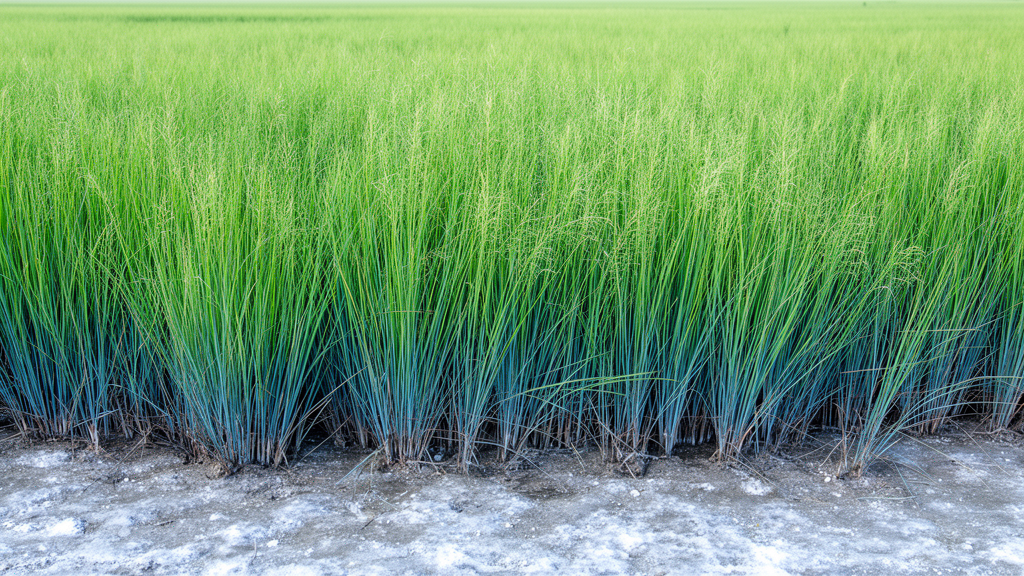
Agronomic researchers evaluating blue panicum across three contrasting saline environments in Morocco have established that doubling planting density from eight to sixteen plants per square meter increases annual fresh forage biomass by twenty-nine percent and dry biomass by thirty percent. The extensive multi-site field trial demonstrated that the perennial C4 grass maintains substantial vegetative productivity even when subjected to elevated soil and irrigation salinity levels, generating up to 202.5 metric tons per hectare of fresh biomass and 41.2 metric tons per hectare of dry biomass under low-salinity conditions. While organic amendments like compost and cattle manure contributed meaningful physiological benefits and modest dry yield increases, planting density exerted the primary agronomic control over total harvestable forage across every site evaluated. These findings offer practical management benchmarks for arid agricultural zones where rising salinity and depleted freshwater reserves increasingly restrict conventional fodder cultivation.
Soil salinization currently impairs roughly 1.38 billion hectares of arable land worldwide, suppressing fundamental plant metabolic pathways, reducing stomatal gas exchange, and triggering extensive crop failures that jeopardize pastoral economies. In arid and semi-arid territories such as southern Morocco, recurrent droughts and deteriorating groundwater quality severely constrain the production of conventional animal feeds, compelling agronomists to introduce resilient forage species including quinoa, sesbania, and blue panicum. First introduced to the Moroccan territory of Laayoune in 2016 as an alternative drought-resilient and salt-tolerant crop, blue panicum is a perennial member of the Poaceae family native to South Asian drylands including Pakistan, India, and Afghanistan. The species is valued for its rapid tiller regeneration following repeated cutting cycles and its high nutritive composition for grazing ruminants, yet standardized crop management protocols concerning field spacing, soil amendment thresholds, and mineral dynamics under saline field conditions have remained inadequately documented.
To establish how cultural practices interact with natural salinity gradients, the research team instituted synchronized field trials across three distinct pedoclimatic zones in Morocco representing low, moderate, and high salinity stresses. The low-salinity site at Oulad Ghanem featured coastal conditions 4.9 meters above sea level with an electrical conductivity of 0.7 decisiemens per meter in soil and 4.5 decisiemens per meter in irrigation water, with a sodium adsorption ratio of 4.86. The moderate-salinity trial at Sidi Abed sat at 16.6 meters altitude, presenting a soil electrical conductivity of 1.3 decisiemens per meter, highly saline irrigation water at 8.6 decisiemens per meter, and a elevated sodium adsorption ratio of 15.72. The inland high-salinity environment at Sed El Mesjoune, situated 406.5 meters above sea level, exhibited severe soil salinity with an electrical conductivity of 7.8 decisiemens per meter alongside irrigation water measured at 2.8 decisiemens per meter and a sodium adsorption ratio of 5.33. Weather conditions varied from mild coastal climates averaging 19 degrees Celsius with over 380 millimeters of rainfall to harsh continental weather averaging 21 degrees Celsius with 360 millimeters of precipitation.
The experimental framework utilized a rigorous split-plot design replicated across four randomized blocks at each testing location, isolating planting density as the main-plot factor and organic amendments across designated subplots. Main plots tested either standard spacing of eight plants per square meter with 0.5-meter row separations or high-density spacing of sixteen plants per square meter with 0.25-meter row separations, while maintaining a constant 0.25-meter intra-row plant interval. Each ten-square-meter subplot received one of five fertility regimes: an unamended control, compost applied at ten or twenty tons per hectare, or farm manure applied at twenty or forty tons per hectare. Chemical analyses revealed that compost applications delivered 165 and 330 kilograms of total nitrogen per hectare, while manure applications supplied 344 and 688 kilograms of total nitrogen per hectare, alongside substantial inputs of phosphorus and potassium. Plots were irrigated through localized drip lines delivering between 450 and 560 millimeters of total water across the full twelve-month cultivation cycle running from June 2023 to July 2024.
Crop productivity tracked across multiple cutting cycles demonstrated the substantial vegetative potential of blue panicum under varying degrees of environmental stress. Over the annual cycle, researchers performed eight manual harvests at Oulad Ghanem and Sidi Abed and seven harvests at Sed El Mesjoune, taking each cut when canopy dry matter approached twenty-one percent during early flowering. Site salinity served as the dominant driver of yield magnitude, with annual fresh biomass dropping from 202.5 tons per hectare at Oulad Ghanem to 145.5 tons at Sidi Abed and 86.5 tons at Sed El Mesjoune, alongside corresponding dry yields of 41.1, 38.0, and 21.6 tons per hectare. Dense planting of sixteen plants per square meter produced an average of 163.7 fresh tons per hectare across sites compared to 125.9 tons under eight plants per square meter, while dry yield reached 37.9 tons per hectare. Manure applications at twenty and forty tons per hectare generated a fourteen percent increase in dry biomass over unamended controls, whereas compost treatments produced statistically equivalent yields.
Physiological monitoring of fully developed leaves captured notable shifts in photosynthetic capacity and transpirational regulation across locations and cultivation regimes. Leaf porometer assessments revealed that stomatal conductance reached 392.8 millimoles per square meter per second under low salinity at Oulad Ghanem but plummeted by sixty-two percent to 188.5 millimoles at Sidi Abed, where irrigation water salinity was highest, before recovering to 294.1 millimoles in the high-salinity soil of Sed El Mesjoune. High planting density caused a fourteen percent reduction in leaf stomatal conductance, declining from low-density levels due to increased microclimatic canopy competition. Conversely, cattle manure applied at twenty and forty tons per hectare elevated stomatal conductance to an average of 317 millimoles per square meter per second. Relative chlorophyll content measured via portable optical meters mirrored this downward trajectory across the environmental gradient, falling from 34.9 SPAD units under low salinity to 19.8 and 17.8 SPAD units at moderate and high salinity sites, with forty tons of manure sustaining the highest overall chlorophyll index of 25 units.
Tissue mineral analyses underscored the specialized ion selectivity and partitioning mechanisms that enable blue panicum to withstand persistent soil and water salinity. Foliar potassium concentrations remained statistically independent of planting density, averaging 3.10 percent during the summer season and 2.82 percent during winter, but responded strongly to site characteristics and organic treatments. Low salinity supported the highest foliar potassium accumulation, peaking at 3.29 percent in summer and 2.96 percent in winter, while manure amendments at twenty tons per hectare maximized summer potassium at 2.92 percent and compost maximized winter levels. Foliar sodium exhibited a contrasting dynamic, reaching its highest values under moderate salinity with 0.29 percent in summer and 0.35 percent in winter due to the elevated sodium adsorption ratio of local irrigation water, while dropping to its lowest concentrations of 0.18 percent and 0.21 percent in the high-salinity soil of Sed El Mesjoune. Consequently, the foliar potassium-to-sodium ratio peaked under high soil salinity at 18.3 in summer and 13.5 in winter, reflecting tight physiological control over sodium translocation.
Evaluation of nutritional forage quality highlighted consistent crude protein synthesis despite intense abiotic stress across the distinct agronomic zones. Total nitrogen determined through Kjeldahl digestion and multiplied by the conventional 6.25 conversion factor showed that crude protein content peaked under moderate salinity at Sidi Abed, achieving 12.90 percent in the summer harvest and 13.87 percent in the winter harvest. Planting density had no detectable influence on foliar protein levels during the summer growing period, although winter measurements revealed a slight advantage for sparse spacing, which yielded 11.48 percent crude protein compared to 10.75 percent in dense plots. Organic amendments did not produce statistically significant shifts in total foliar nitrogen or crude protein concentrations across either season, maintaining overall mean protein levels of 10.14 percent during summer and 11.12 percent during winter. These stable nutritional metrics confirm that blue panicum forage retains sufficient nitrogenous feed value for livestock maintenance across wide variations in soil salinity and fertilizer inputs.
Enzymatic assays of leaf tissue extracts provided critical biochemical insights into how the crop coordinates its defensive antioxidant machinery when challenged by severe salt stress. Spectrophotometric determinations indicated that peroxidase activity was elevated under moderate salinity at 0.37 units per gram of fresh weight and under low salinity at 0.33 units, but declined significantly to 0.25 units under high salinity conditions. In sharp contrast, superoxide dismutase activity surged to its maximum level of 72.01 units per gram of fresh weight under high salinity at Sed El Mesjoune, while catalase activity simultaneously peaked at 9.02 units per gram compared to 4.6 and 5.6 units under low and moderate salinity regimes. While planting density caused only minor variations in peroxidase activity, organic amendments markedly shaped superoxide dismutase activity, with unamended controls and manure treatments registering approximately 66.4 units per gram of fresh weight, significantly higher than the 60.75 units observed in compost treatments, illustrating an enzymatic shift toward reactive oxygen detoxification.
Multivariate principal component analysis synthesized these physiological, agronomic, and biochemical parameters into an integrated portrait of crop adaptation, with the primary plane explaining 59.1 percent of overall data variance and the first axis capturing 39.7 percent. This ordination distinctly separated the three experimental habitats along an axis differentiating growth performance from stress survival. The low-salinity environment at Oulad Ghanem associated with superior biomass accumulation, elevated stomatal conductance, and higher chlorophyll indices, whereas the high-salinity site at Sed El Mesjoune aligned directly with defensive superoxide dismutase and catalase induction alongside elevated potassium-to-sodium ratios. Correlation matrices confirmed that biomass production correlated positively with stomatal conductance, chlorophyll levels, winter protein, and peroxidase activity, but exhibited negative correlations with superoxide dismutase, catalase, and potassium-to-sodium ratios. The investigation establishes that adopting high planting densities of sixteen plants per square meter optimizes forage yields under saline conditions, providing smallholder livestock systems in marginal arid lands with an effective agronomic strategy.
Subject of Research: Planting density and organic amendment effects on blue panicum forage productivity in saline soils
Article Title: Field assessment of blue panicum (Panicum antidotale Retz.) productivity: effects of plant density and organic amendment across three saline sites
Article References: Malki, S., Hassane Sidikou, A. A., Debbagh-Nour, H., Lazaar, K., Benabbas, J., Mamdouh, O., & Hirich, A. (2026). Field assessment of blue panicum (Panicum antidotale Retz.) productivity: effects of plant density and organic amendment across three saline sites. Journal of the Saudi Society of Agricultural Sciences, 25(7), Article 99. https://doi.org/10.1007/s44447-026-00191-3
Image Credits: AI Generated
DOI: 10.1007/s44447-026-00191-3
Keywords: Panicum antidotale, blue panicum, saline agriculture, forage crop productivity, planting density, organic amendments, cow manure, compost fertilization, soil salinity, irrigation salinity, stomatal conductance, chlorophyll index, antioxidant enzymes, potassium sodium ratio, crude protein content, arid land farming, Moroccan agriculture
News Source: Alan Morgan. (November 18, 2026). Higher Plant Density Boosts Blue Panicum Forage Yield Across Saline Lands. Scienmag.