• HOME
  • NEWS
  • EXPLORE
    • CAREER
      • Companies
      • Jobs
    • EVENTS
    • iGEM
      • News
      • Team
    • PHOTOS
    • VIDEO
    • WIKI
  • BLOG
  • COMMUNITY
    • FACEBOOK
    • INSTAGRAM
    • TWITTER
Tuesday, November 17, 2026
BIOENGINEER.ORG
No Result
View All Result
  • Login
  • HOME
  • NEWS
  • EXPLORE
    • CAREER
      • Companies
      • Jobs
        • Lecturer
        • PhD Studentship
        • Postdoc
        • Research Assistant
    • EVENTS
    • iGEM
      • News
      • Team
    • PHOTOS
    • VIDEO
    • WIKI
  • BLOG
  • COMMUNITY
    • FACEBOOK
    • INSTAGRAM
    • TWITTER
No Result
View All Result
Bioengineer.org
No Result
View All Result
Home NEWS Science News Chemistry

High-resolution microscope built from LEGO and bits of phone

Bioengineer by Bioengineer
September 6, 2025
in Chemistry
Reading Time: 3 mins read
0
IMAGE
Share on FacebookShare on TwitterShare on LinkedinShare on RedditShare on Telegram

Research led by Göttingen University shows constructing microscope improves children’s understanding

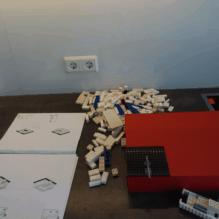
Microscopy is an essential tool in many fields of science and medicine. However, many groups have limited access to this technology due to its cost and fragility. Now, researchers from the Universities of Göttingen and Münster have succeeded in building a high-resolution microscope using nothing more than children’s plastic building bricks and affordable parts from a mobile phone. They then went on to show that children aged 9-13 had significantly increased understanding of microscopy after constructing and working with the LEGO® microscope. Their results were published in The Biophysicist.

The researchers designed a fully functional, high-resolution microscope with capabilities close to a modern research microscope. Apart from the optics, all parts were from the toy brick system. The team realized that the lenses in modern smartphone cameras, which cost around €4 each, are of such high quality that they can make it possible to resolve even individual cells. The scientists produced instructions for building the microscope as well as a step-by-step tutorial to guide people through the construction process whilst learning about the relevant optical characteristics of a microscope. The researchers measured children’s understanding through questionnaires given to a group of 9-13 year olds. The researchers found that children given the parts and plans to construct the microscope themselves significantly increased their knowledge of microscopy. For this particular study, the researchers, whose day-to-day research focusses on fundamental biophysical processes, benefitted from the input and enthusiasm of their 10-year-old co-author.

“An understanding of science is crucial for decision-making and brings many benefits in everyday life, such as problem-solving and creativity,” says Professor Timo Betz, University of Göttingen. “Yet we find that many people, even politicians, feel excluded or do not have the opportunities to engage in scientific or critical thinking. We wanted to find a way to nurture natural curiosity, help people grasp fundamental principles and see the potential of science.” The researchers stayed in contact with the children and monitored their progress: after they had constructed the main parts, they discovered that the lenses can act as magnifying glasses. After exploring this, and realizing that a good light source was important, they initially found it tricky to align two magnifying glasses. However, once they had achieved this, the lenses generated tremendous magnification. This enabled the children to literally “play” with the microscope: make their own adaptations; explore how the magnification works; and discover the exciting world of the micro-cosmos for themselves.

“We hope that this modular microscope will be used in classrooms and homes all over the world to excite and inspire children about science,” continues Betz. “We have shown that scientific research does not need to be separate from everyday life. It can be enlightening, educational and fun!”

###

All plans and instructions are available in English, German, Dutch and Spanish. They are free to access here: https://github.com/tobetz/LegoMicroscope

Original publication: Timo Betz et al, “Designing a high-resolution, LEGO-based microscope for an educational setting”, The Biophysicist 2021, Doi: 10.35459/tbp.2021.000191, text also available here

Contact:

Professor Timo Betz

University of Göttingen

Faculty of Physics

Friedrich-Hund-Platz 1, 37077 Göttingen, Germany

Tel: +49 551 39 26921

Email: timo.betz@phys.uni-goettingen.de

http://www.betzlab.uni-goettingen.de/

Media Contact
Melissa Sollich
melissa.sollich@uni-goettingen.de

Original Source

https://www.uni-goettingen.de/en/3240.html?id=6301

Related Journal Article

http://dx.doi.org/10.35459/tbp.2021.000191

Tags: BiochemistryCell BiologyChemistry/Physics/Materials SciencesEducationK-12Medical EducationMicrobiologyNonprofessionalOpticsScience/Math
Share13Tweet8Share2ShareShareShare2

Related Posts

Statistical Models Reveal Distinct Aerosol Pollution Patterns in Beijing and Finland

Statistical Models Reveal Distinct Aerosol Pollution Patterns in Beijing and Finland

November 17, 2026
Panax notoginseng Glucan Stabilizes Selenium Nanoparticles That Inhibit Lung Cancer Cells

Panax notoginseng Glucan Stabilizes Selenium Nanoparticles That Inhibit Lung Cancer Cells

November 17, 2026

Planets and Stars Set New Limits on Dark Matter Electromagnetic Properties

November 17, 2026

Manganese Poses Highest Contamination Risk in Northern Hainan Coastal Groundwater

November 17, 2026
Please login to join discussion

POPULAR NEWS

  • Mobile Health Units With Community Workers Address Critical Hypertension Care Gaps

    Mobile Health Units With Community Workers Address Critical Hypertension Care Gaps

    29 shares
    Share 12 Tweet 7
  • Brazilian EQ-5D Mapping Algorithm Offers Alternative to European-Based Standards

    29 shares
    Share 12 Tweet 7
  • Self-Assembled Berberine-Gallic Acid Nanorods Ameliorate Ulcerative Colitis in Mice

    29 shares
    Share 12 Tweet 7
  • Tablet Augmented Reality System May Reduce Preoperative Anxiety in Pediatric Surgical Patients

    29 shares
    Share 12 Tweet 7

About

We bring you the latest biotechnology news from best research centers and universities around the world. Check our website.

Follow us

Recent News

Statistical Models Reveal Distinct Aerosol Pollution Patterns in Beijing and Finland

Study Links Initial Social Orienting to Fine-Grained Attention in Autism

New Proximal Method Generates Unique Fractal Attractors in Neutrosophic Metric Spaces

Subscribe to Blog via Email

Enter your email address to subscribe to this blog and receive notifications of new posts by email.

Join 88 other subscribers
  • Contact Us

Bioengineer.org © Copyright 2023 All Rights Reserved.

Welcome Back!

Login to your account below

Forgotten Password?

Retrieve your password

Please enter your username or email address to reset your password.

Log In
No Result
View All Result
  • Homepages
    • Home Page 1
    • Home Page 2
  • News
  • National
  • Business
  • Health
  • Lifestyle
  • Science

Bioengineer.org © Copyright 2023 All Rights Reserved.