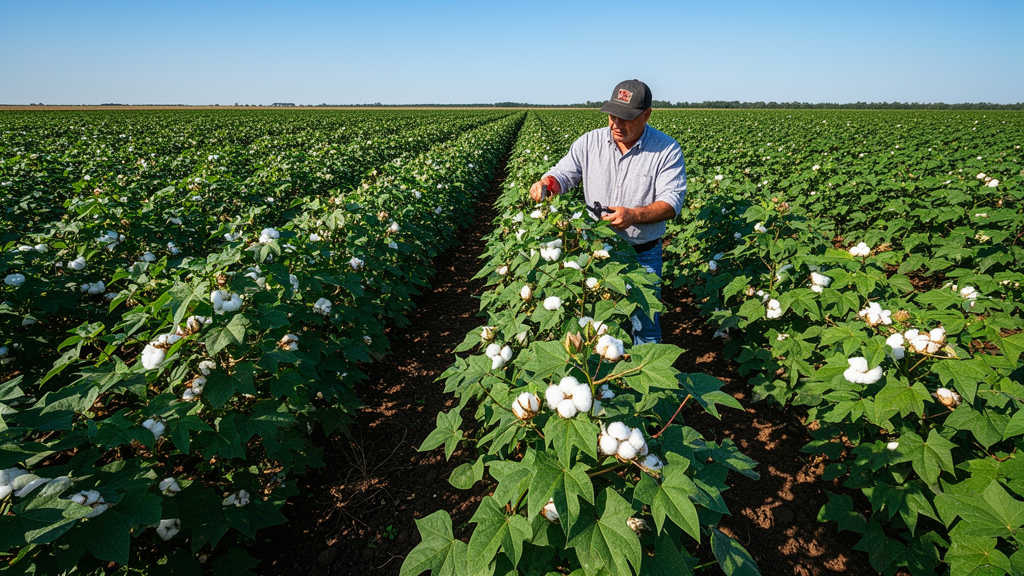
In cotton cultivation involving Gossypium barbadense L., balancing vegetative and reproductive growth is crucial for enhancing overall yield because the plant naturally displays an indeterminate growth pattern. Researchers Houda A. Rabeh and Elsherbiny A. Elsherbiny investigated whether determining an appropriate nitrogen fertilizer rate combined with topping practice could successfully establish this necessary physiological balance.
Field experiments were conducted from 2024 to 2025 using a split-split-plot design arranged within a randomized complete block design. The experimental setup evaluated three nitrogen fertilization levels in main plots at 110, 140, and 180 kilograms per hectare. Subplots evaluated three distinct cultivars designated as G92, G94, and G95, while sub-sub-plots tested the topping practice against untopped control plants.
Evaluation of nitrogen rates revealed distinct responses across yield components and fiber quality. The application of 180 kilograms of nitrogen per hectare achieved maximum vegetative branching and boll development. Under this highest rate, plants attained 16.24 sympodial branches, 30.94 total bolls per plant, 24.92 open bolls per plant, an average boll weight of 2.27 grams, and a seed cotton yield of 50.05 grams per plant and 4.18 tonnes per hectare.
In contrast, fiber properties peaked under lower nitrogen inputs. The highest lint percentage of 39.20 percent, fiber length of 33.22 millimeters, uniformity index of 85.05 percent, and Pressley index of 11.24 were recorded at 110 kilograms of nitrogen per hectare. These fiber quality values observed at 110 kilograms per hectare were on par with results recorded at 140 kilograms of nitrogen per hectare.
Notable differences also emerged among the three cotton cultivars tested. Cultivar G95 exhibited the highest lint percentage at 41.11 percent and the highest seed cotton yield at 4.90 tonnes per hectare. Cultivar G92 produced the longest fiber at 34.23 millimeters and a micronaire reading of 3.44, whereas cultivar G94 recorded the highest seed index at 10.05 grams.
The topping practice demonstrated clear quantitative gains over untopped plants across multiple harvest and quality metrics. Topped cotton plants exhibited 27.91 percent higher open bolls per plant, 3.18 percent higher boll weight, 19.29 percent higher seed cotton yield per hectare, and a 3.26 percent higher Pressley index compared to untopped plants.
Treatment interactions showed contrasting optimal combinations for yield volume versus fiber physical dimensions. The interaction between 180 kilograms of nitrogen per hectare and topped plants achieved the highest total and open bolls per plant, boll weight, and seed cotton yield. Conversely, 110 kilograms of nitrogen per hectare with untopped plants gave maximum fiber length and uniformity index. Statistical analysis revealed that seed cotton yield was significantly correlated with total bolls, open bolls, and boll weight, recording correlation coefficients of r = 0.80, r = 0.77, and r = 0.83, respectively.
Nitrogen application at 180 kilograms per hectare with topping significantly promoted boll formation and boll weight to improve seed cotton yield productivity, whereas 110 to 140 kilograms per hectare with untopped plants enhanced fiber length and uniformity index. The authors conclude that manual topping combined with an appropriate nitrogen application rate is recommended for enhancing and balancing seed cotton yield and fiber quality.
Subject of Research: Cotton yield and fiber quality responses to nitrogen levels and plant topping
Article Title: Cotton (Gossypium barbadense L.) yield and fiber quality under nitrogen levels with topping practice
Article References: Rabeh, H. A., & Elsherbiny, E. A. (2026). Cotton (Gossypium barbadense L.) yield and fiber quality under nitrogen levels with topping practice. BMC Plant Biology, 26(1), Article 1977. https://doi.org/10.1186/s12870-026-10137-0
Image Credits: AI Generated
DOI: 10.1186/s12870-026-10137-0
Keywords: Gossypium barbadense, cotton yield, fiber quality, nitrogen application, plant topping, boll weight, open bolls, lint percentage, fiber length, uniformity index, Pressley index, sympodial branches, cultivar G92, cultivar G94, cultivar G95, micronaire, seed cotton yield
News Source: Drew Townsend. (November 17, 2026). High Nitrogen and Plant Topping Increase Cotton Yield in Field Study. Scienmag.