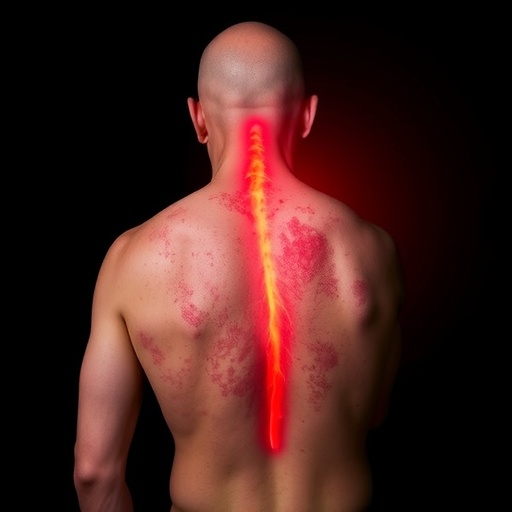
In a groundbreaking advancement for dermatological therapeutics, researchers have unveiled pivotal findings from a randomized phase 2 clinical trial investigating the efficacy of risankizumab, a selective interleukin-23 (IL-23) inhibitor, in the treatment of patients suffering from moderate-to-severe plaque psoriasis. This chronic autoimmune condition, characterized by hyperproliferation of keratinocytes and persistent skin inflammation, has long posed significant treatment challenges, particularly in cases where conventional therapies fall short or introduce intolerable side effects. The trial results, published in Nature Communications by Blauvelt, Jiang, Shi, et al., illuminate a promising new avenue to modulate psoriasis pathogenesis with enhanced dosing strategies.
The IL-23 pathway has garnered considerable attention in recent years due to its critical role in orchestrating the inflammatory cascade that underlies the immunopathology of psoriasis. Risankizumab targets the p19 subunit of IL-23 with high specificity, effectively dampening the activation and maintenance of pathogenic T-helper 17 (Th17) cells, which secrete pro-inflammatory cytokines such as IL-17A and IL-22. The elevated dosing regimen examined in this trial was designed to optimize therapeutic outcomes by intensifying the initial immune suppression, potentially leading to faster and more robust clinical responses while maintaining a favorable safety profile.
This carefully designed randomized study enrolled a representative cohort of adult participants exhibiting moderate-to-severe plaque psoriasis, defined by the Psoriasis Area and Severity Index (PASI) and the Investigator’s Global Assessment (IGA) metrics. The trial implemented a high-induction dosing strategy at baseline followed by maintenance doses, a departure from the conventional fixed-dose schedules previously established in phase 1 and lower-dose trials. By doubling or adjusting the loading doses during induction, investigators sought to accelerate the clinical amelioration of lesions, aiming to achieve earlier skin clearance and improved patient quality of life.
Throughout the trial, rigorous clinical assessments were conducted at predefined intervals, incorporating both objective dermatological evaluations and patient-reported outcome measures. The study’s methodology emphasized the reduction of PASI scores by 75%, 90%, and even complete clearance (PASI 100), benchmarking the efficacy against placebo controls and current standard-of-care biologics. Importantly, the trial also incorporated molecular analyses, including skin biopsies and biomarker profiling, to elucidate risankizumab’s mechanistic impact on cytokine expression and immune cell populations within psoriatic plaques.
The results were compelling. Patients receiving the intensified induction dose regimen exhibited a statistically significant increase in PASI 90 and PASI 100 responses at earlier time points compared to those on conventional dosing or placebo. These rapid improvements correlated with notable reductions in the expression of IL-17A, IL-22, and related pro-inflammatory mediators in lesional skin, reinforcing the mechanistic rationale of the high-induction protocol. By facilitating earlier disease control, this approach demonstrated potential to mitigate the psychosocial burden and physical morbidity associated with prolonged active psoriasis.
Moreover, the trial underscored the safety and tolerability of risankizumab even at escalated doses. Adverse events were predominantly mild or moderate, primarily consisting of transient injection site reactions and manageable upper respiratory infections. Crucially, no increase in serious infections, malignancies, or immune-related adverse effects was observed, which has been a concern in therapies targeting immune pathways. These data support the expanded dosing regimen as a viable clinical strategy warranting further exploration in larger phase 3 trials and real-world settings.
Pharmacokinetic analyses confirmed favorable drug exposure profiles with enhanced peak and trough concentrations, affirming the biological plausibility that higher induction doses can sustain IL-23 inhibition sufficiently to disrupt the self-perpetuating inflammatory cycles in psoriatic skin. This pharmacodynamic effect translated into sustained durable remissions in a significant subset of patients through the study’s follow-up period, marking a crucial step forward in the quest for long-lasting psoriasis therapies.
Experts in immunodermatology have hailed these findings as a milestone. The ability to manipulate cytokine signaling pathways with precision biologics such as risankizumab represents the contemporary frontier in psoriasis management, shifting the paradigm from symptomatic control towards potential modification of underlying disease mechanisms. With this robust evidence supporting a high-induction dosing regimen, clinicians may soon have new tools to tailor treatments more effectively to patient needs and disease severity.
Beyond psoriasis, the insights gained from this trial hold profound implications for other IL-23-driven inflammatory and autoimmune diseases. Conditions such as psoriatic arthritis, inflammatory bowel disease, and ankylosing spondylitis, which share common immunopathogenic pathways, could benefit from similar dosing innovations, paving the way for broader applications of risankizumab and related agents.
As the trial’s results disseminate through scientific and clinical communities, the emphasis will inevitably shift toward optimizing individualized treatment algorithms. Factors influencing response variability, such as genetic predispositions, comorbidities, and prior therapy exposure, will become pivotal in determining which patients stand to benefit most from intensified induction approaches. The integration of biomarker-driven precision medicine in routine clinical practice highlights the evolving sophistication in treating complex immune-mediated disorders.
This study also exemplifies the power of collaborative, multidisciplinary research integrating clinical trials, molecular biology, and biostatistics. The comprehensive approach utilized by Blauvelt, Jiang, Shi, and colleagues serves as a template for future endeavors aiming to translate benchside discoveries into bedside breakthroughs, enhancing therapeutic efficacy while prioritizing patient safety.
While the phase 2 results are promising, the scientific community eagerly anticipates confirmatory data from phase 3 trials designed to evaluate long-term effectiveness, safety, and comparative benefits against existing biologics on the market. Regulatory bodies will also scrutinize dosage escalation strategies to ensure patient welfare and treatment accessibility are preserved alongside clinical innovation.
Simultaneously, ongoing investigations into other biologics targeting different nodes of the IL-23/IL-17 axis promise a proliferation of options, making psoriasis management increasingly nuanced and personalized. The incorporation of real-world evidence, pharmacoeconomic analyses, and patient-centric outcomes will be fundamental to shaping future standards of care.
In conclusion, this landmark phase 2 clinical trial offers robust evidence supporting the utility of high-induction dosing of risankizumab in significantly improving outcomes for patients grappling with moderate-to-severe plaque psoriasis. By harnessing precise immunomodulation and refining dose strategies, this approach sets the stage for enhanced disease control, improved quality of life, and potentially disease remission. As research progresses, it heralds a new era where sophisticated biologic therapies redefine the clinical landscape for psoriasis and allied inflammatory disorders.
Subject of Research: Treatment of moderate-to-severe plaque psoriasis using high-induction dosing of risankizumab in a randomized phase 2 clinical trial.
Article Title: A randomized phase 2 clinical trial to treat moderate-to-severe plaque psoriasis patients with high-induction dosing of risankizumab.
Article References:
Blauvelt, A., Jiang, R., Shi, L. et al. A randomized phase 2 clinical trial to treat moderate-to-severe plaque psoriasis patients with high-induction dosing of risankizumab. Nat Commun (2025). https://doi.org/10.1038/s41467-025-67475-0
Image Credits: AI Generated
Tags: chronic autoimmune skin conditiondermatological therapeutics advancementsenhanced dosing strategies for psoriasisfavorable safety profile of risankizumabHigh-dose risankizumabIL-23 inhibitor efficacyimmune suppression in psoriasis treatmentpro-inflammatory cytokines in psoriasispsoriasis pathogenesis modulationrandomized phase 2 clinical trialsevere psoriasis treatmentT-helper 17 cell activation