


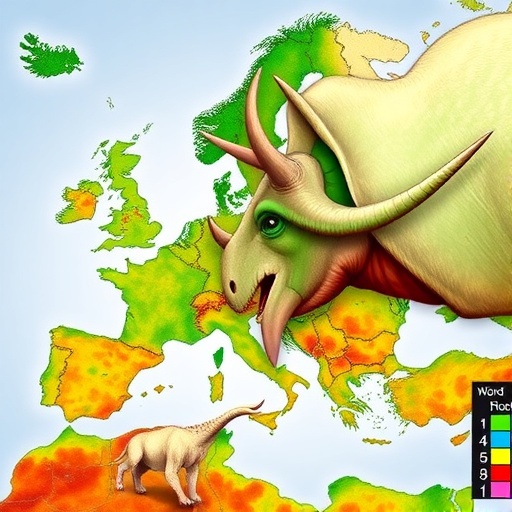
In a breakthrough discovery that redefines our understanding of Late Cretaceous dinosaur ecosystems, new fossil evidence from Europe reveals a surprisingly diverse assemblage of horned dinosaurs, or ceratopsians, previously hidden within island ecosystems long thought to be dominated by other groups. This groundbreaking study overturns the long-held belief that ceratopsians were absent from European Late Cretaceous faunas, revealing instead a complex scenario of dinosaur diversity influenced by island biogeography and evolutionary convergence.
Late Cretaceous Europe, approximately 70 to 66 million years ago, was not a continuous landmass but rather an extensive archipelago of islands scattered across the ancient Tethys Sea. Paleontological research has shown that this unique geography shaped its dinosaur faunas in remarkable ways. Known island effects include low species diversity, the persistence of archaic lineages (relictualism), and insular dwarfism, a phenomenon where species evolve smaller body sizes due to limited resources. These patterns have been particularly evident among the groups traditionally identified within the region’s fossil assemblages.
One of the most prominent dinosaur groups endemic to this region has been the rhabdodontids, a lineage classified within early-branching iguanodontian ornithopods. Rhabdodontids are recognizable for their distinctive dental morphology and postcranial skeletal adaptations yet have been known mainly from fragmentary fossils. For decades, the absence of definitive ceratopsian fossils led researchers to conclude that Europe lacked these horned dinosaurs entirely, despite their widespread presence in contemporaneous ecosystems across Asia and North America.
This conventional framework has now been dramatically challenged by the discovery and subsequent description of new fossil material attributed to the genus Ajkaceratops from Hungary. Initially described as the earliest definite European ceratopsian, this identification faced substantial skepticism due to the fragmentary nature of the remains and ambiguous morphological features. However, the most recent analyses incorporate cutting-edge phylogenetic techniques that leverage comprehensive morphological datasets and statistical robustness to revisit Ajkaceratops’s position within dinosaur evolutionary trees.
The phylogenetic assessments conducted by the research team demonstrate that Ajkaceratops unquestionably belongs to the ceratopsian lineage, enriching our view of horned dinosaur evolution in Europe. More strikingly, some taxa previously assigned to rhabdodontids are now unequivocally reclassified as ceratopsians, suggesting a concealed diversity that had eluded detection under traditional taxonomic frameworks. This reassignment implies that ceratopsians were more widespread and ecologically significant in Late Cretaceous European archipelagos than ever appreciated.
The implications of this discovery extend well beyond taxonomy. The confirmation of ceratopsian presence alongside a diverse community of iguanodontians within Europe points to ecological parallels with contemporaneous Laurasian ecosystems in Asia and North America. Such a scenario favors a more intricate understanding of herbivorous dinosaur community structure, highlighting convergent evolutionary trajectories and faunal exchanges facilitated by fluctuating sea levels and intermittent land connections.
Furthermore, the recognition of previously undetected ceratopsian diversity underscores the complexities of island biogeography during the Late Cretaceous. These insular ecosystems exerted selective pressures that likely drove endemic radiations and morphological specializations, contributing to an underestimated richness buried within sparse fossil records. The phenomenon of insular dwarfism famously associated with European ornithischians now demands fresh interpretation in light of these new ceratopsian discoveries.
The study also prompts a fundamental reevaluation of the evolutionary history of Ornithischia, the clade encompassing both ceratopsians and iguanodontians. The revelation that European dinosaur faunas harbored a hidden diversity of horned dinosaurs suggests that diversification events and dispersal patterns were far more complex. This could signal cryptic faunal interchange between Western Eurasia, Asia, and North America during the terminal Cretaceous, with significant implications for biogeographic models and paleobiology.
Additionally, the findings challenge the notion that isolated insular faunas necessarily lack the broad-scale diversity seen on larger continental landmasses. Instead, these results posit that islands can act as reservoirs of endemic clades whose evolutionary trajectories differ from those elsewhere, enriching our appreciation of how geography and ecology interact to shape biodiversity through deep time.
Technological advances in fossil preparation, three-dimensional imaging, and analytical methods have been pivotal in enabling this discovery. By integrating new fossil data with extensive comparative datasets and applying rigorous phylogenetic frameworks, paleontologists can now detect subtle morphologies indicative of ceratopsian affinities that eluded prior studies relying solely on traditional taxonomic criteria.
The research team’s comprehensive approach lays a foundation for future explorations targeted at uncovering further ceratopsian material across Europe. Their work calls for renewed field surveys, stratigraphic analyses, and interdisciplinary cooperation to reconstruct these lost ecosystems in greater detail, fostering a richer understanding of dinosaur evolution just prior to the K–Pg extinction event.
In conclusion, this study represents a paradigm shift in paleontology, revealing previously unseen diversity within an iconic dinosaur group in an unexpected region. The late Cretaceous European archipelago, once considered a stronghold of rhabdodontid iguanodontians, emerges as a veritable hotspot of ceratopsian evolution, challenging long-standing beliefs and opening new avenues of research into dinosaur biodiversity, paleoecology, and island biogeography at the end of the Mesozoic.
Subject of Research: Evolutionary diversity and phylogenetic classification of Late Cretaceous European ceratopsian dinosaurs.
Article Title: A hidden diversity of ceratopsian dinosaurs in Late Cretaceous Europe.
Article References:
Maidment, S.C.R., Butler, R.J., Brusatte, S.L. et al. A hidden diversity of ceratopsian dinosaurs in Late Cretaceous Europe. Nature (2026). https://doi.org/10.1038/s41586-025-09897-w
Image Credits: AI Generated
DOI: https://doi.org/10.1038/s41586-025-09897-w
Tags: ancient Tethys Sea ecosystemsarchipelago island ecosystemsceratopsian evolutionEuropean dinosaur diversityevolutionary convergence in dinosaurshorned dinosaurs fossil evidenceisland biogeography in dinosaursLate Cretaceous ceratopsianspaleontological discoveries in Europerelictualism in ceratopsiansrhabdodontids and insular dwarfismunique dinosaur assemblages



