• HOME
  • NEWS
  • EXPLORE
    • CAREER
      • Companies
      • Jobs
    • EVENTS
    • iGEM
      • News
      • Team
    • PHOTOS
    • VIDEO
    • WIKI
  • BLOG
  • COMMUNITY
    • FACEBOOK
    • INSTAGRAM
    • TWITTER
Sunday, November 22, 2026
BIOENGINEER.ORG
No Result
View All Result
  • Login
  • HOME
  • NEWS
  • EXPLORE
    • CAREER
      • Companies
      • Jobs
        • Lecturer
        • PhD Studentship
        • Postdoc
        • Research Assistant
    • EVENTS
    • iGEM
      • News
      • Team
    • PHOTOS
    • VIDEO
    • WIKI
  • BLOG
  • COMMUNITY
    • FACEBOOK
    • INSTAGRAM
    • TWITTER
No Result
View All Result
Bioengineer.org
No Result
View All Result
Home NEWS Science News Biology

Hematopoietic stem cells: Making blood thicker than water

Bioengineer by Bioengineer
March 13, 2019
in Biology
Reading Time: 3 mins read
0
IMAGE
Share on FacebookShare on TwitterShare on LinkedinShare on RedditShare on Telegram

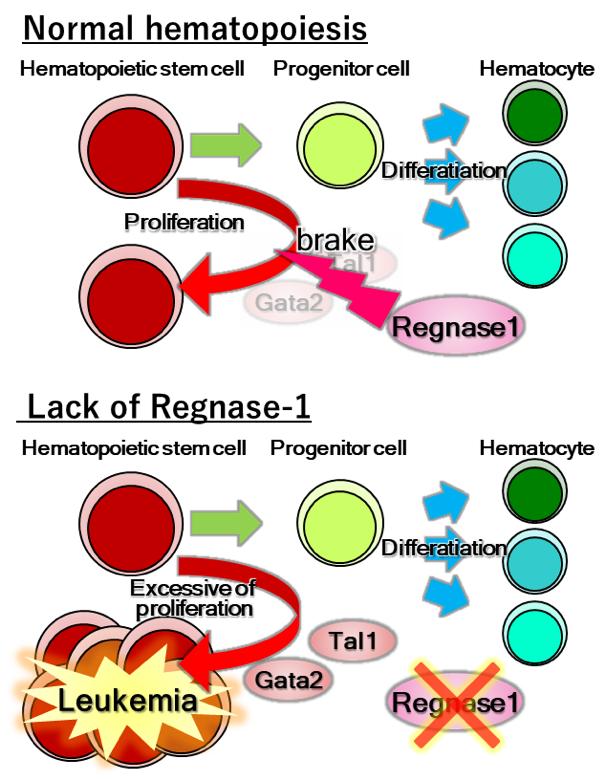
Researchers at Osaka University reveal how a regulatory molecule ensures an appropriate supply of blood cells while avoiding the excessive proliferation associated with conditions like leukemia
IMAGE

Credit: Osaka University

Osaka, Japan – The body needs to create a continuous supply of blood cells to enter circulation. Blood cells have a wide variety of functions ranging from supplying oxygen to tissues, fighting infections, and enabling the blood to clot upon injury. Avoiding deficiency of these cells or their excessive proliferation must involve a strict regulatory mechanism, but much remains to be clarified about how this works.

A team led by Osaka University has shed light on this issue by revealing that a molecule called Ragnase-1 is key to regulating the renewal and differentiation of hematopoietic stem and progenitor cells (HSPCs), from which all blood cells are derived. They show how dysfunction of this molecule can lead to an inability to regulate blood cell production, which can have adverse effects such as the development of blood-based malignancies.

In this new study, reported in Nature Communications, the team first used a computer-based analysis to identify those genes that differed markedly in their expression between adult and embryonic HSPCs. Among these genes, they then selected Ragnase-1 for further analyses, given earlier findings of its role in the differentiation of another stem cell type. These further analyses included experiments with the deletion of one or both copies of the Ragnase-1 gene in mice, followed by evaluations of stem cell differentiation into other blood cell lineages and the overall health of these mice.

“Our findings showed that the deletion of both or even just one of the copies of Ragnase-1 led to abnormalities in the renewal and differentiation of HSPCs from the bone marrow,” corresponding author Nobuyuki Takakura says. “The Ragnase-1 knockout mice also showed physiological abnormalities like weight loss and an enlarged spleen–and they died at a young age.”

The team then looked into the mechanism by which Ragnase-1 facilitates its functions. They found that it exerts regulatory activity at the post-transcriptional level by degrading target mRNAs, Gata2 and Tal1, a process that is important for controlling hematopoiesis.

“Our findings showed that this activity of Ragnase-1 is key to determining whether stem cells remain in a quiescent state, self-renew to maintain a pool of such cells for future differentiation, or start to differentiate into the various blood cell lineages depending on the current needs of the body,” lead author Hiroyasu Kidoya says.

The team’s finding that Ragnase-1 plays a key role in the self-renewal and differentiation of HSPCs provides a new target for therapeutic strategies aimed at treating diseases such as leukemia.

###

The article “Regnase-1-mediated post-transcriptional regulation is essential for hematopoietic stem and progenitor cell homeostasis” is published in Nature Communications at DOI: https://doi.org/10.1038/s41467-019-09028-w.

Media Contact
Saori Obayashi
gi-strategy@cgin.osaka-u.ac.jp

Original Source

https://resou.osaka-u.ac.jp/en/research/2019/20190306_2

Related Journal Article

http://dx.doi.org/10.1038/s41467-019-09028-w

Tags: BioinformaticsBiologycancerCell BiologyHematologyMolecular Biology
Share12Tweet8Share2ShareShareShare2

Related Posts

Review Maps Multistep Host Networks Directing Human Papillomavirus Entry and Trafficking

Review Maps Multistep Host Networks Directing Human Papillomavirus Entry and Trafficking

November 22, 2026
Improved Double-Buffer Extraction Yields High-Purity Genomic DNA from Rare Himalayan Tree

Improved Double-Buffer Extraction Yields High-Purity Genomic DNA from Rare Himalayan Tree

November 22, 2026

Wastewater Predator Outperforms Soil Microbe in Tackling Mixed Waterborne Bacterial Pathogens

November 22, 2026

Emirates Internal Medicine Conference Highlights Advances Across Critical Care and Pharmacotherapy

November 22, 2026
Please login to join discussion

POPULAR NEWS

  • Analysis Links Ganoderma Lucidum Target NR3C2 and Gut Microbiota to Insomnia

    Analysis Links Ganoderma Lucidum Target NR3C2 and Gut Microbiota to Insomnia

    29 shares
    Share 12 Tweet 7
  • THAM Catalyzes Efficient Green Gewald Synthesis of Diverse 2-Aminothiophene Heterocycles

    29 shares
    Share 12 Tweet 7
  • Waste Glass and Sisal Fibers Increase Concrete Strengths in Neural Network Study

    29 shares
    Share 12 Tweet 7
  • Cementless Megaprosthesis Achieves Favorable Long-Term Stability After Bone Tumor Resection

    29 shares
    Share 12 Tweet 7

About

We bring you the latest biotechnology news from best research centers and universities around the world. Check our website.

Follow us

Recent News

Lower Circulating Immunosurveillance Proteins Are Linked to Higher Prostate Cancer Risk

Wrinkled leaf-like electrocatalyst accelerates oxygen evolution reaction with high stability

Machine Learning Estimates Transparent Wood Transmittance More Accurately Than Haze

Subscribe to Blog via Email

Enter your email address to subscribe to this blog and receive notifications of new posts by email.

Join 89 other subscribers
  • Contact Us

Bioengineer.org © Copyright 2023 All Rights Reserved.

Welcome Back!

Login to your account below

Forgotten Password?

Retrieve your password

Please enter your username or email address to reset your password.

Log In
No Result
View All Result
  • Homepages
    • Home Page 1
    • Home Page 2
  • News
  • National
  • Business
  • Health
  • Lifestyle
  • Science

Bioengineer.org © Copyright 2023 All Rights Reserved.