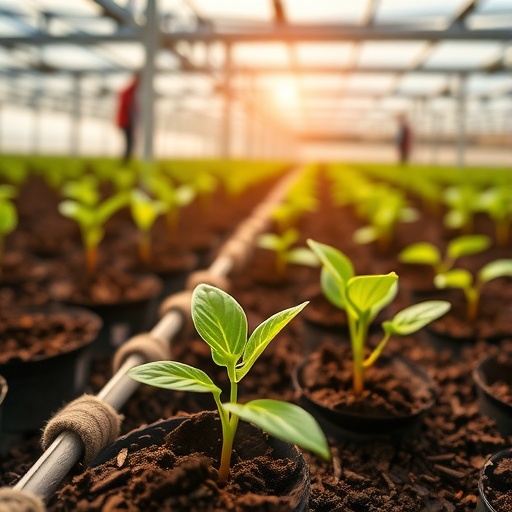
In a groundbreaking advancement in plant science, researchers at the Technical University of Munich (TUM) have unveiled a complex interplay between plants and their microbiomes that could revolutionize agricultural practices. This pioneering study has highlighted how specific bacterial communities not only influence root development but also significantly enhance nitrogen uptake, a critical process for plant growth. By leveraging cutting-edge multi-omics technologies, the team has decoded the genetic, metabolic, and physiological interdependencies that define this symbiotic relationship.
Plants exist in a dynamic ecosystem teeming with microorganisms that engage in constant molecular dialogue with their hosts. This complex network is not a passive environment but rather an interactive system where plants exert control by selectively modulating the microbial composition according to their developmental needs or environmental stressors. Such plasticity in the plant microbiome presents a fertile ground for agricultural innovations, particularly in optimizing nutrient acquisition, which is paramount for crop productivity and environmental sustainability.
At the heart of this discovery is the bacterial genus Sphingopyxis, identified as a highly effective enhancer of root growth and nitrogen assimilation. Nitrogen, an essential macronutrient, largely dictates plant vigor and yield, yet its availability is often a limiting factor in cultivation due to soil depletion and environmental constraints. Traditional reliance on synthetic nitrogen fertilizers has raised ecological concerns, including runoff and greenhouse gas emissions. The prospect of harnessing naturally occurring microbes such as Sphingopyxis offers a promising biological alternative to boost nitrogen uptake efficiently, potentially reducing the dependency on chemical fertilizers.
Using a large-scale multi-omics approach, which integrates genomic, transcriptomic, and metabolomic data from both host plants and associated microorganisms, the research team was able to dissect the molecular bases underpinning the plant-microbiome interaction. The analyses revealed that 203 bacterial genes are markedly influenced by host plant factors, such as root exudates and metabolic byproducts. This specificity underscores an evolutionary adaptation where plants actively sculpt their root-associated microbial communities to fulfill essential functions, including nutrient cycling and stress resistance.
Remarkably, the study quantified that approximately 45% of the natural variation in nitrogen uptake efficiency in rapeseed plants can be attributed to the combined genetic influence of both the plant host and its microbiome. This finding dramatically expands our understanding of plant nutrition, emphasizing the necessity to consider the holobiont— the integrated unit of the plant and its microbial partners—when developing strategies for crop improvement. Thus, plant genetics alone no longer suffice as predictors or enhancers of nutrient acquisition.
Experimental inoculation of rapeseed with Sphingopyxis strains demonstrated significant enhancement in root architecture, even when cultivated in nitrogen-deficient soils. Root morphology is tightly linked to the exploration capacity of soil nutrients, and optimized root systems translate directly to increased nutrient uptake efficiency. The microbial intervention thus operates not only by direct nitrogen exchange but also by modifying plant root traits favorable for nutrient absorption.
These insights hold immense potential for sustainable agriculture by mitigating adverse environmental impacts linked to excessive fertilizer use. By fostering beneficial microbial communities tailored to the crop’s genotype and soil conditions, farmers could harness nature’s inherent capabilities for nutrient management. Such biotechnological interventions align with global objectives to reduce agrochemical inputs while maintaining or enhancing crop yields in an era increasingly challenged by climate change and resource scarcity.
Looking forward, researchers aim to formulate a probiotic consortium that goes beyond a single bacterial genus. This cocktail of microbial allies would synergistically promote diverse plant functions— not only nitrogen acquisition but also phosphorus uptake, disease resistance, and tolerance to abiotic stresses such as drought or salinity. The integration of multi-layered omics data will facilitate the precision design of these probiotics, personalized for different crops and farming environments.
This research embodies a new paradigm in agricultural biotechnology, shifting the focus from conventional fertilization to microbiome engineering. By understanding and manipulating the microbiome’s influence on root development and nutrient assimilation, scientists are paving the way for next-generation biofertilizers that are both effective and environmentally benign. Such innovations could reshape global food security while safeguarding ecosystems.
Professor Peng Yu and colleagues at TUM have charted a promising path towards realizing the full potential of plant-microbiome interactions. Their findings mark a significant step forward, providing a genetic and functional framework for developing microbial solutions that enhance plant growth in sustainable and ecologically responsible ways. The coming years will undoubtedly witness exciting progress in this burgeoning field as new microbial candidates are discovered and translated into practical applications.
The implications of this work extend beyond agriculture into broader ecological and evolutionary contexts. Understanding how plants negotiate interactions with their microbiomes can inform conservation strategies, crop breeding programs, and the management of plant health under climate stress. This integrative perspective highlights the importance of viewing plants not as solitary organisms but as meta-organisms whose performance and resilience derive from intimate microbial partnerships.
Ultimately, the promise of harnessing Sphingopyxis and other beneficial microbes to foster plant nutrition represents an inspiring fusion of molecular biology, ecology, and agronomy. It reinforces the concept that sustainable intensification of agriculture can be achieved not simply through innovation in chemical inputs but by intelligent management of biological resources and ecosystem services intrinsic to the soil microbiome. As this research progresses, it aims to deliver tangible benefits for farmers, consumers, and the planet alike.
Subject of Research: Not applicable
Article Title: ‘Large-scale multi-omics unveils host–microbiome interactions driving root development and nitrogen acquisition’
News Publication Date: 3-Feb-2026
Web References: http://dx.doi.org/10.1038/s41477-025-02210-7
Image Credits: Peng Yu, TU Munich
Keywords: plant microbiome, nitrogen uptake, root development, Sphingopyxis, multi-omics, probiotics for plants, sustainable agriculture, biofertilizers, plant-microbe interactions
Tags: agricultural innovations in microbiomesenhancing crop productivityenvironmental stressors affecting plantsmulti-omics technologies in agriculturenitrogen uptake in plantsoptimizing nutrient acquisition in cropsplant-microbiome interactionsprobiotics for plant healthroot development enhancementSphingopyxis bacterial genussustainable agriculture practicessymbiotic relationships in plant science