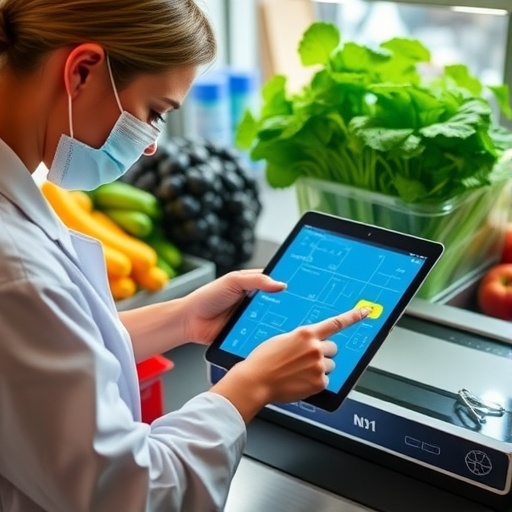
In the rapidly evolving field of nutritional science, the accurate measurement of dietary intake remains a paramount challenge, one with profound implications for both human health and environmental sustainability. Diet not only shapes individual wellness trajectories but also drives significant impacts on planetary systems, yet traditional methods to capture dietary data often fall short in precision and reliability. Self-reporting mechanisms—ranging from food diaries to frequency questionnaires—have dominated the landscape for decades but are intrinsically limited by participant recall errors, social desirability bias, and systemic reporting gaps. These shortcomings hinder the ability of researchers and clinicians to robustly connect dietary patterns to health outcomes and ecological footprints. The necessity for meticulous and objective dietary assessment tools has never been more pressing, particularly as society confronts complex issues such as chronic disease prevention and climate change mitigation through food system transformations.
Emerging technological innovations bring promise to this long-standing conundrum by offering novel means to enhance accuracy, objectivity, and user engagement. Smartphone applications, image-based dietary tracking, and biomarkers of food intake (BFIs) represent the frontiers of this transformation. Smartphone apps streamline data entry and enable real-time tracking, lessening the burdens on users and mitigating some traditional errors. Image-based methods, utilizing automated or semi-automated analysis of meal photographs, further reduce subjectivity. Despite these advances, both strategies retain elements of self-reporting and voluntary participation, leaving room for systematic errors and missing data. This highlights an inherent paradox: while technological augmentation improves data fidelity, it cannot fully eliminate the need for human input or overcome the complexities of food intake variability.
Biomarkers of food intake, derived from omics technologies—such as metabolomics, proteomics, and genomics—are rapidly gaining traction as objective, biologically anchored indicators of dietary exposure. Unlike self-reported data, BFIs quantify metabolites, food-specific DNA fragments, or proteins directly from biological samples such as blood, urine, or stool, providing a window into actual consumption patterns without relying on memory or subjective estimation. These tools offer unprecedented specificity and temporal resolution but also introduce new complexities. Most notably, BFIs typically reflect short-term intake rather than habitual dietary patterns, necessitating intricately timed sampling schemes to capture representative long-term dietary behavior. Additionally, the analytical demands and costs of omics assays present logistical challenges in large-scale or routine settings.
The integration of these diverse technologies—self-reports augmented by app and image data with objective biomarker assessments—promises a paradigm shift in dietary measurement. Multimodal approaches leveraging cross-validation and data triangulation can fill gaps left by individual tools, enhancing overall accuracy and contextual understanding. For example, smartphone-based image capture can trigger timed biomarker sampling, while biomarkers can validate or correct self-reported intake metrics. This interplay of methods opens new avenues for longitudinal monitoring, enabling researchers to track dietary changes and their physiological consequences over time with unparalleled granularity. Such dynamic, multi-sampling strategies align well with the heterogeneity inherent in human diets and the shifting landscapes of food environments.
Beyond individual precision, improving dietary assessment methodologies has critical implications for public health policies and environmental sustainability initiatives. Robust data linking dietary constituents and patterns to health endpoints underpin evidence-based dietary guidelines. When combined with ecological metrics, accurate dietary intakes also inform assessments of food-related environmental burdens, facilitating sustainable food system redesign. The potential to unravel intricate interactions between diet, metabolic health, microbiome dynamics, and planetary impact rests heavily on these advancements in measurement science. Without reliable data foundations, interventions risk being misguided or ineffective.
Notwithstanding these opportunities, the path forward involves addressing substantial methodological and operational challenges. Calibration across diverse populations, validation of novel biomarkers for broader food groups, standardization of app interfaces and image algorithms, and harmonization of sampling protocols are vital milestones. Ethical and privacy concerns around intensive data collection, especially biological sampling, must be carefully navigated to maintain participant trust and compliance. The scalability and cost-efficiency of integrated technologies remain barriers for widespread implementation, particularly in resource-limited contexts.
The multidisciplinary nature of this field, requiring collaboration between nutritionists, technologists, bioinformaticians, and behavioral scientists, underscores the complexity and innovation driving the new dietary assessment era. Cutting-edge machine learning models are enhancing image recognition accuracy, while advances in metabolomic profiling improve biomarker sensitivity and specificity. Cloud-based platforms facilitate data integration and feedback loops, empowering participants with actionable insights. Collectively, these technological strides enable a transition from static snapshots to continuous, nuanced dietary surveillance.
As public health priorities intensify towards personalized nutrition and precision medicine, accurate, real-time dietary data will be crucial for tailored interventions. Understanding individual metabolic responses to specific foods and dietary patterns hinges on capturing detailed intake data coupled with biological markers. Similarly, in the context of climate-smart nutrition policies, pinpointing the environmental costs of dietary choices requires high-resolution consumption data. Integrated assessment platforms offer transformative potential to underpin both clinical and planetary health strategies with robust empirical evidence.
Looking ahead, the vision for dietary assessment is one of convergence—melding traditional wisdom with futuristic tools to create a holistic, efficient, and user-friendly system. The scaling up of multi-sampling frameworks alongside technological enhancements will likely revolutionize how diets are monitored, analyzed, and optimized globally. Such systems will not only accelerate scientific understanding but also empower individuals and policymakers to make informed, sustainable food choices, ultimately improving health outcomes and reducing environmental harms simultaneously.
In conclusion, modern technologies are ushering in a new epoch in the measurement of dietary intake that balances objectivity with practicality and temporal depth. The thoughtful integration of self-report, image analytics, and omics-based biomarkers promises to bridge historical gaps in dietary science, offering a clearer, more comprehensive view of what people eat and how it affects their bodies and the planet. While significant challenges remain—from technical validation to ethical governance—the synergies created by these innovations mark a transformative advance that could redefine nutritional epidemiology and sustainability research in the coming decade. The quest to accurately capture human diets is proving not only possible but essential for addressing the intertwined crises of health and environmental degradation.
Subject of Research: Integration of modern technologies to enhance dietary assessment accuracy for improved human and planetary health outcomes.
Article Title: Integration of modern technologies to advance dietary assessment.
Article References:
Cuparencu, C., Diener, C., Wilson, T. et al. Integration of modern technologies to advance dietary assessment. Nat Food 7, 17–26 (2026). https://doi.org/10.1038/s43016-025-01290-0
Image Credits: AI Generated
DOI: January 2026
Tags: biomarkers of food intakechallenges in dietary data collectionchronic disease prevention through dietdietary assessment technologyenvironmental impact of dietary habitsimage-based dietary tracking methodsimproving accuracy in dietary assessmentsinnovations in nutritional sciencemodern tools for dietary evaluationprecision nutrition and technologyself-reporting limitations in nutritionsmartphone applications for nutrition tracking