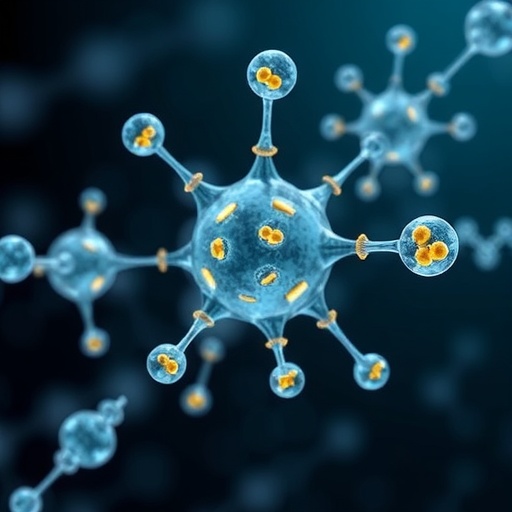
In a groundbreaking advancement for sustainable chemistry, researchers at ETH Zurich have unveiled a novel catalyst that dramatically enhances the efficiency of methanol synthesis from carbon dioxide and hydrogen. This innovation hinges on the strategic use of isolated single indium atoms anchored on a hafnium oxide (hafnia) support, which collectively redefine the landscape of catalytic conversion by significantly lowering the energy barrier of this critical industrial chemical reaction. Such a development not only promises to reduce energy consumption and costs but also advances the goal of developing climate-neutral chemical manufacturing processes.
Every chemical transformation is governed by kinetic barriers, energy thresholds that must be overcome for reactants to convert into products. These barriers often necessitate high energy input, limiting the sustainability and economic viability of industrial reactions. Traditionally, catalysts—substances that accelerate chemical reactions without themselves being consumed—have mitigated these challenges by providing alternate reaction pathways. Metallic catalysts, especially those comprised of rare or precious metals, have been the mainstay in fostering such reactions due to their unique surface properties and electronic structures.
The ETH Zurich team’s breakthrough hinges on engineering a catalyst at the atomic scale. Unlike conventional catalysts that rely on metal nanoparticles composed of thousands of atoms, this new approach harnesses the catalytic potential of individual indium atoms. Each atom behaves as an isolated active site, maximizing the utility of the metal and providing far-reaching implications for resource efficiency, especially with scarce or expensive metals. The method constitutes a paradigm shift from the often empirical “hit or miss” strategies used in catalyst development, enabling a more rational and predictive design process.
Methanol serves as a cornerstone chemical in global industry, underpinning the production of fuels, plastics, solvents, and a broad portfolio of materials. Professor Javier Pérez-Ramírez, a leading figure in catalysis research and head of the ETH Zurich group, refers to methanol as the “Swiss army knife of chemistry.” Its versatility makes it a pivotal molecule for transitioning from fossil-based feedstocks toward more sustainable, renewable routes of chemical synthesis. The ability to synthesize methanol from CO₂ directly addresses the urgent need to recycle a major greenhouse gas, converting a climate liability into a valuable product.
A defining feature of this new catalytic system is the single-atom architecture, wherein indium atoms are dispersed sparsely and anchored on the surface of a uniquely structured hafnium oxide substrate. This support material was meticulously engineered to not only stabilize the isolated atoms under demanding reaction conditions but also to facilitate their interaction with reactant molecules. The singular atom configuration ensures that every indium atom is catalytically active—a stark contrast to traditional catalysts where the majority of metal atoms within nanoparticles remain chemically inert.
To achieve this finely dispersed state, the research team developed novel synthetic pathways. One particularly effective method involved combusting precursor materials in flames at extreme temperatures ranging from 2,000 to 3,000 degrees Celsius, followed by rapid quenching. Such conditions prevent the aggregation of indium atoms into larger clusters, instead “locking” individual atoms onto the hafnium oxide surface. This high-temperature synthesis also imparts remarkable thermal stability to the catalyst, allowing it to endure the rigorous conditions characteristic of methanol synthesis—temperatures upwards of 300°C and pressures reaching 50 atmospheres.
The ability of this catalyst to remain stable and active under such extreme conditions addresses a long-standing challenge in heterogeneous catalysis. Conventional single-atom catalysts often suffer from sintering, where atoms migrate and coalesce into inactive clusters, diminishing catalytic performance over time. By leveraging the robustness of hafnium oxide as a support, the ETH team’s catalyst combines single-atom precision with exceptional durability, opening avenues for industrial adaptation.
Analyzing the reaction mechanisms underpinning methanol synthesis on this catalyst has also been revolutionized. Unlike nanoparticle catalysts, where signals from inactive internal atoms obfuscate mechanistic insights, the isolated atom format permits more accurate and less noisy characterization techniques. This clarity has enabled researchers to dissect the role of metal-support interactions and understand how the electronic environment of single indium atoms facilitates CO₂ activation and hydrogenation, shedding light on the fundamental steps that govern catalytic performance.
Indium’s catalytic potential has been recognized before, albeit in nanoparticulate form, used over the past decade in various methanol synthesis contexts. The ETH Zurich study conclusively demonstrates the superiority of single-atom indium species supported on hafnia, achieving higher methanol yields and selectivity compared to their nanoparticle counterparts. This evidence supports the notion that catalysts can unlock novel reaction pathways or reduce activation energies when metals assume isolated atomic states.
The interdisciplinary effort behind this research underlines the importance of collaboration spanning chemistry, materials science, and chemical engineering. By combining synthetic innovations, rigorous characterization, and detailed mechanistic studies, the ETH research collective has not only engineered a high-performance CO₂ conversion catalyst but also established a foundational strategy applicable to a wide range of catalytic transformations.
Beyond environmental benefits, the increased efficiency and metal atom utilization present a pathway toward the economic viability of catalytic processes reliant on precious or rare metals. This atomically precise paradigm may lead to downsizing the quantity of expensive catalysts required, thereby fostering sustainable industrial practices. Moreover, the catalyst’s robust performance under industrially relevant conditions indicates readiness for scale-up and integration into existing chemical production infrastructure.
This achievement represents a crucial milestone in the quest for carbon-neutral chemical manufacturing. By transforming CO₂ from a problematic emission into a core feedstock for key industrial chemicals, the ETH Zurich team’s catalyst embodies the potential of nanotechnology and atomic-level engineering to solve pressing environmental challenges. The convergence of fundamental science and technological innovation charts a promising course for future methanol production and broader applications in green chemistry.
In summary, the development of single-atom indium catalysts supported on hafnium oxide not only offers a groundbreaking solution to enhance methanol synthesis from greenhouse gases but also establishes a versatile platform for rational catalyst design. With sustainability at its heart and scalability in sight, this research paves the way toward a more efficient, environmentally friendly, and economically feasible chemical industry.
Subject of Research: Catalysis, Single-atom catalysis, Green chemistry, Carbon dioxide conversion, Methanol synthesis.
Article Title: Single atoms of indium on hafnia enable superior CO2-based methanol synthesis.
News Publication Date: 2 March 2026.
Web References: DOI:10.1038/s41565-026-02135-y
Image Credits: Graphic by Constance Ko / ETH Zurich.
Keywords
Single-atom catalyst, Indium, Hafnium oxide, Methanol synthesis, CO2 conversion, Green chemistry, Sustainable catalysis, Nanotechnology, Catalyst design, Carbon neutrality, Industrial chemistry, Renewable fuels.
Tags: atomic-scale catalyst designcatalytic conversion of carbon dioxideclimate-neutral industrial chemistryefficient CO2 hydrogenation methodsenergy-efficient catalytic processesETH Zurich catalyst innovationfossil-free chemical manufacturing technologyindium atoms on hafnium oxide supportlow energy barrier chemical reactionsnovel catalysts for green chemistrysingle atom catalysis for CO2 conversionsustainable methanol synthesis catalyst