To achieve carbon neutrality, advancements in energy conversion and storage technologies are essential. Current aqueous energy devices suffer from performance limitations due to the trade-off between permeability and selectivity in permselective membranes. This trade-off hampers the efficiency of energy conversion and storage systems, necessitating the development of membranes that can balance these properties effectively. Due to these challenges, further research is required to explore innovative membrane structures that can enhance the performance of energy conversion and storage devices.
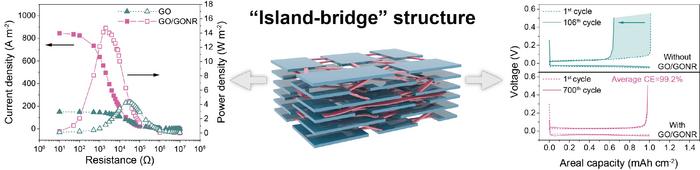
Credit: Energy Materials and Devices, Tsinghua University Press
To achieve carbon neutrality, advancements in energy conversion and storage technologies are essential. Current aqueous energy devices suffer from performance limitations due to the trade-off between permeability and selectivity in permselective membranes. This trade-off hampers the efficiency of energy conversion and storage systems, necessitating the development of membranes that can balance these properties effectively. Due to these challenges, further research is required to explore innovative membrane structures that can enhance the performance of energy conversion and storage devices.
A research team from Tsinghua University has published a study (DOI: 10.26599/EMD.2024.9370041) in Energy Materials and Devices on June 24. They developed a novel “island-bridge” structured nanofluidic membrane to address the critical challenge of balancing permeability and selectivity in energy conversion and storage systems. This innovative membrane design promises to significantly enhance the efficiency of aqueous energy devices, paving the way for more effective and reliable renewable energy solutions.
The study introduces a pioneering “island-bridge” design that self-assembles two-dimensional nanoribbons and nanosheets into nanofluidic membranes. Nanosheets act as isolated islands with high surface charge density, providing superior ionic selectivity. Meanwhile, the bridge-like nanoribbons enhance permeability and water stability due to their low surface charge density and high aspect ratio. Molecular simulations and experiments demonstrated that these membranes significantly boost the performance of osmotic power generators and zinc metal batteries. Notably, the membranes achieved a power density of 18.1 W/m² in osmotic power generation, surpassing the commercial benchmark of 5 W/m². Additionally, the membranes exhibited high Coulombic efficiency and extended lifespan in zinc metal batteries, showcasing their potential in improving energy storage solutions. This design effectively balances permeability and selectivity, addressing a major bottleneck in current energy conversion and storage technologies, and shows promise for scalable applications in enhancing the efficiency and stability of these systems.
Dr. Yu Lei, a leading researcher in the study, emphasized the significance of their findings, “Our innovative island-bridge nanofluidic membranes mark a significant advancement in energy technology. By effectively balancing permeability and selectivity, these membranes not only enhance the efficiency of energy conversion and storage devices but also offer a stable and scalable solution. This breakthrough opens new possibilities for integrating renewable energy sources into the power grid, which is crucial for achieving global carbon neutrality goals.”
The successful implementation of these high-performance membranes could revolutionize the field of renewable energy by providing more efficient and reliable energy conversion and storage solutions. These advancements pave the way for enhanced integration of renewable energy sources into the power grid, contributing significantly to global carbon neutrality goals.
This work is granted by National Key Research and Development Program of China (Grant No. 2022YFB2404500), Shenzhen Outstanding Talents Training Fund, the Fundamental Research Project of Shenzhen (Grant No. JCYJ20230807111702005), Guangdong Provincial Natural Science Foundation of China (Grant No. 2022A1515110936), Shenzhen Science and Technology Program (Grant No. ZDSYS20230626091100001), National Natural Science Foundation of China (Grant No. 22309102), and China Postdoctoral Science Foundation (Grant No. 2022M711788).
About Energy Materials and Devices
Energy Materials and Devices is launched by Tsinghua University, published quarterly by Tsinghua University Press, exclusively available via SciOpen, aiming at being an international, single-blind peer-reviewed, open-access and interdisciplinary journal in the cutting-edge field of energy materials and devices. It focuses on the innovation research of the whole chain of basic research, technological innovation, achievement transformation and industrialization in the field of energy materials and devices, and publishes original, leading and forward-looking research results, including but not limited to the materials design, synthesis, integration, assembly and characterization of devices for energy storage and conversion etc.
About SciOpen
SciOpen is an open access resource of scientific and technical content published by Tsinghua University Press and its publishing partners. SciOpen provides end-to-end services across manuscript submission, peer review, content hosting, analytics, identity management, and expert advice to ensure each journal’s development. By digitalizing the publishing process, SciOpen widens the reach, deepens the impact, and accelerates the exchange of ideas.
Journal
Energy Materials and Devices
DOI
10.26599/EMD.2024.9370041
Article Title
“Island-bridge”-structured nanofluidic membranes for high-performance aqueous energy conversion and storage
Article Publication Date
24-Jun-2024